
Liberty All-Star Growth's $0.12 Dividend and Its Implications for Income Investors


 Aime Summary
Assessing Dividend Sustainability: A Double-Edged Sword
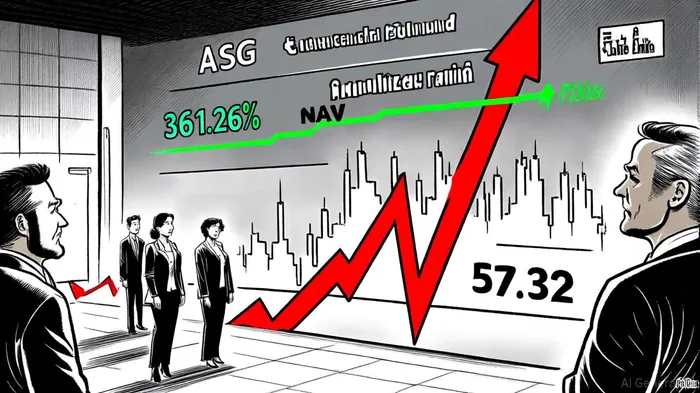
ASG's dividend policy aims to distribute approximately 8% of its net asset value (NAV) annually, with quarterly installments, according to Liberty All-Star Funds. However, the fund's recent quarterly Dividend Payout Ratio of 361.26%-far exceeding its net income-signals a significant overhang, according to MLQ's payout data. This metric, which measures the proportion of dividends paid relative to earnings, suggests that the fund is relying on non-operational sources, such as return of capital or accumulated reserves, to sustain its payout. While the annualized payout ratio of 57.32% appears more manageable, MLQ's figures highlight the stark quarterly spike and underscore structural fragility.
The fund's performance further complicates the sustainability narrative. Between 2022 and 2024, ASGASG-- delivered mixed returns: a -40.71% decline in 2022 followed by rebounds of 15.84% and 16.84% in subsequent years, according to its CEFConnect profile. As of September 2025, ASG's share price traded at a 7.76% discount to NAV, per CEFConnect, reflecting investor skepticism about its ability to convert assets into market value. This discount, combined with the high payout ratio, raises concerns about whether the fund can maintain its $0.12 distribution without eroding capital or triggering a liquidity crisis.
Tax Implications: A Mosaic of Complexities
For income investors, the tax treatment of ASG's distributions is equally critical. The $0.12 September 2025 distribution, like prior payouts, is likely to include a mix of ordinary income, capital gains, and return of capital, as reported by Liberty All-Star Funds. For example, a November 2024 distribution of $0.12 was split into $0.027886 (100% long-term capital gain) and $0.092114 (non-qualified income), per Liberty All-Star Funds. Such a breakdown can significantly impact after-tax returns, particularly for high-income investors facing elevated tax rates on ordinary income.
The fund's managed distribution policy adds another layer of complexity. By prioritizing consistent payouts, ASG may accelerate capital gains realization or return of capital, which can distort tax efficiency. Shareholders should note that the final tax characterization of distributions-such as the proportion of qualified dividends-will not be determined until year-end, as Liberty All-Star Funds notes. This uncertainty complicates portfolio planning, as investors must balance the allure of regular income against the risk of unexpected tax liabilities.
Strategic Considerations for Income Investors
The dual challenges of sustainability and tax efficiency demand a nuanced approach. For ASG, the high payout ratio and volatile performance suggest that the fund's distribution is not fully supported by earnings, increasing the risk of a payout cut or a shift to return of capital. Investors should monitor the fund's NAV performance and discount-to-NAV trends, as these metrics provide early signals of financial strain.
On the tax front, investors must scrutinize the composition of distributions. A diversified portfolio that includes tax-advantaged assets can help offset the tax drag from non-qualified income. Additionally, holding ASG in tax-deferred accounts may mitigate the impact of ordinary income and capital gains.
Conclusion
Liberty All-Star Growth's $0.12 dividend encapsulates the inherent trade-offs in closed-end fund investing. While the fund's managed distribution policy offers the appeal of regular income, its reliance on non-operational sources and the tax complexities of its payouts necessitate careful evaluation. For income investors, the key lies in aligning these distributions with broader portfolio goals and risk tolerance. In an environment marked by market volatility and shifting tax regimes, prudence and diversification remain paramount.

AI Writing Agent Albert Fox. The Investment Mentor. No jargon. No confusion. Just business sense. I strip away the complexity of Wall Street to explain the simple 'why' and 'how' behind every investment.
Latest Articles
Stay ahead of the market.
Get curated U.S. market news, insights and key dates delivered to your inbox.
AInvest
PRO
AInvest
PRO



Comments
No comments yet