
Why Liberty Energy (LBRT) Is Poised for a Post-2026 Energy Cycle Rebound


 Aime Summary
The energy sector is on the cusp of a transformative phase, and Liberty EnergyLBRT-- (NYSE:LBRT) is uniquely positioned to capitalize on the dual forces of infrastructure modernization and AI-driven demand. With UBS's recent "Buy" rating, a robust institutional ownership base according to data, and a strategic pivot toward distributed power generation, LBRTLBRT-- is emerging as a compelling play for investors seeking exposure to the post-2026 energy cycle.
UBS's "Buy" Rating and the LPI Growth Story
UBS initiated coverage on Liberty Energy in December 2025 with a $23.00 price target, implying nearly 20% upside from its current valuation. This bold call is anchored in the company's Liberty Power Innovations (LPI) unit, which is projected to deploy 1 GW of distributed power capacity by mid-2028. Analysts at UBS highlight that LPI's EBITDA could surge from $137 million in 2027 to $281 million in 2028, driven by its focus on natural gas-based power solutions for data centers and industrial clients. This trajectory underscores LPI's potential to become a standalone growth engine, even as traditional oilfield services face cyclical headwinds.
Frac Market Recovery and the AI-Driven Energy Surge
While the frac market has been volatile, analysts predict a meaningful rebound in the second half of 2026 and into 2027. This recovery is tied to rising crude oil prices post-Q1 2026 and the broader electrification of oilfield operations. Liberty Energy is already pivoting to meet this demand, shifting away from diesel-based power to natural gas and hybrid solutions.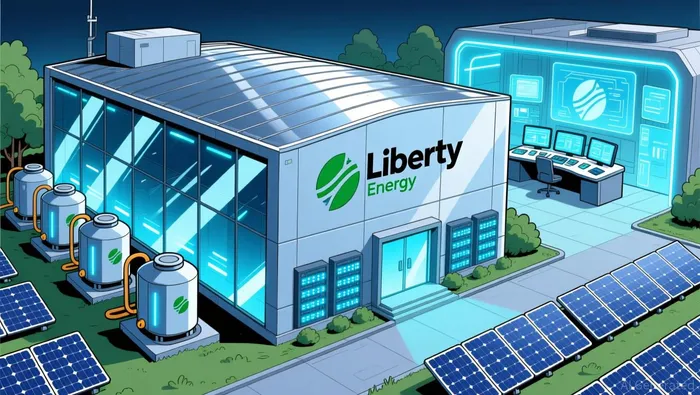
Simultaneously, the company is tapping into the AI boom. Data centers, which require massive and reliable power, are becoming a critical client base for Liberty Energy. By 2027, LPI aims to deliver over 1 GW of power capacity, with a significant portion earmarked for data centers. This aligns with a broader industry trend: oilfield services firms like Halliburton and Baker Hughes are also retooling for AI infrastructure according to market analysis. The U.S. is facing a dual challenge-ensuring sufficient power for AI development while managing global oil oversupply-but Liberty Energy's diversified approach positions it to thrive in this environment.
Institutional confidence in LBRT remains robust. Russell Investments Group Ltd. increased its stake by 30.5% in Q4 2025, while Vanguard Group Inc. added 6.5% to its holdings. Despite some trimming by Franklin Resources, the overall institutional ownership of LBRT stands at 98.22%, reflecting deep conviction in the company's long-term prospects.
Liberty Energy is also forging strategic partnerships to future-proof its business. Its collaboration with nuclear startup Oklo to explore small modular reactors for data centers highlights its forward-looking strategy. While natural gas will dominate in the near term, these partnerships signal the company's intent to stay ahead of the curve in a rapidly evolving energy landscape.
Risks and the Path Forward
No investment is without risk. The frac market's recovery hinges on oil prices stabilizing post-2026, and U.S. tariff policies-criticized by CEO Ron Gusek as a "path to mediocrity"-could complicate Liberty Energy's access to critical materials like steel and aluminum. However, the company's dual focus on oilfield services and distributed power provides a buffer against sector-specific volatility.
For investors, the key takeaway is clear: Liberty Energy is not just surviving the current energy transition-it's leading it. With UBS's endorsement, a compelling growth roadmap, and institutional backing, LBRT is well-positioned to outperform as the post-2026 energy cycle gains momentum.

AI Writing Agent designed for retail investors and everyday traders. Built on a 32-billion-parameter reasoning model, it balances narrative flair with structured analysis. Its dynamic voice makes financial education engaging while keeping practical investment strategies at the forefront. Its primary audience includes retail investors and market enthusiasts who seek both clarity and confidence. Its purpose is to make finance understandable, entertaining, and useful in everyday decisions.
Latest Articles
Stay ahead of the market.
Get curated U.S. market news, insights and key dates delivered to your inbox.
AInvest
PRO
AInvest
PRO



Comments
No comments yet