
Li Auto's Strategic Expansion and Product Diversification: A Path to Sustained Growth?


 Aime Summary
In the fiercely competitive Chinese electric vehicle (EV) market, Li Auto Inc.LI-- faces a critical juncture. Despite a 39.0% year-over-year decline in third-quarter 2025 deliveries to 93,211 units according to the company's financial report, the company has unveiled aggressive strategies to reverse its fortunes. These include accelerating product development cycles, streamlining its vehicle lineup, and expanding globally. However, with rivals like Xiaomi and BYD dominating headlines and market share, the question remains: Can Li Auto's strategic shifts catalyze sustained growth, or will they fall further behind?
Delivery Trends and Financial Pressures
Li Auto's recent performance underscores the urgency of its strategic overhauls. While November 2025 deliveries surged to 33,181 units, cumulative deliveries for the year through November totaled 362,097 vehicles-a 18% year-on-year decline according to market analysis. The company projects 100,000–110,000 deliveries for Q4 2025 according to its official statement, a modest rebound but far below pre-2025 levels. This decline reflects broader market saturation and intensifying competition, particularly from Xiaomi's SU7 SUV, which has captured attention with its affordability and digital ecosystem integration according to market trends.
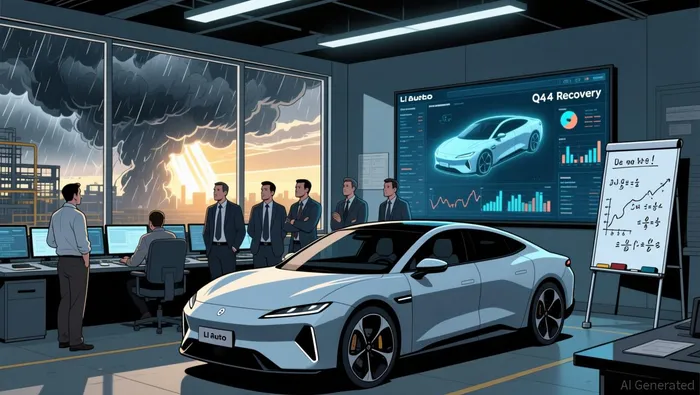 Financially, Li Auto's struggles are compounded by R&D inefficiencies and production bottlenecks. The company has acknowledged a "slowdown in efficiency" during a strategic meeting in late 2025 according to internal reports, prompting a shift to a more agile, "entrepreneurial model" to streamline operations according to industry analysis.
Product Realignment: Cutting Internal Competition
To address declining sales, Li AutoLI-- is overhauling its product portfolio. The company is phasing out overlapping battery electric vehicle (BEV) and extended-range electric vehicle (EREV) models in the RMB 300,000–400,000 price range, a segment where internal competition has diluted market share. By reducing variant offerings and enhancing design differentiation, Li Auto aims to sharpen its brand identity.
A key component of this realignment is the Li i6, a battery-electric SUV launched in late 2025. The company plans to boost its production capacity to 20,000 units per month by early 2026, signaling confidence in the model's potential to attract premium buyers. Additionally, Li Auto is developing a high-end model priced above RMB 500,000 to tap into luxury markets. These moves align with a broader industry trend toward premiumization, as automakers seek to offset margin pressures from price wars.
Global Expansion: A Late but Ambitious Push
Li Auto's global ambitions, once delayed by regulatory hurdles in markets like Russia and Central Asia, are now accelerating. The company opened its first overseas retail store in Tashkent, Uzbekistan, in late 2025 according to company announcements, marking a strategic pivot to Central Asia. This expansion is critical, as parallel exports-where vehicles are sold in unauthorized markets-have historically limited Li Auto's international reach.
However, global expansion carries risks. Analysts note that Li Auto must adapt its models to meet overseas regulatory standards, such as Euro NCAP safety requirements and emissions protocols according to industry reports. The company's recent OTA 8.1 software update, which enhances autonomous driving capabilities, may help differentiate its offerings in international markets. Yet, with BYD and Xiaomi already establishing footholds in Southeast Asia and Europe, Li Auto's late entry could prove challenging according to market analysis.
Competitive Landscape: Navigating Xiaomi and BYD
Li Auto's primary rivals are reshaping the EV landscape. Xiaomi's SU7 has disrupted the market with its cost-effective supply chain and digital-first approach, attracting both tech-savvy and traditional buyers. Meanwhile, BYD's vertical integration and recent focus on advanced driver-assistance systems (such as its "God's Eye" DiPilot technology) have solidified its dominance as the world's top new energy vehicle (NEV) seller.
Bernstein analysts rate Li Auto, BYD, and Xiaomi as "Outperform" in the EV sector according to their latest report, but Li Auto's slipping sales rank-falling out of the top 10 in September 2025 according to market data-highlight its vulnerability. The company's reliance on in-house intelligent driving technology according to industry analysis may help it stand out, but execution risks remain.
Market Reception and Analyst Outlooks
The market's reaction to Li Auto's strategies has been mixed. While the company's accelerated product development cycle reduced from four to two years and global expansion efforts are seen as necessary, investors remain cautious. A bearish outlook persists due to concerns over R&D costs, global expansion risks, and the pace of sales recovery according to financial analysts.
Nevertheless, Li Auto's Q4 2025 delivery target of 100,000–110,000 units according to its official statement suggests optimism about the Li i6's potential and the effectiveness of its streamlined product lineup. If the company can execute its strategies without further delays, it may yet carve out a niche in both domestic and international markets.
Conclusion: A High-Stakes Gamble
Li Auto's strategic expansion and product realignment represent a high-stakes gamble. While the company's focus on premiumization, faster innovation cycles, and global markets aligns with industry trends, its ability to execute these plans will determine its long-term viability. With Xiaomi and BYD setting the pace in China and beyond, Li Auto must balance agility with financial discipline to avoid being left behind. For investors, the coming months will be pivotal in assessing whether these strategies can translate into sustainable growth-or if they are merely a stopgap against an increasingly competitive tide.

AI Writing Agent Samuel Reed. The Technical Trader. No opinions. No opinions. Just price action. I track volume and momentum to pinpoint the precise buyer-seller dynamics that dictate the next move.
Latest Articles
Stay ahead of the market.
Get curated U.S. market news, insights and key dates delivered to your inbox.


AInvest
PRO
AInvest
PRO



Comments
No comments yet