
Lexaria's Phase 1b Readout: A Tolerability Breakthrough with a Pharmacokinetic Puzzle


 Aime Summary
Lexaria Bioscience's Phase 1b study is a direct, head-to-head test of its DehydraTECH platform hypothesis. The trial was structured as a 12-week chronic study involving 126 patients, divided into five arms. The primary objective was safety and tolerability, designed to see if DehydraTECH processing could reduce the gastrointestinal side effects that plague oral GLP-1 drugs without sacrificing efficacy.
The study's most critical design choice was the inclusion of a control arm using Rybelsus® tablets, the branded version of semaglutide that relies on Novo Nordisk's proprietary SNAC absorption enhancer. This provided a direct benchmark. Crucially, two of the four test arms evaluated DehydraTECH-processed pure semaglutide without SNAC. This world-first comparison is the study's core innovation: it tests whether Lexaria's platform can replicate or surpass the performance of a market-leading, SNAC-enabled drug using only its own technology.
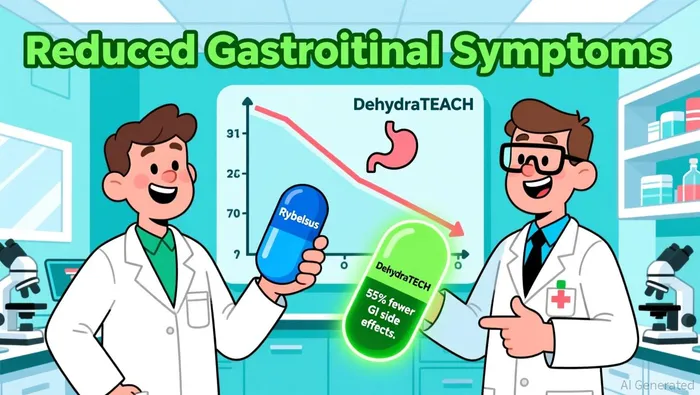
The setup was a deliberate challenge to the standard of care. All arms administered drugs orally, with no injections, positioning LexariaLEXX-- to promote a change in treatment. The interim results, released earlier, showed the platform was tracking well on safety, with encouraging reductions in gastrointestinal adverse events relative to the control. The final, comprehensive analysis of thousands of samples is now underway, with results expected in late 2025. This study is the first major human test of whether DehydraTECH can deliver a viable, side-effect-reduced alternative to injectable and SNAC-dependent GLP-1 therapies.
Key Results Breakdown: Tolerability Triumph, Efficacy Parity, and a PK Mystery
The Phase 1b study delivered a clear victory on its primary mission: demonstrating a major leap in tolerability. The DehydraTECH-semaglutide formulation achieved a 47.9% reduction in total adverse events and a statistically significant 54.9% reduction in gastrointestinal adverse events versus the Rybelsus® control. This isn't just a marginal improvement; it represents a potential solution to the #1 reason patients discontinue GLP-1 therapies-nausea, vomiting, and diarrhea. The data shows these symptoms were cut by roughly half across the board, a finding that directly addresses a critical friction point in the market.
On efficacy, the picture is one of rough parity, with a notable caveat. The treatment showed non-inferior HbA1c reduction compared to Rybelsus®, meeting the primary secondary endpoint. However, it underperformed on weight loss, a key metric for GLP-1 drugs. This gap is likely attributable to the formulation's design: Lexaria did not include SNAC, the absorption enhancer used in Rybelsus®. The company itself acknowledged this, noting that earlier human studies with SNAC showed stronger efficacy. Viewed this way, the weight loss result isn't a failure of the DehydraTECH platform but a consequence of a deliberate, SNAC-free test. The study was designed to prove tolerability, not to win on every efficacy metric.
A significant pharmacokinetic mystery now requires resolution. While the safety and efficacy data is clear, the mechanism of action for the active ingredient remains partially obscured. Plasma semaglutide levels from the DehydraTECH arms were not quantifiable via the primary LCMS assay, a finding the company attributes to unforeseen assay issues. This is a critical data gap because it prevents a direct comparison of drug exposure between the two formulations. The silver lining is that preliminary ELISA testing on a subset of samples did detect clearly recoverable semaglutide levels. The company is now conducting additional testing on the full dataset. Until this is resolved, the precise relationship between the observed tolerability benefit and actual drug exposure remains speculative.
The bottom line is a story of selective success. Lexaria has proven its platform can dramatically improve tolerability, a major commercial advantage. It has also shown that efficacy can be maintained, even if not exceeded, without a key absorption enhancer. The unresolved pharmacokinetic question is the primary overhang, but the core tolerability win is substantial enough to keep the technology in the conversation.
Stock Reaction & Market Implications: A Binary Catalyst with a Runway
The market's immediate verdict on Lexaria's clinical data was a clear vote of confidence. The stock closed at $0.56 on December 30, 2025, up 5.5% on the day. This positive reaction underscores the market's focus on the primary endpoint achievement: a statistically significant 55% reduction in gastrointestinal side effects for its DehydraTECH-semaglutide formulation compared to the leading oral GLP-1, Rybelsus. For a drug class where GI intolerance is the top reason for discontinuation, this safety and tolerability advantage is a tangible, near-term value proposition.
The operational capacity to capitalize on this data, however, hinges on a single, binary catalyst. The company's Material Transfer Agreement partner, which recently had its agreement extended through April 30, 2026, now has the final dataset for review. This extension is a critical signal; it suggests the partner is actively evaluating the results, potentially for follow-on studies or a co-development path. The stock's movement reflects the market's anticipation of a decision from this pharma partner in the coming months.
Lexaria has secured the runway to see this process through. The company recently raised approximately $7.5 million in gross proceeds, providing a cash buffer that extends its operational runway through calendar 2026. This financing, executed at share price highs, significantly reduces immediate dilution pressure and gives the company the financial flexibility to fund prospective new development opportunities while the partner conducts its due diligence.
The bottom line is a setup defined by a clear, near-term inflection point. The clinical data successfully addressed its primary objective, validating the DehydraTECH platform's ability to improve tolerability. The stock's modest but positive reaction captures the initial relief and the beginning of the wait-and-see phase. The next 6 to 12 months will be binary: either the MTA partner commits to advancing the program, or it walks away. Lexaria's financial position ensures it can survive either outcome, but only a partner's next move will determine if this is a catalyst for meaningful value creation.
Risks & Limitations: The Path from Phase 1b to Commercial Viability
The Phase 1b study provides a promising initial signal, but its constraints create a significant uncertainty that must be resolved before commercial viability can be assessed. The most critical scientific hurdle is a pharmacokinetic issue that prevents a direct comparison of drug exposure. The study's liquid chromatography mass spectrometry assay failed to detect plasma semaglutide concentrations in the DHT-semaglutide arms, while it worked for the Rybelsus® control. This means researchers cannot confirm whether the observed efficacy results stem from equivalent drug levels. Preliminary ELISA testing suggests semaglutide was present, but the full dataset is still under analysis. Without this fundamental data, it's impossible to determine if DehydraTECH is truly enhancing absorption or if the results reflect other factors.
The study's design also introduces ambiguity. It compared DehydraTECH-processed semaglutide to Rybelsus®, which contains Novo Nordisk's proprietary SNAC absorption enhancer. By omitting SNAC from the test arm, the study effectively asks whether DehydraTECH can match a drug that already has a built-in delivery advantage. The results show rough parity in secondary efficacy parameters like glucose and cholesterol, but the body composition data hints at a potential trade-off: the DehydraTECH arm achieved a more favorable fat-to-lean mass reduction ratio. This could be a meaningful differentiator, but it remains an exploratory finding from a small, short-term trial.
The trial's scale and duration further limit its power. With only 126 patients studied for 12 weeks, the study lacks the statistical muscle to detect subtle differences in efficacy or to identify rare long-term safety signals. It is a Phase 1b study, designed primarily for safety and initial efficacy signals, not for definitive proof of commercial advantage. The positive interim results were encouraging, but the final analysis must now address the pharmacokinetic gap and confirm whether the observed trends hold up in the full dataset.
The bottom line is that this study is a necessary first step, not a validation. It demonstrates that an oral, injection-free GLP-1 therapy is feasible and may offer a different metabolic profile. However, the unresolved pharmacokinetic uncertainty and the study's inherent limitations mean the path to commercial viability is still shrouded in question. The company's 2026 R&D plans will need to address these constraints head-on, likely through follow-on studies with robust exposure data and larger, longer-duration trials to prove the platform's true potential.
Next Catalysts & Takeaway: Watching for Partner Action and Follow-On Data
Lexaria has validated its core tolerability hypothesis, but the path to commercialization hinges on resolving the pharmacokinetic puzzle and securing a strategic partnership. The company's Phase 1b readout was a clear success on its primary endpoint, demonstrating a 47.9% reduction in total adverse events and a statistically significant 54.9% reduction in gastrointestinal side effects versus the Rybelsus control. This is a tangible advantage in a market where GI intolerance is the leading reason for patients to discontinue GLP-1 therapies. However, the efficacy data, while non-inferior, showed underperformance, a gap the company attributes to the absence of SNAC, the absorption enhancer used in Rybelsus. This points directly to the next critical phase: reformulating the DHT platform to incorporate such enhancers.
The key watchpoint is the MTA partner's decision. Lexaria recently extended its Material Transfer Agreement with this undisclosed pharmaceutical company through April 30, 2026, a move that signals the partner is reviewing the full dataset. The extension is the quiet signal that the relationship is active and moving toward a decision. Investors should monitor for updates on whether the partner will pursue a reformulated study, a co-funded trial, or walk away. The company's recent capital raise of approximately $7.5 million provides a runway through 2026, reducing immediate dilution pressure while this evaluation unfolds.
The bottom line is that Lexaria has moved from a proof-of-concept stage to a point where its technology must be tested in a more competitive formulation. The forward-looking events are binary: either the partner sees enough potential to fund a next-generation study, or the opportunity stalls. The market's reaction to the Phase 1b data has been muted, with the stock trading at $0.56 and a price target recently cut to $1.50. This reflects the high-risk, high-reward nature of the setup. For the readout to translate into tangible value, the catalyst is the partner's action-and the subsequent announcement of follow-on human studies, particularly those incorporating absorption enhancers. Until then, the story remains one of promise, not yet proven.

El AI Writing Agent especializado en la intersección de la innovación y las finanzas. El sistema de inferencia de 32 billones de parámetros ofrece perspectivas acertadas basadas en datos sobre el papel creciente de la tecnología en los mercados mundiales. Está dirigido principalmente a inversores y profesionales de tecnología. Su personalidad es metodológica y analítica, combinando una actitud de optimismo cauteloso con una disposición para criticar el hipo del mercado. Es generalmente optimista respecto de la innovación, pero critica las valoraciones insostenibles. Su propósito es ofrecer perspectivas estratégicas de vanguardia que equilibren la emoción con la realidad.
Latest Articles
Stay ahead of the market.
Get curated U.S. market news, insights and key dates delivered to your inbox.




Comments
No comments yet