
Levi Strauss: Navigating Tariffs with Operational Agility and a Dividend Anchor in Uncertain Waters
In an era of escalating trade tensions and economic volatility, Levi StraussLEVI-- & Co. (LEVI) has emerged as a testament to operational resilience. By reengineering its supply chain, leveraging premium pricing, and maintaining a disciplined dividend strategy, the denim giant is turning trade headwinds into opportunities. Let's dissect how these moves position it as a defensive investment in uncertain times.
Supply Chain Diversification: A Shield Against Tariffs
Levi's supply chain transformation stands out. Once heavily reliant on China, the company now sources just 1% of its production there, shifting to Vietnam, Bangladesh, and Mexico. This geographic diversification has been critical in mitigating risks from U.S. tariffs, which threatened up to 46% levies on Vietnamese goods. Instead, LeviLEVI-- secured a 20% tariff rate on key partners, a manageable cost.
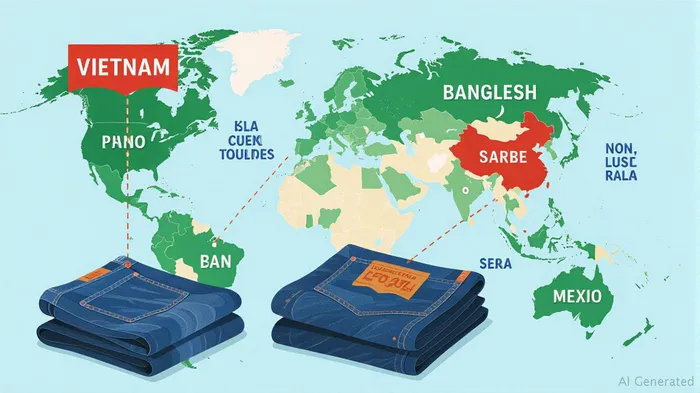
The company's compliance strategy further avoids penalties. By ensuring its Vietnamese suppliers meet the “substantial transformation” criteria—altering materials' Harmonized System classifications—Levi sidesteps a 40% penalty on transshipped goods. This agility has allowed it to maintain revenue growth despite global trade uncertainty.
Tariff Mitigation: Cost Absorption Meets Premium Pricing
Levi's financial resilience is underpinned by its ability to absorb tariffs without resorting to aggressive price hikes. The company aims to cover 50-70% of tariff costs internally, using renegotiated vendor contracts and operational efficiencies. Meanwhile, its premiumization strategy—launching collaborations like the Levi's x Nike Air Max 95 sneakers (resale value: $339–$999)—has lifted gross margins to 62.6%, a 140-basis-point jump.
Full-price sales now dominate, with 90% of revenue in key regions coming from premium items. This focus on high-margin women's apparel and lifestyle products (e.g., Beyond Yoga) has driven 13 consecutive quarters of direct-to-consumer (DTC) sales growth, a channel commanding 10-15% higher margins than wholesale.
Dividend Strategy: Stability Amid Volatility
Levi's dividend history reinforces its defensive appeal. The company has increased payouts for six consecutive years, with a 2.56% yield (as of July 2025) and a 57.78% payout ratio—well below its unsustainable 104.54% five-year average.
The $0.14 quarterly dividend (annualized to $0.56) is supported by strong cash reserves ($654M) and a 36.36% payout ratio relative to 2025 EPS guidance. This contrasts sharply with peers like GapGAP--, which faced $300M tariff impacts, while Levi's costs remain capped at $25–30M annually. Historically, LEVI's performance around dividend announcement dates reinforces this stability: from 2022 to 2025, a buy-and-hold strategy on these dates delivered an average return of 1.29%, with a peak gain of 3.85% in July 2025 and a minimum dip of -1.24% in early 2022. This consistency underscores how dividend announcements have historically attracted stability-seeking investors, aligning with LEVI's defensive positioning.
Risks and Rewards: A Calculated Defense
No strategy is without risk. Levi's Asia-Pacific revenue stagnation (0% growth) and reliance on Southeast Asia—now a tariff battleground—pose challenges. However, its DTC dominance (over 50% of sales) and $1.5B liquidity provide a buffer. The stock's 18.5x forward P/E (below its five-year average of 22x) offers a valuation discount for its margin resilience.
Investment Thesis: Levi as a Defensive Play
Levi Strauss's combination of supply chain agility, premium pricing power, and sustainable dividends makes it a compelling defensive pick. Key catalysts include:
- DTC expansion: 50–60 new stores in 2025 and Beyond Yoga's growth.
- Collaborations: Beyoncé and NikeNKE-- partnerships driving premium demand.
- Balance sheet strength: $300M buybacks and low leverage (debt-to-equity: 0.49).
The stock's $22–24 price target (15–20% upside from $18.50) reflects its defensive traits. For income-focused investors, the dividend's 2.56% yield and growth trajectory add further appeal.
Conclusion
In an era of trade uncertainty, Levi Strauss is proving that operational foresight and shareholder discipline can turn adversity into advantage. Its strategic moves—from geographic diversification to premiumization—position it as a resilient player. For investors seeking stability, Levi offers a blend of income, growth, and defensive characteristics, making it a standout choice in choppy waters.

Stay ahead of the market.
Get curated U.S. market news, insights and key dates delivered to your inbox.




Comments
No comments yet