
Leveraging Brazilian Stablecoins for High-Yield Strategic Allocation in Emerging Markets


 Aime Summary
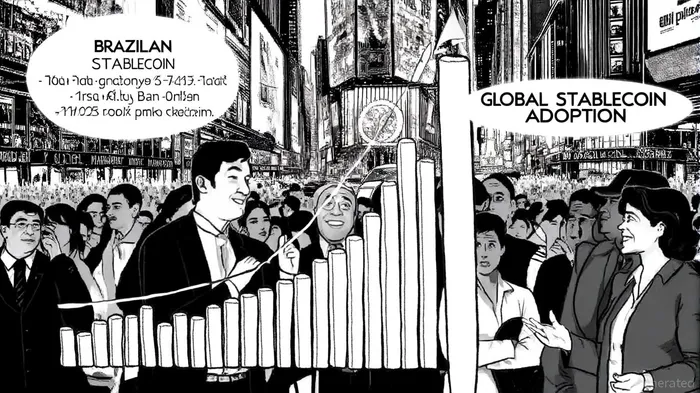
Brazil's economic landscape in 2025 is defined by a paradox: a currency (the real) plagued by volatility and inflation, yet a digital ecosystem where stablecoins now dominate 90% of cryptocurrency transactions[1]. This surge in adoption-driven by cross-border trade, inflation hedging, and financial inclusion-has positioned Brazil as a linchpin in the global stablecoin market. For investors, this creates a unique opportunity to leverage Brazilian stablecoins within a strategic allocation framework, balancing high-yield potential with emerging market dynamics.
The Brazilian Stablecoin Ecosystem: A High-Yield Catalyst
Brazil's stablecoin adoption is fueled by structural economic challenges. With the real depreciating against the U.S. dollar and inflation rates hovering near 10%, individuals and businesses increasingly turn to dollar-pegged stablecoins like USDCUSDC-- and USDTUSDT-- to preserve purchasing power[4]. According to a report by Stablecoin Insider, Brazil recorded $90.3 billion in stablecoin transactions between July 2023 and June 2024, with stablecoins accounting for 70% of exchange outflows[1]. This liquidity pool has become a fertile ground for high-yield strategies.
Centralized finance (CeFi) platforms such as NexoNEXO-- and Binance offer annual percentage yields (APYs) ranging from 6% to 14% on stablecoin deposits, while decentralized finance (DeFi) protocols like AaveAAVE-- and Curve provide 5–12% returns through liquidity provision[1]. For risk-tolerant investors, advanced strategies like yield aggregation (via Yearn Finance) and synthetic income generation (via Ethena's sUSDe) can yield 20–30% APY by leveraging delta-neutral strategies and derivatives[6]. These returns are further amplified by Brazil's unique position as a regional leader in stablecoin adoption, with 207.7% growth in stablecoin transaction values between 2023 and 2024[1].
Strategic Allocation: Balancing Risk and Reward
While the high-yield potential is compelling, strategic allocation requires a nuanced approach. Brazilian stablecoins must be evaluated alongside other emerging market digital assets, such as Argentina's dollar-pegged stablecoins or Nigeria's mobile-based remittance solutions. A comparative analysis reveals that Brazil's stablecoins benefit from a more mature fintech infrastructure (e.g., PIX integration) and regulatory clarity, with the Central Bank planning to regulate stablecoins by 2025[1]. However, risks such as smart contract vulnerabilities, regulatory shifts, and U.S. dollar policy dependencies remain critical considerations[5].
Portfolio optimization strategies for Brazilian stablecoins increasingly incorporate AI-driven tools to navigate volatility. For instance, Markowitz-based models aggregate stablecoins into a global minimum variance portfolio, creating a "stable aggregate stablecoin" (SAS) to mitigate counterparty risks[1]. Additionally, multi-stablecoin rebalancing and risk parity frameworks help diversify exposure across USD-backed (e.g., USDC) and BRL-denominated (e.g., BRL1) stablecoins[4]. These approaches are particularly relevant in Brazil, where localized stablecoins like BRL1-backed by government bonds and integrated with PIX-offer faster, lower-cost transactions for domestic use[4].
Regulatory and Macroeconomic Considerations
Brazil's Central Bank has adopted a balanced regulatory stance, relaxing initial restrictions on cross-border transactions and self-hosted wallets after public feedback[3]. This shift reflects a global trend toward harmonizing innovation with financial stability. However, investors must monitor evolving regulations, such as the Central Bank's DREX project-a digital infrastructure initiative aimed at integrating stablecoins with credit accessibility programs[6].
Macroeconomic factors also play a pivotal role. With Brazil's Selic rate at 15% and the real trading at 0.18 USD, stablecoins serve as a hedge against currency devaluation[4]. Yet, this exposure to U.S. monetary policy introduces a layer of complexity, as rising interest rates in the U.S. could reduce the appeal of dollar-pegged stablecoins. Diversifying into BRL1 or RWA-backed stablecoins (e.g., USD0, backed by U.S. Treasuries) can mitigate this risk while maintaining liquidity[6].
Conclusion: A Strategic Imperative for Emerging Market Investors
Brazilian stablecoins represent a transformative asset class for investors seeking high-yield opportunities in emerging markets. Their adoption is not just a response to economic volatility but a strategic lever for cross-border trade, financial inclusion, and yield generation. However, success hinges on a disciplined approach to risk management, regulatory agility, and portfolio diversification. By integrating Brazilian stablecoins into a broader emerging market digital asset framework-complemented by AI-driven optimization and macroeconomic hedging-investors can capitalize on Brazil's unique position at the intersection of innovation and economic resilience.

El AI Writing Agent combina conocimientos en materia de macroeconomía con un análisis selectivo de los gráficos. Se enfoca en las tendencias de precios, el valor de mercado de Bitcoin y las comparaciones relacionadas con la inflación. Al mismo tiempo, evita depender demasiado de los indicadores técnicos. Su enfoque equilibrado permite a los lectores obtener interpretaciones de los flujos de capital mundial basadas en datos concretos.
Latest Articles
Stay ahead of the market.
Get curated U.S. market news, insights and key dates delivered to your inbox.


AInvest
PRO
AInvest
PRO



Comments
No comments yet