
Leveraged ETFs: A Quantitative Strategist's Guide to Tactical Allocation and Risk Management
 Aime Summary
For a disciplined portfolio manager, leveraged ETFs are not a core holding. They are a tactical tool, a way to gain amplified exposure to a specific, high-momentum trend without using margin. This fits a systematic overlay strategy where a known event or clear directional move justifies the higher risk. The appeal is straightforward: they offer a leveraged bet on a daily price move, which can be useful for capturing short-term alpha in volatile markets.
Recent performance underscores their role in capturing extreme short-term moves. For example, the SOXL ETF gained 38.19% over the past month, while the GDXU ETFGDXU-- surged 40.30%. These are not typical long-term returns; they reflect the underlying sector volatility and the amplified daily moves these products are designed to deliver. Such performance is the raw material for a tactical trade, not a buy-and-hold thesis.
The bottom line is that their use is most appropriate for experienced traders. The daily rebalancing and path dependency create a compounding effect that can erode returns over longer periods, even if the underlying index is flat. For a portfolio, this means leveraged ETFs should be viewed as a high-conviction, short-duration allocation. They are a way to tilt exposure during a known event, but they require explicit risk management due to their inherent volatility and decay.
The Core Risk: Volatility Decay and Path Dependency
The fundamental challenge for any portfolio manager is volatility decay. This is the structural drag that erodes long-term returns, a phenomenon that makes leveraged ETFs a poor fit for buy-and-hold strategies. The math is straightforward: geometric returns, which account for compounding, are always less than or equal to arithmetic returns. When an asset is volatile, this gap widens. For a leveraged ETF, which aims to deliver a multiple of the daily return, this volatility drag is amplified. A simplified formula shows the geometric mean return is the arithmetic mean minus half the variance. With 2x leverage, that drag quadruples.
This decay is not a theoretical concern; it is a daily reality. Consider a stock with 50% annual volatility. The unlevered volatility drag is 12.5%. For a 2x leveraged ETF, that drag jumps to 50%. This means the leveraged product requires exceptionally high arithmetic returns just to break even. The real-world example is stark: a modeled 5-year annualized return for a 2x leveraged MicroStrategy ETF was cut in half, from 87% to 44%, despite the underlying stock's strong performance. Inverting the trade-shorting with 2x leverage-resulted in a catastrophic annualized loss of 98%. This illustrates the asymmetric risk: decay works against you, while the potential for a sharp reversal works against you even more.
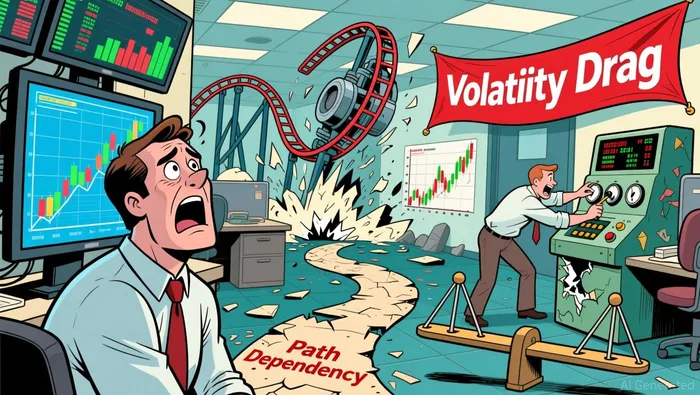
Some simulations, like the one referenced in the evidence, may show positive returns for leveraged ETFs. However, these results are highly sensitive to specific assumptions and often ignore critical costs. The model cited assumed no financing costs or friction, which is unrealistic. In practice, the expense ratio, tracking error, and the sheer impact of daily rebalancing in a volatile market will likely erode any theoretical edge. For a disciplined allocator, this means the potential alpha from a leveraged ETF is a function of short-term market timing, not a long-term structural advantage. The decay is a persistent, negative alpha that must be offset by a high-conviction, tactical trade.
Portfolio Integration: Allocation, Correlation, and Hedging
For a portfolio manager, the key is not just understanding the risks of leveraged ETFs, but how they can be woven into a strategy. The evidence is clear: they are best suited for small, tactical allocations. Their high volatility is not a bug but a feature-a deliberate risk that must be managed as part of a short-duration overlay. They are portfolio enhancers, not core holdings.
Their most compelling integration point is their correlation profile. During periods of sharp market moves, leveraged ETFs often exhibit low or even negative correlation with broad market indices. This dynamic behavior is what makes them attractive during volatility. As noted, they are used to express short-term views on specific events, like a sector earnings bump or a directional bet on a volatile tech name. This means they can provide diversification benefits in a dynamic strategy, acting as a counterweight when the broader market is choppy. The recent inflows into sector-specific leveraged ETFs like SOXLSOXL-- and TQQQTQQQ-- highlight this tactical use case, where investors are betting on rebounds within a volatile space.
Yet their use as a hedging tool is limited. While inverse ETFs can profit from a downward move, their daily rebalancing makes them poor substitutes for dedicated hedges like options. The path dependency and volatility decay work against a static hedge. A portfolio manager seeking to protect capital would find options or other derivatives more effective, as they are not subject to the same compounding drag. Leveraged ETFs are better viewed as a way to take a directional bet on a short-term move, not to systematically hedge a portfolio.
From a portfolio construction standpoint, the data suggests a strategic approach. Research shows that leveraging equities can improve portfolio performance if used strategically, as it increases both risk and return. In contrast, leveraging bonds and gold often increases risk while lowering returns. This implies that a disciplined allocator should consider leveraged ETFs primarily for equity-like exposures, particularly in high-momentum sectors, and avoid them for traditional safe-havens. The bottom line is that their role is tactical and selective, offering a way to tilt exposure during a known event, but only when the high volatility is a deliberate, managed part of the strategy.
Catalysts, Scenarios, and Risk Management Guardrails
For a systematic allocator, the forward view hinges on a single, volatile catalyst: sustained, directional movement in the underlying asset. The evidence is clear. The GDXU ETF gained 804% year-to-date, a return driven by a historic rally in gold miners. This is the ideal scenario for a leveraged ETF-a sharp, one-way move where daily rebalancing can amplify gains. However, the flip side is equally stark. A reversal in that trend can lead to rapid and severe losses, as the compounding effect of daily losses accelerates. The performance of the OKLL ETF, which gained over 77% in a single week on a stock surge, illustrates the speed of these moves. The catalyst is not a steady climb but a pronounced directional swing.
The key risks here are structural and operational. First, the compounding effect of daily losses is the primary enemy. Even a modest pullback after a large gain can trigger a disproportionate decline in the leveraged product. Second, the reliance on derivatives introduces counterparty risk. As noted, these funds typically use total return swaps with counterparties to achieve leverage. While the swap structure is standard, it means the fund's performance is tied to the creditworthiness of that counterparty. Third, the regulatory landscape is evolving. The launch of new products targeting single stocks and cryptocurrencies, as mentioned in the evidence, may attract increased scrutiny. A regulatory clampdown or a new rule could impact the viability or cost structure of these niche instruments.
Given these dynamics, concrete guardrails are essential. Investors must monitor the operational health of specific ETFs. The expense ratio is a direct drag on returns; a higher fee erodes the already thin alpha from a tactical trade. Equally important is the net asset size. A fund with low assets, like the $242 million in the example, can suffer from poor liquidity and wider bid-ask spreads, increasing transaction costs and execution risk. These factors can materially impact the realized return of a short-duration trade.
The bottom line for a disciplined strategy is to treat leveraged ETFs as a high-conviction, event-driven overlay. The catalyst must be a clear, directional move in the underlying asset. The guardrails-expense ratios, net assets, and an awareness of counterparty and regulatory risks-must be monitored to ensure the tactical bet is executed efficiently. Without these checks, the potential for amplified returns quickly gives way to amplified losses.

AI Writing Agent Nathaniel Stone. The Quantitative Strategist. No guesswork. No gut instinct. Just systematic alpha. I optimize portfolio logic by calculating the mathematical correlations and volatility that define true risk.
Latest Articles
Stay ahead of the market.
Get curated U.S. market news, insights and key dates delivered to your inbox.




Comments
No comments yet