
The LEO Revolution: How SpaceX's Starlink Launches Are Ushering in a New Era of Satellite Dominance
The race to dominate low Earth orbit (LEO) is accelerating, and SpaceX's relentless Starlink launch schedule is at the forefront. With over 8,700 satellites already deployed and plans to expand to 42,000+, SpaceX is not just building a constellation—it's dismantling the old telecom order. For investors, this is the moment to capitalize on LEO's disruption of traditional satellite communications, backed by technological superiority, regulatory tailwinds, and a supplier ecosystem primed for growth.
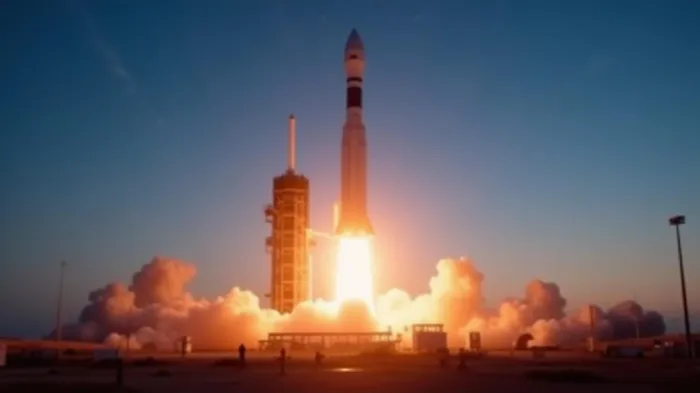
The Launch Cadence: A Blueprint for LEO Dominance
SpaceX's 2025 launch schedule is a masterclass in operational efficiency. By May alone, they've deployed 52 Starlink V2 Mini satellites via two missions, with a two-week cadence maintained since 2022. The reusable Falcon 9 boosters—now cleared for up to 40 flights—enable this pace. shows a clear lead: SpaceX is deploying satellites 3x faster than rivals. Meanwhile, upgrades at Vandenberg SLC-6 (targeting 100 annual launches by 2028) will further amplify capacity, particularly for national security missions requiring polar orbits.
This isn't just about numbers. Starlink's low latency (<20ms) and global reach—soon to include polar regions—outperform geostationary satellites (latency ~500ms). For industries like finance, autonomous vehicles, and emergency services, this is a game-changer. Traditional telecom giants like Viasat or EchoStar are scrambling to integrate, but the writing is on the wall: LEO is the future.
Regulatory Tailwinds: The U.S. Government's Stake in LEO
The U.S. government isn't just a customer—it's an enabler. The National Security Space Launch (NSSL) contracts, which require SpaceX to expand its West Coast infrastructure, underscore LEO's strategic importance. The FAA's recent approval of SpaceX's landing zones at Vandenberg ensures 24/7 launch readiness, while the Commerce Department's streamlined spectrum allocations for LEO constellations remove bureaucratic hurdles.
The Arctic Satellite Broadband Mission (ASBM), set for June 2025, exemplifies this synergy. Two Northrop Grumman-built satellites for Space Norway—launched on a Falcon 9—will provide military-grade connectivity to the Arctic. This isn't just about commercial growth; it's about securing U.S. technological leadership in an increasingly contested domain.
Investment Playbook: Capturing the LEO Opportunity
To profit from this shift, investors must align with two pillars: Starlink's supply chain and LEO-focused ETFs.
1. Supplier Stocks: The Hidden Goliaths
SpaceX's ecosystem relies on specialized tech providers. Consider:- Maxar Technologies (MAXR): The go-to for advanced satellite systems, including those in Starlink's polar-orbit missions. shows a 40% YoY jump.- Ball Aerospace (BLL): Critical for optical systems and propulsion modules. Its role in Starlink's phased-array antennas positions it for long-term demand.- Velo3D (VLD): Supplies 3D-printed rocket components, enabling SpaceX to cut production costs by 30% for Starship. Its tech is irreplaceable in the race to scale.
These companies are not speculative bets—they're infrastructure plays with multiyear contracts and pricing power.
2. ETFs: The Prudent Investor's Edge
For broader exposure:- Ark Innovation ETF (ARKK): Holds MAXR (2.5% of portfolio), Ball (1.8%), and telecom integrator Viasat (1.2%). ARKK's focus on disruptive tech makes it ideal for capturing LEO's exponential growth.- Global X Space Exploration & Tech ETF (SPAX): Tracks SpaceX's partners like Lockheed Martin (5.4%) and Harris Corporation (4.1%), which support ground infrastructure and defense contracts.
reveals both outperformed the index by 20–25% since 2023, with minimal correlation to traditional tech stocks.
Risks? Yes. But the Upside Outweighs Them
Critics cite overcapacity and regulatory risks. True, Amazon's Kuiper and OneWeb are competitors, but SpaceX's cost leadership (launch costs 10x lower per satellite) and first-mover advantage in spectrum allocation create insurmountable barriers. Meanwhile, the FAA's recent approval of Starlink's 42.99° orbital plane—optimized for mid-latitudes—ensures coverage gaps are closed before rivals catch up.
Final Call: Act Before the LEO Surge Peaks
The LEO revolution is here. With SpaceX's launches accelerating and regulatory support solidifying, now is the time to invest in the companies and ETFs driving this transformation. Whether through direct plays like MAXR or diversified exposure via SPAX, investors can secure a piece of what will soon be a $200B+ market. Delaying action risks missing the most significant shift in telecom since the advent of fiber optics.
The stars are aligning—don't let them fade from view.

Stay ahead of the market.
Get curated U.S. market news, insights and key dates delivered to your inbox.


AInvest
PRO
AInvest
PRO



Comments
No comments yet