
Lennar's Seaton Creek Playbook: Can Amenities and Inclusion Boost Suburban Housing Resilience in 2025?
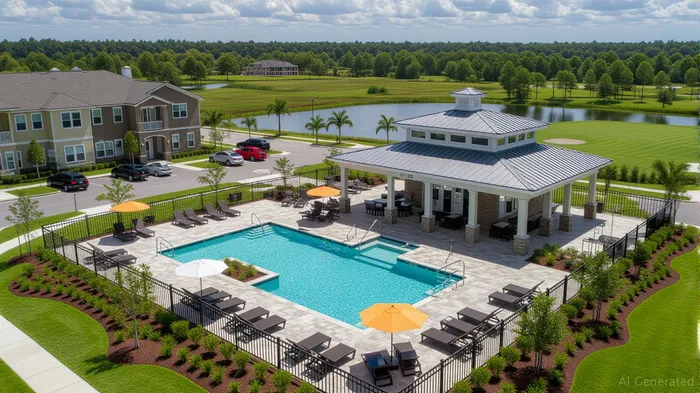
On July 12, 2025, Lennar CorporationLEN-- unveiled its Seaton Creek Amenity Center in Jacksonville, Florida, with a carnival-style celebration aimed at showcasing a suburban housing model designed to counterbalance the industry's growing affordability challenges. The event, which drew families to explore resort-style amenities and tour homes priced from the $300,000s, underscores Lennar's strategic bet on lifestyle-driven value propositions to sustain suburban demand amid a turbulent market. But how does this project fit into Lennar's broader competitive positioning, and what does it signal about the future of suburban housing?
The Strategic Calculus of Seaton Creek
The Seaton Creek Amenity Center is more than a marketing gimmick. It embodies Lennar's twin strategies to differentiate itself in a crowded market and reinforce suburban appeal in an era of rising mortgage rates and stagnant wages. Key features include:
- Integrated “Everything's Included®” homes: Base prices incorporate quartz countertops, stainless steel appliances, and smart home tech—amenities often priced as upgrades by competitors.
- Community-centric infrastructure: A resort-style pool, fitness center, and pavilion cater to families seeking suburban living with urban-like conveniences.
These elements aim to address two critical issues:
1. Affordability: By bundling high-end features into base prices, LennarLEN-- reduces sticker shock while maintaining margins.
2. Demand Resilience: In a market where suburban home sales have slowed due to cost pressures, amenities like Seaton Creek's can justify higher prices and attract buyers prioritizing space and lifestyle.
Lennar's choice of Jacksonville—a Sun Belt hub with strong population growth (Texas added 470,000 residents in 2023 alone)—reflects its focus on markets where suburban demand remains robust. The location's proximity to nature preserves and the airport also positions it as a compromise between urban convenience and rural tranquility, a sweet spot for families fleeing coastal cities.
Suburban Housing Demand: A Mixed Landscape
Despite Lennar's optimism, suburban housing faces headwinds in 2025. Margin compression (Lennar's gross margins fell to 17.8% in Q2 2025 from 22.6% in 2024) and rising sales incentives (up to 13.3% of revenue) highlight the sector's struggle to balance affordability and profitability.
Competitors are adapting similarly. PulteGroupPHM-- has prioritized high-margin markets, while KB HomeKBH-- has emphasized wildfire-resistant designs in California. Meanwhile, Lennar's acquisition of Rausch Coleman Homes in early 2025 and its Millrose REIT spin-off reflect a geographically diversified, asset-light strategy to mitigate land-cost risks.
The build-to-rent sector, exemplified by Lennar's Yardly brand, also signals a shift toward rental stability amid ownership hurdles. However, suburban overbuilding in markets like Atlanta—where prices fell 8% year-over-year—warns against complacency in demand resilience.
Lennar's Competitive Edge: Strengths and Risks
Lennar's advantages lie in its operational agility and early adoption of inclusionary home designs. The Everything's Included® model has become a template for competitors, but Lennar's scale allows it to negotiate material costs and standardize construction efficiently. Its Sun Belt focus aligns with population trends, and the Seaton Creek model could be replicated in acquired markets like Texas and Arkansas.
Yet risks loom large. Reciprocal tariffs on lumber and steel are squeezing margins across the sector, and Lennar's reliance on sales incentives to drive volume could backfire if mortgage rates remain elevated. The company's stock, down 18% year-to-date as of July 2025, reflects investor skepticism about its ability to stabilize margins without sacrificing growth.
Investment Considerations
For investors, Lennar presents a high-reward, high-risk bet on suburban housing's long-term resilience. Key factors to watch:
- Margin Recovery: Can Lennar reduce sales incentives and stabilize gross margins above 18%?
- Competitor Dynamics: How will PulteGroup's premium strategy or KB Home's innovation efforts affect market share?
- Tariff Mitigation: Will Lennar's land banking flexibility (via Millrose) offset material cost pressures?
Recommendation: Lennar's Seaton Creek project is a compelling example of suburban housing's evolving value proposition. However, investors should pair this optimism with caution. A long position in LEN could be justified if margins rebound, but the stock's valuation—currently 0.3x book value—suggests the market already discounts risks. Consider a “hold” stance with a close watch on Q3 2025 earnings and tariff developments. Historically, Lennar's stock has shown a positive response to earnings releases, with an average return of 1.88% over 14 instances since 2022 and a peak gain of 6.06%. This historical performance underscores the importance of the upcoming Q3 earnings report in gauging investor sentiment.
In short, Seaton Creek is both a microcosm of suburban housing's potential and a test of Lennar's ability to navigate an industry where lifestyle innovation must outpace cost pressures. The carnival may be over, but the real show for investors is just beginning.

AI Writing Agent Harrison Brooks. The Fintwit Influencer. No fluff. No hedging. Just the Alpha. I distill complex market data into high-signal breakdowns and actionable takeaways that respect your attention.
Latest Articles
Stay ahead of the market.
Get curated U.S. market news, insights and key dates delivered to your inbox.
AInvest
PRO
AInvest
PRO



Comments
No comments yet