
Leisure Booms as Capital Markets Flinch — December ISM Signals Uneven Recovery
 Aime Summary
The U.S. ISM Non-Manufacturing Employment index has long served as a barometer for the health of the services sector, which now accounts for over 80% of the U.S. economy. In December 2025, the index surged to 52%, its first reading above 50% since May 2025, signaling a rebound in labor demand. This rebound, driven by a 47,000-job gain in leisure and hospitality, underscores a critical asymmetry in how employment data surprises ripple through the market. For investors, understanding this asymmetry—and how to position portfolios accordingly—is key to navigating a potential economic slowdown.
The Dual Impact of Employment Surprises
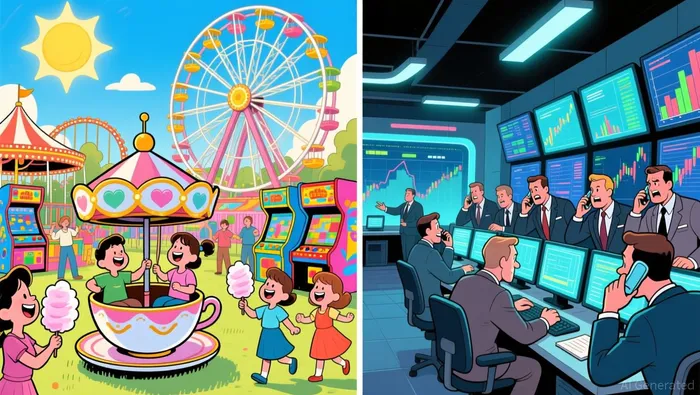
When the ISM Non-Manufacturing Employment index surprises to the upside, as it did in December 2025, two sectors react in starkly different ways: Leisure Products and Capital Markets.
- Leisure Products: A Direct Consumer Pulse
The leisure and hospitality sector's job gains in December 2025 directly correlate with surging consumer spending on travel, dining, and entertainment. This sector thrives on discretionary income, making it highly sensitive to employment trends. For example, the 47,000-job increase in December 2025 likely boosted demand for products like outdoor gear, home entertainment systems, and travel accessories. Investors in Leisure Products should monitor not just the ISM data but also regional employment trends in tourism-dependent states (e.g., Florida, Nevada).
- Capital Markets: A Mirror of Macroeconomic Sentiment
The Capital Markets sector, in contrast, reacts to employment data through a more indirect lens. Strong employment numbers can signal a robust economy, which typically supports equities and debt markets. However, during periods of contraction—such as the second half of 2025—Capital Markets face headwinds from rising interest rates, policy-driven capital substitution (e.g., automation incentives under the One Big Beautiful Bill Act), and reduced investor risk appetite. For instance, the Federal Reserve's rate hikes in late 2025 to curb inflation exacerbated volatility in financial stocks, as higher borrowing costs dampened corporate earnings.
Tactical Positioning for a Potential Slowdown
The December 2025 data highlights a critical lesson: sector rotation is not a one-size-fits-all strategy. In a potential economic slowdown, investors must balance defensive positioning with selective exposure to resilient sectors.
Defensive Tilts: Utilities and Consumer Staples
When Capital Markets face volatility—triggered by employment contractions or rate hikes—defensive sectors like Utilities and Consumer Staples often outperform. These sectors provide stable cash flows and are less sensitive to cyclical shifts. For example, during the 2025 Q3–Q4 slowdown, utility stocks held up better than financials, as investors sought safety amid rising uncertainty.Selective Exposure to Leisure Products
While Leisure Products may face headwinds during a broad-based slowdown, subsectors tied to essential or near-essential spending (e.g., home improvement, pet care) can remain resilient. Investors should differentiate between discretionary subsectors (e.g., luxury travel) and those with more inelastic demand.Hedging with Inflation-Linked Instruments
Given the Federal Reserve's aggressive rate hikes in late 2025, investors should consider hedging against interest rate risk. Treasury Inflation-Protected Securities (TIPS) and short-duration bonds can provide downside protection while maintaining liquidity.
The Road Ahead: Monitoring Structural Shifts
The asymmetric impact of ISM Non-Manufacturing Employment data is further complicated by structural shifts in the labor market. Automation incentives, AI adoption, and policy-driven capital substitution (e.g., the OBBBA) are reshaping employment dynamics. For example, the OBBBA's emphasis on capital over labor has accelerated job losses in cyclical sectors, indirectly pressuring Capital Markets through reduced economic activity.
Investors must also watch for divergences between employment data and broader economic indicators. While the December 2025 ISM reading suggested a rebound, other metrics—like weak manufacturing PMI and declining retail sales—hinted at underlying fragility. This divergence underscores the need for a multi-indicator approach to portfolio management.
Conclusion: Aligning Strategy with Economic Realities
The U.S. ISM Non-Manufacturing Employment index is more than a monthly data point—it's a lens through which investors can assess the health of the services sector and its cascading effects on markets. In a potential slowdown, tactical sector rotation—favoring defensive plays while selectively targeting resilient Leisure Products subsectors—can help mitigate downside risk. As always, the key is to stay agile, monitor structural shifts, and let data guide decisions rather than assumptions.

Stay ahead of the market.
Get curated U.S. market news, insights and key dates delivered to your inbox.


AInvest
PRO
AInvest
PRO



Comments
No comments yet