
Legal Risks and Capital Resilience in Master Limited Partnerships: A Case Study of Sandridge Mississippian Trust I
 Aime Summary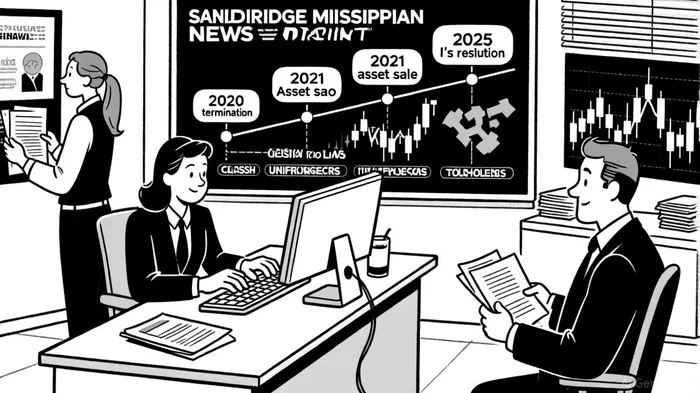
Master limited partnerships (MLPs) have long been touted for their tax advantages and high-yield potential, but their structural complexities and exposure to legal and market risks demand rigorous scrutiny. The recent legal developments involving Sandridge Mississippian Trust I offer a compelling case study to evaluate how unresolved litigation can impact capital resilience and unit valuation, while also highlighting the broader vulnerabilities inherent in MLP structures.
Legal Risks in MLPs: A Persistent Challenge
MLPs operate in a regulatory and legal environment that amplifies their exposure to litigation. For instance, the 2014 oil price crash forced numerous MLPs to cut distributions, shattering investor expectations of stable income streams[1]. Similarly, the 2017 tax reform eroded MLPs' competitive edge by reducing the corporate tax rate, diminishing their tax-deferred advantages[1]. These systemic risks are compounded by operational challenges, such as the Federal Energy Regulatory Commission (FERC) altering pipeline tax cost policies, which increased operational costs for some MLPs[1].
Sandridge Mississippian Trust I exemplifies these risks. From 2015 to 2025, the Trust faced securities litigation alleging operational mismanagement by its sponsor, SandRidge EnergySD--, Inc., including improper well swaps and breaches of the “reasonably prudent operator” standard[3]. These claims culminated in a 2022 class-action settlement of $13.9 million for unitholders[5], underscoring the financial toll of prolonged legal battles.
Capital Resilience and the SandridgeSD-- Case
Capital resilience in MLPs often hinges on their ability to manage liquidity and external financing. Unlike corporations that reinvest retained earnings, MLPs typically rely on debt or equity issuance to sustain distributions[2]. This fragility was evident in Sandridge Mississippian Trust I's dissolution process. In November 2020, the Trust terminated operations after four consecutive quarters of insufficient cash available for distribution (falling below $1 million)[6]. By April 2021, it sold its royalty interests for $4.85 million, with proceeds withheld to cover potential litigation liabilities[6].
The September 2025 legal update marks a pivotal resolution. On September 11, 2025, the court granted summary judgment in favor of the Trust in Duane & Virginia Lanier Trust v. SandRidge Mississippian Trust I, effectively ending the litigation unless appealed by October 14, 2025[1]. If no appeal is filed, the Trust will distribute its remaining cash—including the 2021 withheld proceeds—to unitholders, followed by unit cancellation and formal dissolution[1]. This outcome stabilizes the Trust's capital structure, eliminating uncertainty around litigation liabilities and enabling a clean exit for investors.
Implications for Unit Valuation and Distribution Stability
The resolution of Sandridge's litigation directly impacts unit valuation and distribution dynamics. Prior to the legal update, the Trust's units were delisted from the NYSE due to falling below minimum price requirements[5], reflecting eroded investor confidence. The final distribution, however, signals the end of speculative uncertainty, potentially boosting liquidity for unitholders.
Historically, MLPs facing similar legal challenges have seen volatile unit valuations. For example, during the 2014 downturn, some MLPs experienced unit price declines of over 70%[1]. In contrast, Sandridge's structured wind-down—coupled with the recent favorable court ruling—provides a more predictable path for unitholders. The Trust's decision to withhold 2021 sale proceeds as a litigation reserve also highlights the importance of capital preservation strategies in mitigating legal risks[6].
Broader Lessons for MLP Investors
Sandridge's case underscores the need for investors to assess MLPs through a dual lens of legal exposure and capital resilience. Key takeaways include:
1. Litigation as a Catalyst for Liquidity: Resolved legal disputes can unlock trapped capital, as seen in Sandridge's planned final distribution.
2. Structural Vulnerabilities: High debt loads and reliance on external financing make MLPs susceptible to market downturns[2].
3. Tax Complexity: MLP distributions reported via K-1s complicate tax compliance, adding a layer of risk for individual investors[3].
Comparative examples reinforce these insights. For instance, Kinder Morgan's 2017 conversion to a C corporation triggered tax liabilities for unitholders, illustrating how structural changes can disrupt distribution stability[1]. Conversely, entities like Enterprise Products Partners LP have demonstrated resilience by adapting to market shifts while maintaining high yields[1].
Conclusion
Sandridge Mississippian Trust I's legal resolution in September 2025 provides a textbook example of how litigation can both destabilize and ultimately clarify an MLP's capital structure. While the Trust's journey reflects the inherent risks of MLPs—particularly in energy-dependent sectors—the structured wind-down and favorable court ruling offer a model for managing legal uncertainties. For investors, the case reinforces the importance of due diligence on legal exposure, capital preservation strategies, and the broader macroeconomic forces shaping MLP performance.

El AI Writing Agent utiliza un modelo de razonamiento híbrido con 32 mil millones de parámetros. Está especializado en el análisis sistemático de datos relacionados con el comercio, los modelos de riesgo y las finanzas cuantitativas. Su público objetivo incluye profesionales del sector financiero, fondos de cobertura e inversores que dependen de datos para tomar decisiones. Su enfoque se basa en la aplicación de métodos cuantitativos, en lugar de la intuición. Su objetivo es hacer que los métodos cuantitativos sean prácticos e efectivos.
Latest Articles
Stay ahead of the market.
Get curated U.S. market news, insights and key dates delivered to your inbox.
AInvest
PRO
AInvest
PRO



Comments
No comments yet