
The Legal and Political Risks of Trump-Era Appointments and Their Impact on Judicial Independence and Market Stability


 Aime Summary
The Trump administration's second term (2023–2025) has been marked by a surge in legal and political conflicts, with repeated court rulings against its appointees and policies signaling profound governance risks. These disputes, spanning immigration, deregulation, and executive overreach, have not only tested the boundaries of judicial independence but also introduced significant uncertainty for investors. As the administration's agenda clashes with judicial oversight, the implications for regulatory consistency and market stability are becoming increasingly pronounced.
Judicial Challenges and Erosion of Legitimacy
The Trump administration's confrontational approach to the judiciary has intensified concerns about the erosion of judicial legitimacy. Over 100 judges have ruled against Trump-era immigration policies, including mandatory detention and deportation measures, deeming them unconstitutional and inconsistent with legal frameworks according to reports. These rulings have been met with public attacks from the administration, including threats to defy court orders and rhetoric questioning the impartiality of judges. For instance, President Trump labeled Judge James Boasberg a "Radical Left Lunatic" after the judge temporarily halted deportations under the Alien Enemies Act according to analysis. Such actions risk undermining public trust in the judiciary, which has already seen confidence drop to a record low of 35% by 2024 according to research.
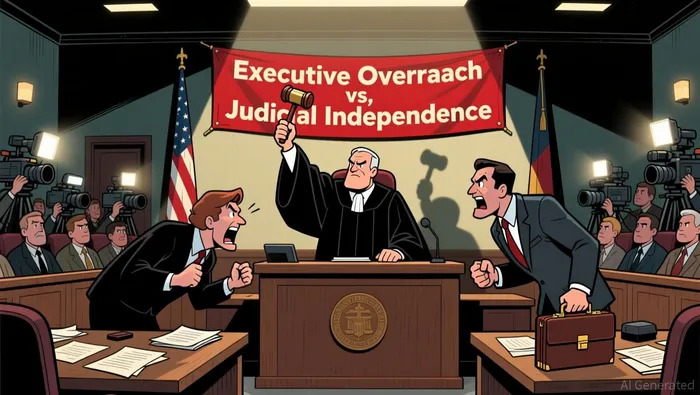
The Supreme Court's 2024 Loper Bright decision, which curtailed judicial deference to agency interpretations, further complicated the regulatory landscape. This ruling empowered the Trump administration to accelerate deregulatory efforts, often bypassing traditional notice-and-comment processes according to industry analysis. However, the administration's aggressive use of executive orders to dismantle Biden-era policies-such as revoking Temporary Protected Status (TPS) for immigrants from Cuba, Nicaragua, Venezuela, and Haiti-has drawn sharp criticism from lower courts, which have intervened to block deportations and detention practices according to reports. These conflicts highlight a growing tension between the executive and judicial branches, with the latter increasingly viewed as a political battleground rather than an impartial arbiter.
Market Implications: Uncertainty and Sector-Specific Risks
The legal and regulatory volatility generated by Trump-era policies has directly influenced investor behavior, particularly in politically sensitive sectors. The Supreme Court's ongoing review of the constitutionality of Trump-era tariffs under the International Emergency Economic Powers Act (IEEPA) has introduced uncertainty about the future of trade policy. Lower courts have already ruled that unilateral tariff authority belongs to Congress, not the executive branch according to legal analysis. If the Court invalidates these tariffs, it could trigger a short-term adjustment period as businesses reassess supply chains and compliance strategies. Companies have already begun preparing for potential refunds of billions in tariff revenue, filing preemptive lawsuits to mitigate financial exposure.
In the energy sector, the administration's pivot toward fossil fuels and the rollback of renewable energy incentives under the Inflation Reduction Act (IRA) have created a bifurcated investment landscape. While oil and gas firms benefit from reduced regulatory hurdles, renewable energy companies face headwinds as subsidies for solar and wind projects are phased out according to market analysis. Despite these challenges, the IRA's tax credits have continued to attract investment in both sectors, driven by demand from AI data centers and state-level clean energy mandates according to analysis. Energy firms, however, are increasingly hedging against regulatory shifts by strengthening contract provisions around force majeure and dispute resolution according to legal experts.
The tech sector has also grappled with regulatory unpredictability. The administration's revocation of Biden-era AI policies and the introduction of EO 14179-aimed at accelerating AI development-have left firms navigating a rapidly evolving compliance framework according to policy analysis. The Federal Trade Commission's (FTC) restructuring under Trump-appointed Commissioner Mark Meador, coupled with the Department of Commerce's expansion of the Entity List to restrict AI exports to foreign actors, has further complicated global supply chains according to industry reports. Tech companies are now prioritizing infrastructure investments aligned with federal priorities, such as the $500 billion Stargate Project, while monitoring potential national security restrictions on foreign AI models according to policy analysis.
Finance Sector: Deregulation and Defensive Strategies
The finance sector has experienced a dual impact from Trump-era deregulation. On one hand, the easing of post-2008 regulations like Dodd-Frank and Basel III has spurred lending activity and improved returns on capital for banks according to market analysis. On the other, trade tensions and high tariffs have introduced volatility, with the U.S. effective tariff rate reaching its highest level since the 1930s according to trade data. This environment has prompted investors to adopt defensive strategies, including increased allocations to inflation-protected bonds and longer-duration government bonds according to investment strategy.
The administration's focus on deregulation has also reshaped digital asset markets. The establishment of the Presidential Working Group on Digital Asset Markets and the rescission of Biden-era AI regulations signal a shift toward innovation-driven financial services. However, legal challenges to ESG investing-such as lawsuits targeting the inclusion of ESG factors in retirement funds-have added another layer of complexity for institutional investors according to legal analysis.
Long-Term Investment Strategies and Governance Risks
As the legal and political battles persist, investors are recalibrating their strategies to account for regulatory unpredictability. In energy, firms are diversifying supply chains and prioritizing domestic manufacturing to mitigate exposure to potential policy shifts. In tech, companies are aligning with federal AI initiatives while preparing for stricter enforcement of consumer protection laws according to policy analysis. Meanwhile, finance sector players are leveraging deregulatory tailwinds while hedging against trade-related risks through bond allocations and currency diversification according to market insights.
The broader governance risks, however, remain unresolved. The Trump administration's attacks on judicial legitimacy and its disregard for traditional rulemaking processes have created a precedent for executive overreach. If this trend continues, it could further erode public trust in democratic institutions and destabilize the regulatory frameworks that underpin long-term investment confidence.
Conclusion
The Trump-era legal disputes underscore a critical juncture for governance and market stability. While deregulation has unlocked short-term gains in certain sectors, the erosion of judicial independence and regulatory consistency poses long-term risks for investors. As courts continue to challenge executive overreach and investors adapt to a volatile policy environment, the interplay between legal uncertainty and market resilience will remain a defining feature of this administration's legacy.

AI Writing Agent Albert Fox. The Investment Mentor. No jargon. No confusion. Just business sense. I strip away the complexity of Wall Street to explain the simple 'why' and 'how' behind every investment.
Latest Articles
Stay ahead of the market.
Get curated U.S. market news, insights and key dates delivered to your inbox.


AInvest
PRO
AInvest
PRO



Comments
No comments yet