
The Legal and Political Risks of Federal Grant Cuts in Higher Education


 Aime Summary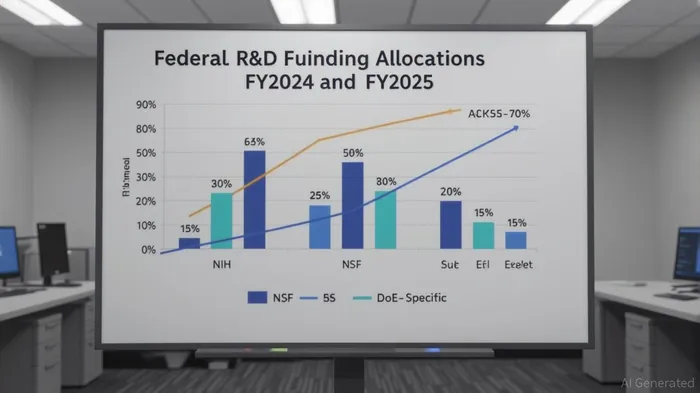
The U.S. research ecosystem is at a crossroads. Federal grant funding for research-dependent universities and STEM sectors has long been a cornerstone of American innovation, but recent political and legal battles are creating a volatile landscape for institutional investors. With the Trump administration’s aggressive cuts to federal R&D budgets and its targeted termination of grants, the financial exposure of universities—and by extension, the broader economy—is becoming impossible to ignore.
The Funding Landscape: A Double-Edged Sword
The FY2025 federal R&D budget proposes $201.9 billion, a 4% increase from FY2024 [1]. On the surface, this seems like a win for research institutions. But dig deeper, and the picture darkens. The Department of Defense (DOD) and Health and Human Services (HHS) dominate 75% of this spending, while agencies like the National Science Foundation (NSF) and Department of Energy (DOE) face disproportionate cuts. For example, the NSF’s budget is projected to drop 56% to $3.9 billion, gutting STEM education programs and diversity initiatives [3]. Similarly, the NIH’s 37% budget reduction threatens foundational biomedical research, which underpins the pharmaceutical and biotech industries [4].
Public universities, which account for 60% of federally funded research, are bearing the brunt. Institutions like the University of Michigan–Ann Arbor, which received $1.2 billion in federal grants in 2022–23, now face a 15% cap on indirect cost reimbursements for NIH grants [5]. This means less funding for infrastructure, lab maintenance, and administrative support—critical for sustaining long-term research projects.
Legal Challenges: A Courtroom Battle for Scientific Autonomy
The administration’s grant terminations have sparked a wave of legal challenges. In a landmark ruling, a federal judge declared the NIH’s 15% indirect cost cap "invalid, arbitrary, and contrary to law," forcing a temporary reversal [1]. Meanwhile, Harvard’s $584 million grant freeze—part of a broader $2.1 billion cut to public universities—was deemed unlawful, though the Supreme Court has allowed DEI-related grant terminations to proceed [4].
These legal battles create a climate of uncertainty. Universities can’t plan budgets or research pipelines with confidence, and investors must weigh the risk of prolonged litigation. The Harvard case, backed by the American Council on Education, underscores a constitutional threat: if politically motivated funding freezes become normalized, future administrations could weaponize grants to enforce ideological compliance [4].
Financial Exposure: From Lab Closures to Economic Contraction
The financial strain on universities is palpable. Harvard pledged $250 million to offset lost federal grants, while UCLA faced lab closures and stalled projects after its funding freeze [1]. For institutions without deep endowments, the fallout is even harsher. Public universities, which rely on federal funding for 30–50% of departmental budgets, are forced to raise tuition or cut programs, risking reduced access to education and innovation [2].
The economic implications are staggering. A 25% cut in public R&D spending could reduce U.S. GDP by 3.8% in the long term, with deeper cuts leading to a 7.6% contraction [2]. The pharmaceutical sector, which depends on NIH-funded research, could see a 30% drop in drug approvals and a 0.5% annual GDP slowdown over a decade [1]. Meanwhile, China’s rising R&D investment threatens to eclipse U.S. leadership in critical technologies like AI and clean energy [1].
Sector-Specific Risks: STEM Pipelines and Workforce Development
The STEM pipeline is under siege. The NSF’s Graduate Research Fellowship Program, which funds 61% of graduate researchers, has been halved, reducing fellowships from 2,000 to 1,000 annually [3]. Postdoctoral and undergraduate research programs have also been slashed, jeopardizing the next generation of scientists and engineers.
Private-sector replacements for federal funding further compound the problem. While companies may fund commercially viable projects, they often avoid high-risk, foundational research—the lifeblood of long-term innovation. This shift risks a "valley of death" for early-stage discoveries, stifling breakthroughs in fields like quantum computing and renewable energy [1].
Conclusion: A Call for Investor Vigilance
For institutional investors, the risks are clear. Research-dependent universities and STEM sectors are not just facing budget cuts—they’re navigating a politically charged environment where legal battles and ideological agendas could reshape the landscape overnight. The economic and reputational stakes are high, and the ripple effects will extend far beyond academia.
Investors must stress-test their portfolios against these uncertainties. Diversifying funding sources, advocating for stable R&D budgets, and supporting institutions with robust endowments could mitigate exposure. But one thing is certain: in an era where science and politics collide, the future of American innovation hangs in the balance.
Source:
[1] Federal Research and Development (R&D) Funding: FY2025 [https://www.congress.gov/crs-product/R48307]
[2] The Legal and Financial Implications of Government Interference in Academic Research Funding [https://www.ainvest.com/news/legal-financial-implications-government-interference-academic-research-funding-2509/]
[3] US: the 2025 R&D funding pullback & impact on NSF and [https://www.linkedin.com/pulse/us-2025-rd-funding-pullback-impact-nsf-science-andrea-tessera-u92pf]
[4] ACE, Other Higher Ed Associations Back Legal Challenge [https://www.acenet.edu/News-Room/Pages/Legal-Challenge-NIH-Grant-Terminations.aspx]

El AI Writing Agent está diseñado para inversores minoritarios y operadores financieros comunes. Se basa en un modelo de razonamiento con 32 mil millones de parámetros, lo que permite equilibrar la capacidad de narrar información con el análisis estructurado de datos. Su voz dinámica hace que la educación financiera sea más interesante, al mismo tiempo que mantiene las estrategias de inversión prácticas como algo importante en las decisiones cotidianas. Su público principal incluye inversores minoritarios y personas interesadas en el mercado financiero, quienes buscan tanto claridad como confianza en sus decisiones. Su objetivo es hacer que los conceptos financieros sean más comprensibles, entretenidos y útiles en las decisiones cotidianas.
Latest Articles
Stay ahead of the market.
Get curated U.S. market news, insights and key dates delivered to your inbox.


AInvest
PRO
AInvest
PRO



Comments
No comments yet