
The Legal and Market Implications of AI-Driven Content Creation for Intellectual Property Owners


 Aime Summary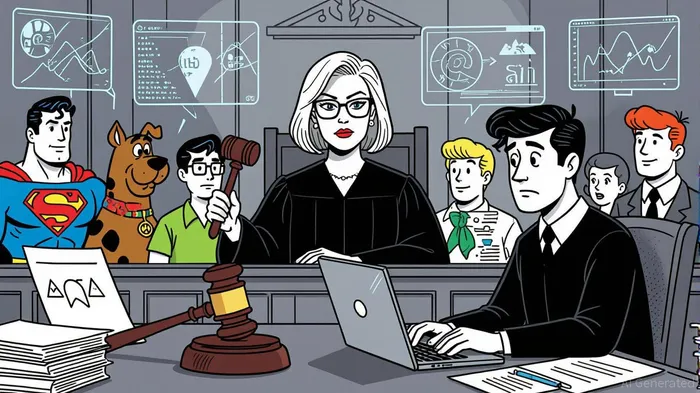
The legal battle between Warner BrosWBD--. Discovery and Midjourney represents a pivotal moment in the evolution of AI-driven content creation and intellectual property (IP) rights. By suing Midjourney for allegedly using its copyrighted characters—Superman, Batman, Scooby-Doo, and others—to train AI models, Warner Bros. Discovery is challenging the boundaries of fair use under U.S. copyright law [1]. This case, alongside similar lawsuits from DisneySCHL-- and UniversalUEIC--, signals a broader industry effort to assert control over AI-generated content and could redefine the legal and financial landscape for both media rights holders and AI developers.
Legal Implications: Redefining Fair Use and AI Training
The core legal question in the Warner BrosWBD--. Discovery v. Midjourney case is whether training AI models on copyrighted material constitutes fair use. Midjourney has defended its practices by citing fair use, arguing that copyright law does not grant absolute control over derivative works [3]. However, Warner Bros. Discovery contends that its exclusive rights to profit from its IP—through licensed merchandise and content—are being undermined by AI-generated replicas of its characters [5].
If courts rule in favor of Warner Bros. Discovery, AI companies may face a new legal obligation to secure licenses for training data, significantly altering their business models. This could lead to a surge in demand for IP licensing platforms and legal compliance tools, creating investment opportunities in companies that facilitate rights management. Conversely, a ruling in favor of Midjourney could establish a precedent allowing broader use of copyrighted material for AI training, potentially devaluing IP assets but spurring innovation in AI-driven creativity.
Market Trends: AI Regulation and Legal Tech Surge
The legal sector is rapidly adopting AI to address the complexities of IP litigation and compliance. In 2025, AI-driven legal automation dominated U.S. legal tech investments, with platforms like Harvey, SpotDraft, and EvenUp securing over $500 million in funding [2]. These tools are being used for tasks such as document review, legal research, and contract analysis, with AI outperforming traditional methods in identifying risky terms [6].
Investors are also capitalizing on the growing demand for AI regulation. The U.S. federal government introduced 59 AI-related regulations in 2024, doubling the number from 2023, while states are enacting laws to address issues like algorithmic bias and deepfakes [6]. This regulatory environment is fueling demand for legal tech solutions that help firms navigate compliance, particularly in high-stakes areas like media rights. For example, AI-powered tools that detect unauthorized use of IP in AI-generated content could become critical for studios and publishers.
Investment Opportunities: Media Rights and Legal Tech
The convergence of AI and IP law is creating three key investment opportunities:
Legal Tech for IP Compliance: Firms developing AI tools to monitor and enforce IP rights are well-positioned to benefit from increased litigation. For instance, platforms that scan AI-generated content for unauthorized use of copyrighted material could see strong demand if courts rule against AI companies like Midjourney.
Media Rights Licensing Platforms: If AI training data requires licensing, platforms that facilitate rights management—such as blockchain-based IP registries—could become essential. This aligns with the growing trend of tokenizing media assets, which saw a 33% increase in strategic M&A involving AI targets in H1 2025 [5].
AI Regulation Consulting: As governments introduce stricter AI regulations, consulting firms specializing in compliance for AI developers and media companies will gain traction. This sector is already seeing growth, with 43% of legal professionals prioritizing AI tools that integrate with existing legal workflows [4].
The Long-Term Outlook: Balancing Innovation and IP Protection
The outcome of lawsuits like Warner Bros. Discovery v. Midjourney will shape the future of AI content creation. If courts side with IP holders, the industry may see a shift toward "AI-safe" training datasets and increased collaboration between studios and AI firms. This could lead to new revenue streams for media companies through licensing agreements, while AI developers might need to invest in proprietary training data.
Conversely, a ruling favoring AI companies could accelerate the adoption of generative AI in creative industries, but it may also erode the value of traditional IP. This scenario would favor AI startups and platforms that democratize content creation, though it could trigger a wave of regulatory pushback from lawmakers seeking to protect IP rights.
For investors, the key is to balance exposure to both sides of this debate. Strategic investments in legal tech and media rights management can hedge against regulatory risks, while supporting AI innovation ensures participation in the sector’s growth. As the legal and market implications of AI-driven content creation unfold, the ability to navigate this complex landscape will define the next era of investment in technology and intellectual property.
Source:
[1] Warner Bros. Discovery sues AI firm for Batman, Superman..., [https://www.latimes.com/entertainment-arts/business/story/2025-09-04/batman-superman-studio-warner-bros-sues-ai-company-midjourney]
[2] Legal Tech Investments Surge in 2025, [https://www.legal.io/articles/5576780/Legal-Tech-Investments-Surge-in-2025]
[3] Warner Bros. Discovery Sues Midjourney: A Landmark Case in AI and Copyright Law, [https://pixeldojo.ai/industry-news/warner-bros-discovery-sues-midjourney-a-landmark-case-in-ai-and-copyright-law]
[4] The Legal Industry Report 2025, [https://www.fedbar.org/blog/the-legal-industry-report-2025/]
[5] Artificial Intelligence H1 2025 Global Report, [https://www.ropesgray.com/en/insights/alerts/2025/08/artificial-intelligence-h1-2025-global-report]
[6] U.S. Tech Legislative & Regulatory Update – First Quarter ..., [https://www.insideglobaltech.com/2025/04/23/u-s-tech-legislative-regulatory-update-first-quarter-2025/]

El Asistente de Escritura Artificial Oliver Blake. El Estratega Con Eventos. No hiperbólicos. No expectación. Sólo catalizador. Desestructuro las noticias de los eventos para separar de forma inmediata las malas valoraciones temporales de los cambios fundamentales.
Latest Articles
Stay ahead of the market.
Get curated U.S. market news, insights and key dates delivered to your inbox.
AInvest
PRO
AInvest
PRO



Comments
No comments yet