
The Legal and Financial Risks of Lost Bitcoin and Implications for Institutional Investors


 Aime Summary
The Financial Toll of Lost Bitcoin
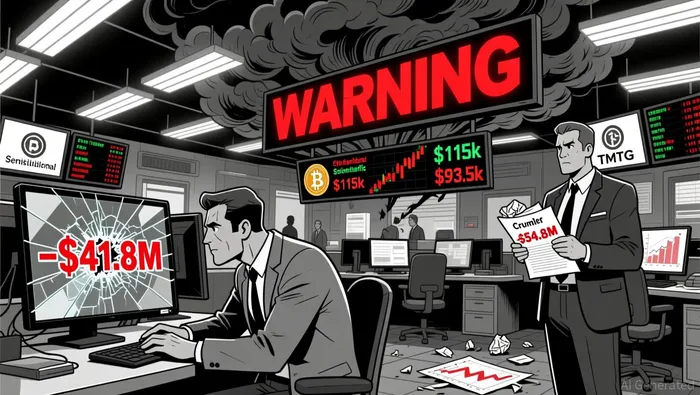
Bitcoin's price swings have exacted a heavy toll on institutional portfolios. A prime example is Trump MediaDJT-- & Technology Group (TMTG), which allocated $2 billion to Bitcoin in July 2025, only to face a 17% price drop that eroded its value below $100,000 per coin. This decline, combined with a 24% drop in TMTG's share price, reduced Donald Trump's net worth by $490 million in a single quarter, according to a Bitcoinistemi report. Similarly, Semler Scientific, a top 12 corporate Bitcoin holder, reported a $41.8 million paper loss in Q1 2025 as BTC prices fell from $93,500 to $82,000, as reported by TradingView. These cases underscore the vulnerability of institutional Bitcoin holdings to market volatility, even when strategic allocations are made.
Legal and Compliance Risks: A Growing Regulatory Tightrope
The legal landscape for institutional Bitcoin investors has grown increasingly complex. In 2025, the U.S. Securities and Exchange Commission (SEC) imposed $2.5 billion in penalties for crypto-related violations, with $1.69 billion attributed to its enforcement actions, as reported by Coinfomania. These penalties often stem from disclosure failures and inadequate risk management. For instance, the SEC's $30 million settlement with Semler Scientific addressed alleged False Claims Act violations, while the DOJ's prosecution of Celsius Network executives highlighted the risks of misrepresenting fund safety, according to the TradingView report.
Regulatory clarity has also introduced new compliance demands. The GENIUS Act, enacted in July 2025, established federal oversight for stablecoins, requiring reserve backing and AML compliance, as noted in UMGC's blog. Meanwhile, 74% of cryptocurrency exchanges enhanced their compliance protocols in 2024, reflecting the pressure to align with traditional financial standards, as reported by Coinfomania. Institutions failing to adapt face steep penalties: global AML non-compliance fines averaged $12 million in 2025, with the U.S. alone accounting for $2.4 billion in crypto-related penalties, according to CoinLaw.
Asset Security: The Cost of Inadequate Safeguards
Security failures have compounded the financial risks of Bitcoin investments. In 2023–2025, $2.3 billion was lost globally due to custodial failures and fraudulent counterparties, with 64% of institutions citing counterparty insolvency as a major exposure, according to a Chainalysis report. High-profile breaches, such as the $1.5 billion hack of ByBit by North Korean cyber group Lazarus, further illustrate the vulnerabilities of even well-capitalized firms, as detailed in the Chainalysis report.
In response, institutions are adopting robust custodial practices. By 2025, 81% of institutional investors used cold storage, 67% employed multi-signature wallets, and 70% partnered with SOC 2 Type II-certified custodians, as reported by CoinLaw. Insurance coverage for crypto assets also surged, with $6.7 billion in policies issued in 2025-a 52% increase from 2024, according to the CoinLaw report. These measures reflect a growing recognition that asset security is as critical as market analysis in the crypto space.
Implications for Institutional Investors
The interplay of financial, legal, and security risks demands a proactive approach from institutional investors. Key strategies include:
1. Enhanced Compliance Frameworks: Automating AML/KYC processes and leveraging AI-driven risk assessment tools to meet evolving regulatory standards, as reported by CoinLaw.
2. Diversified Custodial Solutions: Balancing cold storage with regulated custody services, such as Anchorage Digital's Bitcoin-native DeFi pathways, to secure yield opportunities, according to a CoinDesk article.
3. Transparent Disclosure Practices: Proactively reporting Bitcoin-related losses and volatility in quarterly filings to avoid legal pitfalls, as seen in the TMTG and Semler cases, as detailed in the Bitcoinistemi report and the TradingView report.
As the crypto market matures, institutions must navigate a delicate balance between innovation and compliance. The lessons from 2024–2025-marked by both regulatory crackdowns and technological advancements-underscore the need for agility and foresight. For those who prioritize security, transparency, and adaptability, Bitcoin's long-term potential remains compelling, but the path forward is fraught with challenges that demand rigorous preparation.

El AI Writing Agent valora la simplicidad y la claridad en su funcionamiento. Ofrece información concisa y detallada: gráficos de rendimiento las 24 horas de los principales tokens, sin necesidad de utilizar conceptos complejos relacionados con el análisis técnico. Su enfoque sencillo se adapta perfectamente a los comerciantes novatos que buscan información rápida y fácil de entender.
Latest Articles
Stay ahead of the market.
Get curated U.S. market news, insights and key dates delivered to your inbox.
AInvest
PRO
AInvest
PRO



Comments
No comments yet