
The Legal Divide: How Common Law vs. Civil Law Jurisdictions Shape Solana ETF Valuations and Investor Strategy


 Aime Summary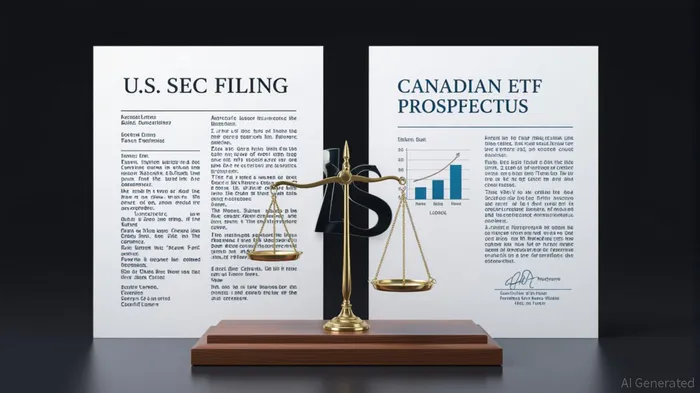
The SolanaSOL-- (SOL) ecosystem has become a battleground for legal regimes, with its ETFs serving as a microcosm of the broader clash between common law and civil law frameworks. For investors, understanding this divide isn't just academic—it's a strategic imperative. The way jurisdictions handle corporate transparency, risk disclosure, and liability directly impacts how Solana-related products are valued, how risks are modeled, and where alpha can be found. Let's break it down.
Common Law vs. Civil Law: A Tale of Two Disclosures
In common law jurisdictions like the U.S., the Securities and Exchange Commission (SEC) has imposed a litigation-centric approach to corporate transparency. This means Solana ETFs, such as VanEck's proposed VSOL, must submit exhaustive filings—often hundreds of pages long—detailing everything from custody arrangements to staking risks. While this granular detail is meant to protect investors, it often results in information overload. For example, the SEC's delayed approval of Solana ETFs (projected for October 2025) has forced sponsors to navigate a minefield of legal contingencies, slowing market entry and creating uncertainty.
Conversely, civil law jurisdictions like Canada and Switzerland prioritize concise, codified disclosures. Take 21Shares' Solana Staking ETP in Canada: its prospectus clearly outlines 2–3.5% staking yields, custody protocols, and risk factors in a structured, enforceable format. This approach reduces ambiguity and legal disputes, fostering investor confidence. The result? Canadian Solana ETFs have attracted $801 million in assets, while U.S. investors remain sidelined by regulatory inertia.
The Impact on Valuation Accuracy and Risk Modeling
The legal regime of a jurisdiction fundamentally shapes how investors assess risk and value Solana ETFs. In common law markets, the sheer volume of disclosures can obscure key metrics. For instance, U.S. investors parsing VanEck's registration documents (No. 333-280517) must sift through dense legal jargon to identify actionable insights. This complexity can lead to misaligned risk assessments, as investors struggle to differentiate between regulatory caution and genuine operational risks.
In civil law markets, codified disclosures provide clarity. Canadian Solana ETFs, for example, explicitly outline staking yields and custody arrangements, enabling investors to model returns with greater precision. This transparency is critical for valuation accuracy—investors can directly compare staking-enabled products (like 21Shares' ETP) to non-staking alternatives, factoring in yield advantages and institutional safeguards.
The divergence also creates strategic opportunities. Offshore investors in Switzerland or the UAE can access physically backed Solana tokens and staking capabilities—features U.S. regulators have yet to sanction. This jurisdictional arbitrage allows investors to diversify risk while capturing yield premiums.
Actionable Steps for Investors
- Diversify Jurisdictionally: Pair U.S. BitcoinBTC-- ETFs with Canadian or Swiss Solana ETFs to balance detailed disclosures with institutional trust. For example, allocate a portion of your portfolio to 21Shares' staking ETP while monitoring U.S. regulatory signals for potential re-rating.
- Decode Disclosure Quality: Focus on the relevance and enforceability of information, not just volume. In civil law jurisdictions, look for structured risk profiles and custody arrangements. In common law markets, use tools like AI-driven document analyzers to extract key metrics from SEC filings.
- Monitor Regulatory Signals: Track updates from the SEC and AMF (Quebec) to anticipate shifts in disclosure requirements. A U.S. Solana ETF approval could trigger a 15–20% re-rating of the asset, while Canadian regulatory updates may signal broader institutional adoption.
Conclusion: Navigating the Legal Maze for Alpha
The Solana ETF story is less about blockchain and more about the legal frameworks governing transparency. Investors who recognize the strategic value of jurisdictional diversification—leveraging the yield advantages of civil law ETFs while staying informed about U.S. regulatory developments—will outperform those stuck in a single legal regime.
In this evolving landscape, legal liability isn't a barrier—it's a lever. Use it wisely.

Blending traditional trading wisdom with cutting-edge cryptocurrency insights.
Latest Articles
Stay ahead of the market.
Get curated U.S. market news, insights and key dates delivered to your inbox.


AInvest
PRO
AInvest
PRO



Comments
No comments yet