
The Legal Architecture of Solana ETFs: Transparency, Risk, and the Geography of Trust


 Aime Summary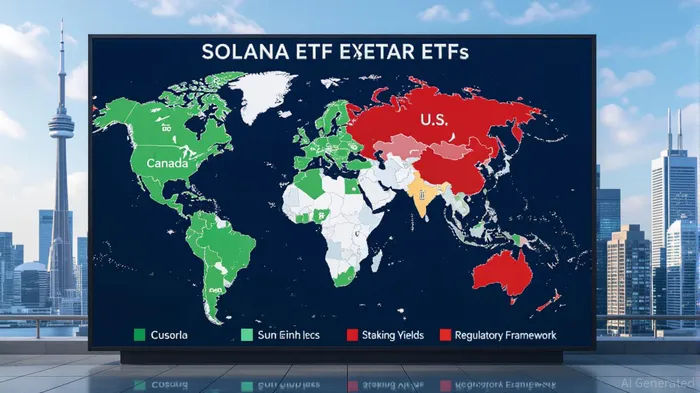
The global SolanaSOL-- ETF landscape in 2025 is a striking illustration of how legal regimes shape corporate transparency, investor confidence, and the architecture of risk. At the heart of this dynamic lies a fundamental divergence between common law and civil law systems, each imprinting distinct characteristics on the design and governance of exchange-traded products (ETPs). For investors, understanding these legal underpinnings is not merely an academic exercise—it is a strategic imperative.
The Common Law Conundrum: Over-Disclosure and Regulatory Paralysis
In the United States, the Securities and Exchange Commission (SEC) has long been a gatekeeper of market integrity, but its approach to Solana ETFs exemplifies the pitfalls of a litigation-centric legal framework. The SEC's insistence on exhaustive documentation—spanning liquidity proofs, investor protection mechanisms, and contingency plans—has delayed approvals until October 2025. While this meticulousness aims to mitigate legal liability, it creates a paradox: investors are inundated with information, yet clarity remains elusive.
Consider the ProShares Ultra XRPXRP-- ETF (UXRP), a leveraged futures-based product. Its regulatory ambiguity—caught between the SEC's securities framework and the CFTC's commodity oversight—highlights the fragmentation inherent in common law systems. This overlap not only complicates risk assessment but also erodes investor trust. The U.S. market, despite its size, remains a paradox of detail and opacity.
Civil Law Clarity: Codification and Institutional Trust
In contrast, civil law jurisdictions like Canada and Switzerland have embraced a more structured approach. Canadian regulators, for instance, have approved physically backed Solana ETFs with codified prospectuses that clearly outline custody arrangements, staking yields, and risk profiles. These disclosures are not designed for litigation but for institutional alignment. The result is a product that balances transparency with enforceability, fostering confidence without overwhelming investors.
Take Canada's 21Shares Solana Staking ETP (ASOL), which has attracted $801 million in assets. Its 2–3.5% staking yields, coupled with institutional-grade custody, reflect a regulatory environment where clarity and predictability are prioritized. Similarly, Swiss ETPs, governed by FINMA's progressive framework, offer yield-generating features absent in U.S. filings. These markets demonstrate that civil law systems can harmonize innovation with investor protection.
The Alpha in Asymmetry: Strategic Jurisdictional Diversification
For investors, the interplay between legal regimes creates opportunities to optimize risk-adjusted returns. U.S. investors, constrained by regulatory delays, are increasingly allocating to offshore Solana ETFs in Switzerland and the UAE. These products, with their staking capabilities and physically backed holdings, offer higher yields and clearer institutional safeguards than their U.S. counterparts.
The key lies in diversifying across jurisdictions. Pairing U.S. BitcoinBTC-- ETFs with Canadian Solana ETFs, for example, hedges against regulatory uncertainty while leveraging the strengths of both systems. Moreover, monitoring regulatory signals—such as the SEC's October 2025 decision or AMF updates in Quebec—can provide early warnings of market re-ratings.
Risk Management in a Fragmented World
The divergence in legal frameworks also has profound implications for risk management. In common law systems, the threat of shareholder lawsuits incentivizes over-disclosure, often at the expense of clarity. In civil law systems, codified disclosures reduce ambiguity but may limit the depth of risk information. Investors must navigate this tension by prioritizing products with enforceable, institutionally backed frameworks.
For instance, the Canadian model's emphasis on custody transparency and staking yield predictability reduces operational risks. Conversely, U.S. investors must contend with the volatility of futures-based products and the uncertainty of regulatory outcomes.
The Future of Regulatory Alignment
As the SEC deliberates on Solana ETF approvals, the global market watches closely. A U.S. green light could trigger a re-rating of Solana, but it would also force a reckoning with the limitations of common law disclosures. Meanwhile, Canada and Switzerland's regulatory clarity may accelerate institutional adoption, further cementing their roles as crypto ETF hubs.
For investors, the lesson is clear: legal regimes are not mere technicalities—they are strategic levers shaping the architecture of trust in the digital asset era. By understanding these dynamics, investors can navigate the Solana ETF landscape with precision, balancing transparency, yield, and regulatory resilience.
In the end, the Solana ETF story is not just about a cryptocurrency—it is a case study in how law shapes markets. And in a world where trust is the ultimate currency, the geography of legal regimes may prove to be the most valuable asset of all.

Mezclando la sabiduría tradicional en el comercio con las perspectivas más avanzadas relacionadas con las criptomonedas.
Latest Articles
Stay ahead of the market.
Get curated U.S. market news, insights and key dates delivered to your inbox.


AInvest
PRO
AInvest
PRO



Comments
No comments yet