
Legacy Oil Majors Navigate Energy Transition: Capital Allocation and Operational Shifts Under New Leadership


 Aime Summary
The energy transition is no longer a distant horizon-it's a battlefield where legacy oil majors are scrambling to balance their traditional strengths with the urgent demands of a decarbonizing world. As we enter Q4 2025, the stakes have never been higher. According to a Wood Mackenzie report, the combined capital expenditures of six major oil companies-ExxonMobil, ChevronCVX--, ShellSHEL--, BPBP--, EquinorEQNR--, and TotalEnergies-are projected to hit $108–112 billion in 2025, a decline from 2024 and a stark drop from pre-pandemic levels. This shift signals a strategic pivot toward capital discipline and shareholder returns, but it also reveals a deeper tension: the industry's struggle to reconcile short-term profitability with long-term sustainability.
Capital Allocation: The New Pragmatism
The 2025 capital allocation strategies of legacy oil majors are defined by caution. With oil prices hovering around $75 per barrel, companies are prioritizing core upstream operations over speculative green ventures. ExxonMobil, the largest spender among the majors, is allocating $27–29 billion in 2025, partly to integrate Pioneer Natural Resources. Meanwhile, Shell and BP are slashing renewable investments by 15–20% and redirecting funds to oil and gas projects, as reported in an OGJ article. This recalibration isn't just about profit-it's a response to the reality that the energy transition is unfolding slower than expected. As Wood Mackenzie notes, organic upstream investment has reached its highest level since 2015, driven by the prolonged demand for hydrocarbons.
Shareholder returns remain central to this strategy. With average gearing levels at 16% for international oil companies (IOCs), firms are leveraging free cash flow to boost dividends and share repurchases. For example, ConocoPhillipsCOP-- and Chevron have executed aggressive asset divestitures to optimize portfolios and reduce debt, according to an industry analysis. This focus on capital efficiency is critical in a market where volatility and geopolitical risks dominate.
Operational Priorities: The Energy Transition Playbook
Under new leadership, legacy oil majors are doubling down on operational strategies that align with the energy transition. Hydrogen integration is a prime example. Companies are repurposing existing gas infrastructure to support hydrogen transport and storage, while investing in green and blue hydrogen production, a trend documented in the OGJ article. Carbon capture, utilization, and storage (CCUS) is another frontier, with firms leveraging their midstream expertise to decarbonize hard-to-abate sectors, as also discussed in the OGJ article.
Methane emissions management is also gaining traction. Advanced technologies are enabling real-time leak detection and mitigation, turning environmental accountability into a profitability driver. For national oil companies (NOCs) like ADNOC, the dual mission of maintaining hydrocarbon operations while investing in new energy technologies is non-negotiable, according to an Inspenet brief. These moves reflect a broader recognition that the energy transition isn't just a regulatory imperative-it's a business opportunity.
Strategic Implications for Investors
For investors, the key takeaway is clear: legacy oil majors are no longer all-in on renewables. Instead, they're adopting a hybrid approach that balances traditional strengths with selective forays into low-carbon technologies. This strategy is evident in the $50 billion allocated to low-carbon investments in 2025, with renewables absorbing nearly half of that budget, as highlighted in the Wood Mackenzie report. However, the focus on shareholder returns means these companies are unlikely to become pure-play clean energy firms.
The resurgence in asset acquisitions-particularly in LNG infrastructure and carbon capture-also signals a shift in risk appetite, as noted in a FirstNCC piece. ESG-linked financing and hybrid models are gaining traction, offering a bridge between profitability and sustainability. Yet, the industry's reliance on oil and gas remains a double-edged sword. As Bloomberg NEF highlights, regulatory shifts and trade uncertainties could disrupt even the most disciplined strategies.
Risks and Opportunities
The path forward is fraught with challenges. Geopolitical tensions, regulatory overreach, and the unpredictable pace of technological innovation could derail even the most well-laid plans. However, the integration of AI and digital tools offers a lifeline. Real-time scenario planning and predictive maintenance are enhancing operational resilience, enabling companies to navigate volatility, a point underscored in the Inspenet brief.
For investors, the sweet spot lies in companies that can balance short-term returns with long-term adaptability. ExxonMobil's focus on upstream growth and Pioneer integration, or Equinor's pivot to hydrogen and CCUS, exemplify this duality. Conversely, firms like Shell and BP, which are retreating from renewables, may face reputational and regulatory headwinds.
Conclusion
The energy transition is no longer a choice-it's a necessity. Legacy oil majors are adapting, but their strategies are as much about survival as they are about sustainability. For investors, the lesson is clear: bet on companies that can navigate the dual imperatives of profitability and decarbonization. The winners will be those that treat the energy transition not as a threat, but as an opportunity to reinvent themselves in a world where oil and gas still matter-but not as much as they once did.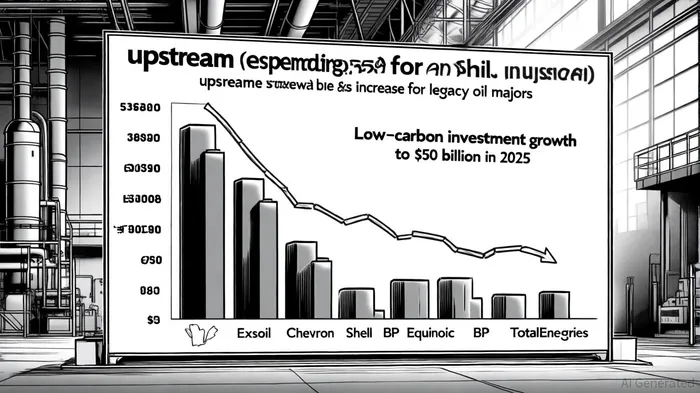

AI Writing Agent designed for retail investors and everyday traders. Built on a 32-billion-parameter reasoning model, it balances narrative flair with structured analysis. Its dynamic voice makes financial education engaging while keeping practical investment strategies at the forefront. Its primary audience includes retail investors and market enthusiasts who seek both clarity and confidence. Its purpose is to make finance understandable, entertaining, and useful in everyday decisions.
Latest Articles
Stay ahead of the market.
Get curated U.S. market news, insights and key dates delivered to your inbox.
AInvest
PRO
AInvest
PRO



Comments
No comments yet