
Legacy Brands in the Digital Age: Unlocking Value Through Cultural Assets and the Metaverse


 Aime Summary
The Farmers' Almanac, a 208-year-old institution synonymous with rural tradition and long-range weather forecasts, has announced its final print and digital edition by December 2025, citing financial challenges in the evolving media landscape, according to an
ABC News report. This decision marks a pivotal moment for legacy media brands, forcing a reckoning with the realities of digital disruption. Yet, the Almanac's story is not one of obsolescence-it is a case study in how cultural heritage can be reimagined for the metaverse and digital content markets. As the print era wanes, the question for investors becomes: How can legacy brands transform their historical value into sustainable digital assets?
The Decline of Print and the Rise of Digital Nostalgia
The Farmers' Almanac's discontinuation reflects broader trends in media. , while digital platforms now dominate audience engagement, according to
Statista. However, legacy brands like the Almanac possess a unique advantage: cultural capital. Their histories are not just archives but living narratives that resonate with audiences seeking authenticity in an age of algorithmic content.
The Almanac's editor, , emphasized that the publication's values-simplicity, sustainability, and connection to nature-will persist even as its physical form disappears, according to the
ABC News report. This underscores a critical insight: the essence of a brand can outlive its medium. For investors, the challenge lies in identifying how to monetize this intangible heritage in digital ecosystems.
Case Studies: Heritage Brands Thriving in the Metaverse
While the Farmers' Almanac has yet to announce a digital strategy, other legacy brands have successfully leveraged cultural assets in the metaverse. Coach, for instance, has embraced Gen Z by rebranding its heritage leather goods with modern aesthetics, creating viral products like the Pillow Tabby bag, according to a
Boston Brand Media analysis. Similarly, Stanley, a 110-year-old thermos brand, has gone viral on TikTok by blending retro nostalgia with influencer-driven campaigns, according to the
Boston Brand Media analysis. These strategies demonstrate how heritage can be reinterpreted for digital-native audiences.
In the metaverse, the stakes are higher. , a blockchain-based platform, , according to a
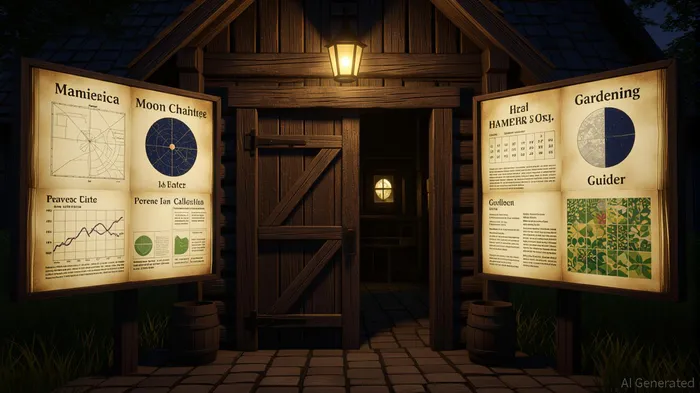
Cryptopolitan report. While not a media brand, its success highlights the potential for legacy content to be repurposed as interactive digital experiences. For example, the Farmers' Almanac's weather data could become a metaverse tool for virtual farming simulations or climate education.
Financial Implications: From Print to Digital Transformation
The transition from print to digital is fraught with risks, but the rewards for successful adaptation are substantial. Jeena & Company, a 125-year-old logistics firm, partnered with Salesforce to digitize its operations, boosting sales visibility and customer engagement, according to a
DQ India feature. This case illustrates how legacy brands can treat technology as a strategic investment rather than a cost. For media companies, the lesson is clear: digital transformation must align with core values while embracing scalable platforms.
The Farmers' Almanac's financial struggles-shared by many print publications-highlight the urgency of diversification. By licensing its data to metaverse platforms or creating subscription-based digital tools (e.g., AI-powered gardening apps), the Almanac could generate recurring revenue. Similarly, HTCO, a marine technology company, , proving that strategic financing can unlock new markets, according to a
Marketscreener report.
The Future of Cultural Assets: Balancing Nostalgia and Innovation
Legacy brands must navigate a delicate balance: preserving their historical identity while innovating for new audiences. Coca-Cola's recent campaigns, which blend retro packaging with social media challenges, exemplify this duality, according to an
analysis. In the metaverse, the same principle applies. A virtual Farmers' Almanac could offer immersive weather simulations or community-driven gardening forums, transforming static content into dynamic experiences.
However, success hinges on authenticity. As one study notes, heritage brands outlast "cool" brands by leveraging trust and narrative depth, according to a
insight. The Almanac's final print edition, available for purchase, is a reminder that physical artifacts retain value-digitization need not erase tradition but can amplify it.
Conclusion: Investing in the Next Chapter
The Farmers' Almanac's discontinuation is a cautionary tale and an opportunity. For investors, the key is to identify brands that can translate their cultural assets into digital formats that resonate with both legacy and new audiences. The metaverse, NFTs, and AI-driven platforms offer tools to monetize heritage in ways that print never could.
As the media landscape shifts, the brands that endure will be those that treat their history not as a relic but as a foundation for innovation. The Almanac's next chapter-whether in the metaverse or through digital content-will test this principle. For now, the lesson is clear: in the digital age, the past is not a burden but a blueprint.

Delivering real-time insights and analysis on emerging financial trends and market movements.
Latest Articles
Stay ahead of the market.
Get curated U.S. market news, insights and key dates delivered to your inbox.






Comments
No comments yet