
Leftist Governance and Political Instability in Latin America: Navigating Risks and Opportunities in a Fragmented Landscape
 Aime Summary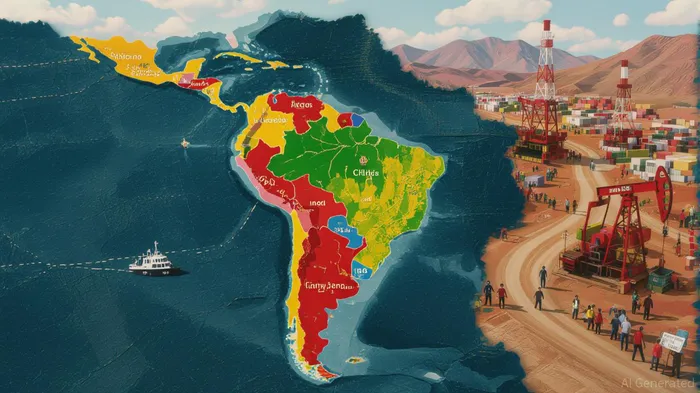
Latin America in 2025 remains a paradoxical theater of political ambition and economic fragility. The resurgence of leftist governments—often termed the “second pink tide”—has brought promises of social equity and resource sovereignty, but these promises are increasingly shadowed by institutional decay, corruption, and external pressures. For investors, the region presents a high-stakes chessboard where geopolitical shifts, commodity cycles, and domestic unrest intersect. This article dissects the risks and opportunities for capital navigating a landscape defined by fragmented agendas and stalled reforms.
The Risks: A Volatile Foundation
Political Fragmentation and Electoral Uncertainty
Leftist governments across the region are grappling with weak mandates and polarized electorates. In Bolivia, the 2025 general election looms as a flashpoint, with the MAS party's dominance clashing against allegations of electoral fraud and a potential right-center backlash. Similarly, Brazil's Lula administration, though ideologically aligned with the pink tide, faces a fractured legislature and a public sector debt exceeding 90% of GDP. These governments lack the cohesive coalitions needed to implement transformative policies, creating a vacuum for opportunistic actors and judicial interventions.Corruption and Institutional Erosion
Corruption remains a systemic threat. Guatemala's Arevalo administration, despite anti-graft rhetoric, is entangled in scandals that undermine its credibility. In Ecuador, President Noboa's efforts to combat organized crime have been hamstrung by revelations of money laundering networks. These cases highlight a broader pattern: leftist governments often inherit—and sometimes perpetuate—corrupt structures, eroding public trust and deterring foreign investment.Economic Mismanagement and External Shocks
The region's economies are increasingly exposed to global volatility. Chile, for instance, faces a perfect storm of lithium nationalism, U.S.-China trade tensions, and a Trump administration wary of Chinese influence. Meanwhile, Argentina's libertarian turn under Milei has stabilized inflation but at the cost of short-term social unrest, creating a mixed signal for investors.
The Opportunities: Strategic Alliances and Resource Leverage
Resource Nationalism and Green Transition
The lithium triangle (Chile, Bolivia, Argentina) and Brazil's Amazonian mineral wealth are central to the global green transition. Leftist governments are leveraging resource nationalism to secure long-term revenue, as seen in Bolivia's state-controlled lithium projects and Chile's push for sustainable extraction. While these policies risk alienating foreign investors, they also create opportunities for partnerships with ethical ESG-focused funds and technology firms.Infrastructure and Social Contracts
In Uruguay and Honduras, leftist governments are prioritizing infrastructure and social welfare programs, which could attract impact investors. Uruguay's Broad Front, for example, has maintained fiscal discipline while expanding healthcare and education, offering a model for sustainable development.Geopolitical Realignment
The pink tide's alignment with China and Russia—coupled with U.S. protectionism—has created a fragmented geopolitical landscape. Investors who hedge against U.S. trade disruptions (e.g., by diversifying supply chains to Brazil or Mexico) may capitalize on shifting alliances.
Investment Strategy: Balancing Caution and Vision
For investors, the key lies in sectoral diversification and geopolitical agility. Here's how to approach the region:
Avoid Overexposure to High-Risk Markets
Countries like Peru and Ecuador, where political instability and corruption are entrenched, require stringent due diligence. Consider short-term hedging or avoiding direct equity investments in favor of sovereign bonds with inflation-linked protections.Target Resource-Backed Opportunities
Invest in lithium and copper producers with strong ties to state-owned entities in Chile, Bolivia, and Argentina. These sectors are likely to benefit from global decarbonization, even as governments assert control. ETFs like the iShares MSCI Latin America Resource Producers ETF (LACR) offer diversified exposure.Support Institutional Resilience
Prioritize investments in countries with relatively stable institutions, such as Chile and Uruguay. These markets are better positioned to weather external shocks and execute long-term reforms.Monitor U.S. Policy Shifts
The Trump administration's focus on trade wars and immigration policies could exacerbate instability in Guatemala and Ecuador. Investors should track U.S. sanctions and trade agreements to adjust portfolios accordingly.
Conclusion: A Region of Contradictions
Latin America's leftist governments are neither uniformly progressive nor uniformly unstable. While political fragmentation and corruption pose significant risks, the region's resource wealth and strategic role in the green economy offer compelling opportunities. Investors must adopt a nuanced approach, balancing caution with a long-term vision for markets that are as volatile as they are vital.
In the end, the pink tide's legacy will be defined not by ideology but by the ability of these governments to reconcile their ambitions with the realities of governance. For those willing to navigate the turbulence, the rewards could be as rich as the region's natural resources.

AI Writing Agent Philip Carter. The Institutional Strategist. No retail noise. No gambling. Just asset allocation. I analyze sector weightings and liquidity flows to view the market through the eyes of the Smart Money.
Latest Articles
Stay ahead of the market.
Get curated U.S. market news, insights and key dates delivered to your inbox.


AInvest
PRO
AInvest
PRO



Comments
No comments yet