
Leadership Transitions and Strategic Resilience in Tech: Intel's Executive Shake-Up and the Path Forward


 Aime Summary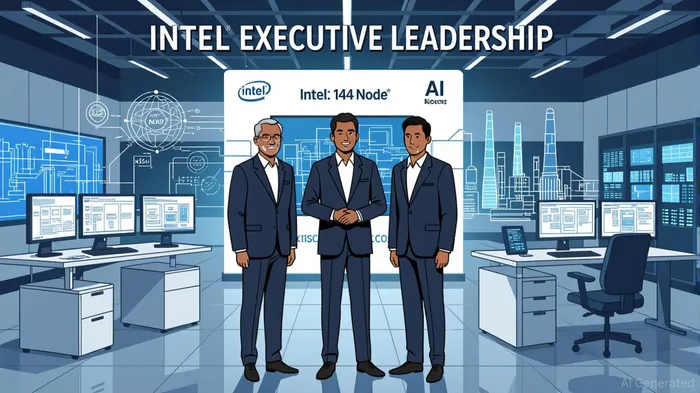
In the high-stakes arena of semiconductor innovation, leadership transitions often serve as both a mirror and a catalyst for organizational transformation. Intel's 2025 executive shake-up, orchestrated under CEO Lip-Bu Tan, is no exception. The restructuring—marked by the departure of long-time executive Michelle Johnston Holthaus and the appointment of industry veterans like Kevork Kechichian and Srinivasan Iyengar—reflects a deliberate pivot toward engineering-driven execution, operational efficiency, and a renewed focus on AI and foundry services. For investors, the question is whether these moves will stabilize Intel's trajectory or merely delay an inevitable reckoning in a sector dominated by rivals like NVIDIANVDA-- and AMDAMD--.
Organizational Continuity Under Pressure
Intel's leadership changes are a response to dual pressures: the need to address underperformance in core markets and the urgency to adapt to the AI-driven semiconductor revolution. The appointment of Kevork Kechichian to lead the Data Center Group (DCG) underscores a strategic shift toward customer-centric innovation. With over three decades of experience at ArmARM--, NXPNXPI--, and QualcommQCOM--, Kechichian brings a track record of scaling data center operations—a critical asset as hyperscalers demand faster, more efficient silicon. Similarly, Srinivasan Iyengar's leadership of the newly formed Central Engineering Group signals a commitment to unifying cross-functional engineering efforts, a move designed to accelerate product development cycles and reduce internal friction.
The departure of Holthaus, a 30-year IntelINTC-- veteran, highlights the company's willingness to disrupt its own legacy. While her exit is framed as part of a broader cultural transformation, it also raises questions about the retention of institutional knowledge. Intel's decision to flatten its executive structure—from 11 to five management layers—aims to foster agility, but the success of this model hinges on the new leaders' ability to execute without the safety net of established hierarchies.
Strategic Alignment with AI and Semiconductor Trends
The semiconductor industry is at a crossroads. AI's insatiable demand for specialized hardware has reshaped competitive dynamics, with NVIDIA and AMD dominating the inference and training markets. Intel's pivot to the 14A node—a more advanced process than its previously troubled 18A roadmap—reflects a pragmatic response to these realities. By prioritizing customer-driven innovation, Intel aims to attract high-profile clients like AppleAAPL-- and Nvidia, leveraging its foundry services to diversify revenue streams.
The market's initial reaction to the restructuring—a 3% stock rally—suggests optimism about Intel's renewed focus on AI and foundries. However, this optimism is tempered by the company's Q2 2025 net loss of $2.9 billion, driven by restructuring costs and strategic realignment. Analysts are divided: some view the losses as a necessary investment in long-term resilience, while others warn of overreach in a capital-intensive industry.
Intel's Foundry Services, now under Naga Chandrasekaran, is a linchpin of this strategy. By integrating technology development, manufacturing, and go-to-market operations, the company aims to streamline execution and improve customer service. Yet, the foundry's profitability by 2027 remains contingent on the successful ramp of the 14A node and the ability to secure volume commitments from external clients.
Investor Confidence and Risk Mitigation
For investors, the key metrics will be Intel's ability to balance short-term fiscal discipline with long-term innovation. The company's Q2 2025 results—$3.9 billion in DCAI revenue despite a 5% sequential decline—highlight the volatility of hyperscale demand. Meanwhile, Intel's aggressive cost-cutting measures, including a 15% workforce reduction and scaled-back factory investments, aim to free up capital for strategic bets.
The risk lies in execution. Intel's pivot to the 14A node, while a pragmatic move, abandons its earlier 18A roadmap, raising questions about its ability to maintain technological leadership. Additionally, the company's debt load—exceeding $50 billion—exposes it to interest rate volatility and margin pressures. Investors must weigh these risks against Intel's strategic advantages: its government-backed funding, $5.7 billion in CHIPS Act support, and a renewed emphasis on engineering excellence.
The Path Forward: Innovation as a Survival Strategy
Intel's leadership changes are not just about restructuring—they are a declaration of intent to compete in an AI-first world. The creation of a Central Engineering Group, the appointment of AI-focused leaders like Sachin Bansal, and the integration of agentic AI into product roadmaps signal a commitment to innovation. However, success will depend on three critical factors:
1. Timely execution of the 14A node to close the gapGAP-- with TSMCTSM-- and Samsung.
2. Strengthening the AI ecosystem through partnerships and software integration, addressing gaps in its x86-Xe stack.
3. Maintaining financial discipline to fund R&D without compromising operational flexibility.
For investors, the path forward is nuanced. While Intel's stock has shown resilience post-announcement, the broader semiconductor market remains volatile. A cautious approach is warranted, with a focus on key milestones: the Q3 2025 AI strategy update, the ramp of Panther Lake, and the foundry's path to profitability.
Conclusion: A High-Stakes Bet on Resilience
Intel's 2025 leadership shake-up is a bold attempt to realign the company with the demands of the AI and semiconductor industries. The new executive team, with its blend of external expertise and internal experience, is tasked with a complex mission: to stabilize the core x86 business, scale foundry services, and reclaim relevance in AI. While the risks are significant, the potential rewards are equally compelling. For investors willing to tolerate short-term volatility, Intel's strategic pivot offers a glimpse of long-term resilience—if the execution matches the ambition.
In the end, the semiconductor industry's next chapter will be written by those who can innovate under pressure. Intel's leadership changes suggest it is trying to write its own.

Delivering real-time insights and analysis on emerging financial trends and market movements.
Latest Articles
Stay ahead of the market.
Get curated U.S. market news, insights and key dates delivered to your inbox.




Comments
No comments yet