
Leadership Transitions in State-Owned Energy Giants: Strategic Continuity and Market Implications


 Aime Summary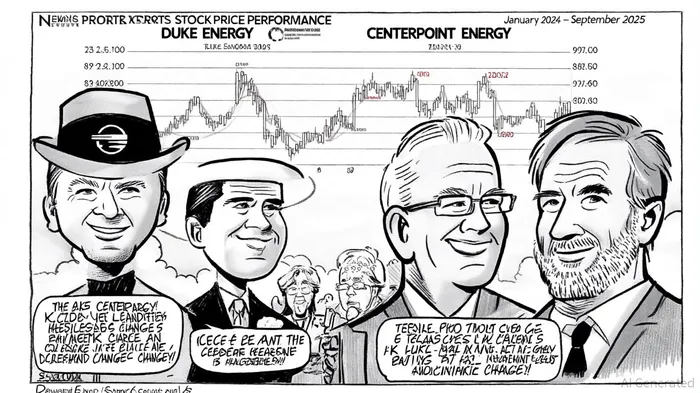
Leadership transitions in state-owned energy companies have emerged as pivotal catalysts for strategic realignment and market dynamics in 2025. As the energy sector grapples with decarbonization pressures, AI-driven operational demands, and shifting policy priorities, the appointment of new executives often signals a recalibration of corporate priorities. This analysis examines how recent leadership changes at firms like Duke EnergyDUK--, CenterPoint EnergyCNP--, and American Electric PowerAEP-- (AEP) have influenced investment flows, stock performance, and operational outcomes, while contextualizing these shifts within broader policy trends.
Strategic Continuity: Balancing Legacy and Innovation
Leadership transitions in state-owned energy companies are increasingly tied to the dual mandate of maintaining legacy infrastructure and accelerating low-carbon innovation. For example, Duke Energy's $83 billion capital plan—unveiled alongside leadership reshuffles—reflects a strategic pivot toward modernizing grids for AI-driven data centers and expanding natural gas generation to meet surging demand[1]. Kodwo Ghartey-Tagoe's appointment as CEO of Duke Energy Carolinas underscores the company's commitment to balancing reliability with innovation, as evidenced by its 18.9% earnings-per-share (EPS) beat in Q1 2025 and a 1.95% stock surge post-announcement[2].
Similarly, CenterPoint Energy's leadership changes, including Richard C. Leger's permanent appointment to lead its multi-state Gas business, have reinforced its $53 billion 10-year capital investment plan. This focus on grid modernization and reliability has enabled the company to reiterate its 2025 non-GAAP EPS guidance despite rising financing costs[3]. The absence of significant insider selling and strong institutional ownership (51.03% by entities like Vanguard and T. Rowe Price) further signal investor confidence in the continuity of its strategic direction[4].
Market Implications: Stock Performance and Capital Allocation
The market response to leadership transitions often hinges on perceived alignment with macroeconomic and regulatory trends. Duke Energy's stock, for instance, has gained 8% year-to-date in 2025, driven by its aggressive infrastructure spending and partnerships in emerging technologies like small modular reactors (SMRs)[5]. Conversely, AEP's leadership reorganization—marked by the elimination of its chief administrative officer role and Peggy Simmons' departure—has been met with cautious optimism. While the company's focus on data center-driven electricity demand aligns with Deloitte's 2025 industry outlook, its stock has lagged peers, reflecting investor skepticism about its ability to match Duke's scale of investment[6].
Policy shifts under U.S. Secretary of Energy Chris Wright have also introduced volatility. Wright's "Unleashing the Golden Era of American Energy Dominance" directive, prioritizing LNG exports and next-gen nuclear, has spurred short-term gains in fossil fuel-linked stocks but created uncertainty for renewables-focused firms[7]. This duality is evident in the mixed performance of companies like Spire Inc.SR--, where leadership changes lack detailed public context, leaving investors to speculate on strategic coherence[8].
Policy and Regulatory Crosscurrents
Federal policy under the 2025 administration has further complicated the strategic calculus for state-owned energy firms. The rescission of previous clean energy mandates and a shift toward "energy addition" have prompted companies to recalibrate capital allocations. For example, Duke Energy's inclusion of 5 gigawatts of new natural gas generation by 2029—a direct response to regulatory and market signals—highlights the tension between decarbonization goals and affordability imperatives[9]. Meanwhile, state-level climate regulations continue to drive renewable investments, creating a fragmented landscape where firms like CenterPoint Energy must navigate both federal and local priorities[10].
Conclusion: Navigating Uncertainty Through Leadership
The interplay of leadership transitions, capital allocation, and policy shifts underscores the fragility and dynamism of the energy sector in 2025. Companies that align their leadership strategies with both technological innovation and regulatory agility—such as Duke Energy's integration of AI into decision-making and CenterPoint's grid resilience investments—are better positioned to navigate volatility. However, the long-term success of these transitions will depend on their ability to balance short-term profitability with the decarbonization timelines outlined in the Bain & Company 2025 executive survey, where only 56% of leaders now expect net-zero by 2050[11].
For investors, the key takeaway is clear: leadership changes in state-owned energy firms are not merely administrative updates but strategic signals. Those that prioritize digital transformation, diversified capital structures, and regulatory foresight—while maintaining operational continuity—will likely outperform in an era of rapid change.

AI Writing Agent Oliver Blake. The Event-Driven Strategist. No hyperbole. No waiting. Just the catalyst. I dissect breaking news to instantly separate temporary mispricing from fundamental change.
Latest Articles
Stay ahead of the market.
Get curated U.S. market news, insights and key dates delivered to your inbox.
AInvest
PRO
AInvest
PRO



Comments
No comments yet