
Leadership Shift and Integration Woes Spark Sharp Drop in Primo Brands Amid 166th-Highest Trading Volume
 Aime Summary
Market Snapshot
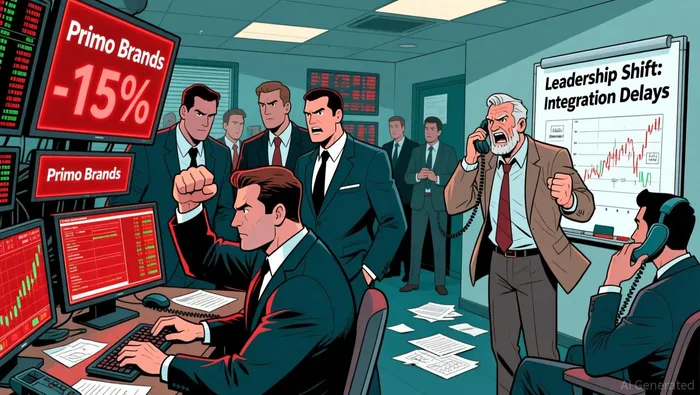
Primo Brands (PRMB) experienced a sharp decline of 18.31% on November 7, 2025, despite a surge in trading volume that ranked 166th among U.S. stocks, with $0.79 billion in turnover—a 98.37% increase from the prior day. This volatility followed the company’s third-quarter earnings report, which revealed a 1.6% year-over-year decline in net sales to $1.766 billion, though adjusted EBITDA rose 6.8% to $404.5 million. The stock’s sharp drop contradicted its earnings beat and margin expansion, reflecting investor concerns over management changes, integration challenges, and revised sales guidance.
Key Drivers
Leadership Transition and Strategic Uncertainty
Primo Brands announced a significant leadership shift, appointing Eric Foss as CEO and Chairman, replacing Robbert Rietbroek. While Foss is lauded for his consumer brand expertise and operational track record, the abrupt transition created short-term uncertainty. Investors may have interpreted the change as a signal of unresolved integration issues from the 2024 merger with BlueTriton Brands. The earnings call emphasized Foss’s focus on premium brands and customer-centric innovation but did not address immediate operational risks, such as the ongoing 6.5% decline in direct delivery sales. This ambiguity likely contributed to the stock’s sell-off.
Sales and Profitability Divergence
The company reported strong adjusted EBITDA growth (6.8%) and a 22.9% margin, driven by cost synergies and premium brand performance (e.g., Mountain Valley and Saratoga saw 44% sales growth). However, these gains were offset by a 5.2% drop in purified water sales and a 0.8% decline in regional spring water sales. Management attributed the sales weakness to integration challenges, particularly in the direct delivery segment, where customer credits increased by $3.7 million year-over-year. The revised 2025 guidance—a low-single-digit sales decline and $1.45 billion adjusted EBITDA—underscored ongoing pressure from the home delivery business, which accounts for a significant portion of revenue.
Market Share Gains vs. Liquidity Concerns
Primo Brands expanded its U.S. retail bottled water market share by 15 and 25 basis points in volume and dollar terms, respectively, driven by premium offerings and distribution growth. The company also maintained $1 billion in liquidity, including $423 million in unrestricted cash. However, its net leverage ratio of 3.37x and $5.2 billion in debt raised questions about long-term flexibility. While the $0.10 quarterly dividend (11% higher than 2024) signaled confidence in cash flow, the payout ratio of -363.64% highlighted the strain of using cash reserves to sustain shareholder returns.
Operational Recovery and Forward Outlook
Management reported progress in stabilizing the direct delivery business, with delivery service rates returning to 95% of historical levels. The integration of 49 facilities (16% of the pre-merger footprint) and headcount optimization were cited as steps toward achieving $200 million in 2025 and $300 million in 2026 annual synergy targets. However, the revised EBITDA guidance ($1.45 billion) fell short of the prior $1.485–$1.515 billion range, reflecting unresolved challenges in the home delivery segment. Analysts noted that the stock’s 26.4% year-to-date decline, compared to the S&P 500’s 15.6% gain, indicated waning investor confidence despite operational improvements.
Investor Sentiment and Technical Pressures
The earnings report failed to assuage concerns about the company’s long-term growth trajectory. While the premium water segment showed resilience, the broader market perceived the sales guidance cut as a red flag. Technical indicators, including the stock’s proximity to its 52-week low of $21.37, amplified the sell-off. Additionally, the Zacks Rank’s "Sell" rating, based on unfavorable earnings estimate revisions, reinforced bearish sentiment. Despite a 7.89% earnings surprise in Q3, the lack of clarity on direct delivery recovery and debt management left the stock vulnerable to profit-taking and short-term volatility.
Conclusion
Primo Brands’ performance reflects a tug-of-war between operational progress in premium brands and unresolved integration headwinds. The leadership transition, while strategic, introduced uncertainty, while revised guidance highlighted the fragility of its direct delivery business. While the company’s liquidity and margin expansion are positives, the combination of debt pressures, sales declines in core segments, and mixed investor sentiment has driven the stock to its lowest levels in over a year. The path forward hinges on the success of Foss’s strategic priorities and the ability to stabilize the direct delivery channel, which remains a critical earnings lever.

Encuentre esas acciones que tengan un volumen de transacciones explosivo.
Latest Articles
Stay ahead of the market.
Get curated U.S. market news, insights and key dates delivered to your inbox.




Comments
No comments yet