
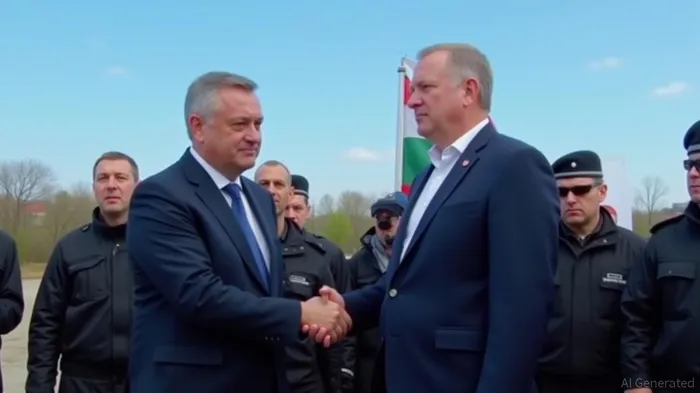
The leaders of Hungary and Slovakia made a joint show of defiance over pressure to quit Russian oil at the border separating the two countries on Sunday.
ByAinvest
Sunday, Sep 28, 2025 9:46 am ET1min read
The leaders of Hungary and Slovakia made a joint show of defiance over pressure to quit Russian oil at the border separating the two countries on Sunday.
Hungary and Slovakia, two European Union (EU) member states, have jointly demonstrated their defiance over pressure to halt Russian oil imports at the border separating the two countries. This stance was evident during a meeting held on Sunday, September 12, 2025.The leaders of Hungary and Slovakia have maintained their position despite increasing international pressure, including demands from U.S. President Donald Trump. Trump has repeatedly urged Nato allies to cease all energy purchases from Russia, particularly oil and gas, in an effort to strengthen Western sanctions against Moscow.
Hungary's Prime Minister Viktor Orbán and Slovakia's Prime Minister Peter Pellegrini have both emphasized that their countries' reliance on Russian energy is due to infrastructure limitations and the lack of viable alternatives. Orbán has defended Hungary's position by framing it as a matter of energy security rather than politics. He has stated that Hungary's energy supplies are a "purely physical question" and that the country cannot ensure a safe energy supply without Russian oil or gas sources .
Similarly, Slovakia's Prime Minister Peter Pellegrini has stated that his country cannot replace Russian energy overnight and needs technical and logistical help before any major shift. He has emphasized that Slovakia needs multiple sources of gas and energy to diversify its supply chain .
Both leaders have cited the need for time and resources to find and implement alternative energy routes and sources. This stance reflects the countries' heavy reliance on the Soviet-era Druzhba network and the fact that most of their energy infrastructure is geared towards imports from the east.
The leaders' defiance has been met with criticism from some quarters, who argue that continuing to purchase Russian energy is effectively financing Moscow's war in Ukraine. However, Orbán and Pellegrini maintain that their countries have no feasible alternatives and that cutting ties with Russia would threaten the stability of their energy grids and economies.
This situation highlights the complex interplay between political and economic factors in EU energy policy. While the EU has been working to reduce its dependence on Russian energy, the reality on the ground is more complex, with some countries facing significant infrastructure challenges in transitioning to alternative energy sources.
Stay ahead of the market.
Get curated U.S. market news, insights and key dates delivered to your inbox.


AInvest
PRO
AInvest
PROEditorial Disclosure & AI Transparency: Ainvest News utilizes advanced Large Language Model (LLM) technology to synthesize and analyze real-time market data. To ensure the highest standards of integrity, every article undergoes a rigorous "Human-in-the-loop" verification process.
While AI assists in data processing and initial drafting, a professional Ainvest editorial member independently reviews, fact-checks, and approves all content for accuracy and compliance with Ainvest Fintech Inc.’s editorial standards. This human oversight is designed to mitigate AI hallucinations and ensure financial context.
Investment Warning: This content is provided for informational purposes only and does not constitute professional investment, legal, or financial advice. Markets involve inherent risks. Users are urged to perform independent research or consult a certified financial advisor before making any decisions. Ainvest Fintech Inc. disclaims all liability for actions taken based on this information. Found an error?Report an Issue


ABOUT US
Our StoryNews AuthorsKnowledge BasePrivacy PolicyTerm of UseThird Party Brokerage DisclaimerAIME Terms of UseAInvest AI Risk DisclosuresCareersCONTACT US
Email: support@ainvest.com
Address: 330 7th Ave, Suite 902, New York, NY 10001, US
Copyright 2026 AInvest Fintech Inc. All rights reserved.


Comments
No comments yet