
LayerZero Integrates with Cardano to Enhance Cross-Chain Interoperability
 Aime Summary
- Cardano has integrated with LayerZeroZRO-- for cross-chain interoperability, enabling trustless message passing with chains like EthereumETH-- and SolanaSOL--.
- The Midnight mainnet, set to launch by the end of March 2026, will support privacy-focused zero-knowledge smart contracts and data protection by design.
- Cardano is enhancing institutional infrastructure with the CIP-113 standard, Archax integration, and real-world asset tokenization pilots like a $50M+ commercial real estate project according to reports.
Cardano has partnered with LayerZero to expand its cross-chain capabilities, allowing for seamless communication between blockchains. This integration leverages LayerZero’s Endpoint smart contracts on Cardano’s network to facilitate message validation and routing. Developers can now build omnichain applications (OApps) anchored on Cardano’s proof-of-stake layer.
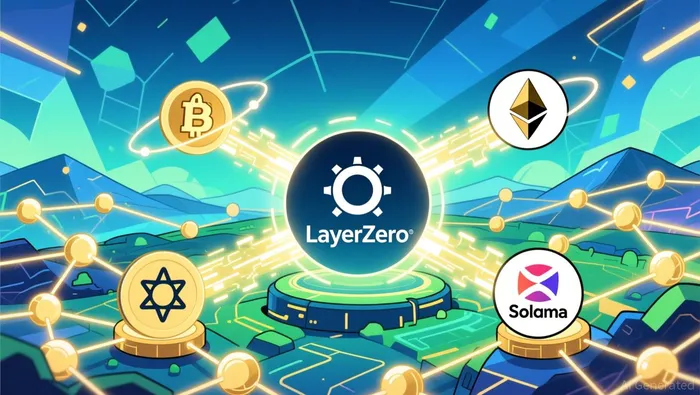
The LayerZero integration is designed to address the issue of blockchain silos by enabling decentralized applications (dApps) on CardanoADA-- to interact with applications on other chains. This marks a pivotal step in Cardano’s strategy to position itself as a hub for secure and connected Web3 applications.
In parallel, Cardano is set to launch the Midnight mainnet by the end of March 2026. This privacy-focused blockchain will support zero-knowledge smart contracts and data protection by design, enabling users to selectively disclose information while keeping sensitive data off-chain.
What is the significance of Cardano's cross-chain integration with LayerZero?
Cardano’s integration with LayerZero enhances its interoperability across major blockchains like Ethereum and Solana. This enables developers to build omnichain applications (OApps) anchored on Cardano’s secure layer.
The LayerZero integration allows for trustless message passing, reducing the need for centralized intermediaries. This improves security and scalability while maintaining Cardano's proof-of-stake consensus.
By enabling seamless cross-chain communication, Cardano strengthens its appeal as a multi-chain hub. This can attract developers and users looking for a secure and scalable platform for building connected Web3 applications.
How does Cardano's CIP-113 standard support institutional infrastructure?
The CIP-113 standard introduces programmable tokens with compliance features such as KYC checks, enabling institutional custody and trading of ADAADA-- and tokenized assets.
Cardano’s integration with Archax allows for institutional custody and trading of ADA and tokenized assets on an FCA-authorized platform. This supports compliant asset flows and meets regulatory requirements.
The CIP-113 standard enables functional instruments beyond ledger records. This allows for conditional transfers and compliance logic, making it suitable for regulated use cases like real estate tokenization.
The ecosystem is also funding real-world projects through the Venture Hub, including a $50M+ commercial real estate tokenization pilot. This initiative aligns with a growing on-chain tokenized real-world asset market driven by institutional players.
Cardano’s advancements in institutional infrastructure aim to attract builders and scale capital flows, with upcoming privacy-focused Midnight blockchain and LayerZero integration further enhancing its capabilities.
What are the broader implications for the Cardano ecosystem?
Cardano’s institutional infrastructure efforts, including CIP-113 and Archax integration, are designed to enable compliant custody, trading, and real-world applications like real estate tokenization.
The integration of regulated asset tokenization and the CIP-113 standard can attract institutional investors by providing compliance features and KYC checks. This supports the growth of a robust and scalable tokenized asset market.
The Midnight mainnet and LayerZero integration will enhance Cardano’s technical capabilities, supporting privacy-focused applications and cross-chain liquidity. These developments position Cardano as a key player in the institutional digital asset space.
The real test for Cardano will be the first major RWA token issuance on the CIP-113 standard, which will demonstrate the network’s ability to handle high-value, compliant tokenization.
The combination of regulated futures and native USDC access addresses major institutional objections related to hedging instruments and stable liquidity. These developments are foundational for broader Cardano engagement in the institutional market.

La combinación de la sabiduría tradicional en el comercio con las perspectivas más actuales sobre las criptomonedas.
Latest Articles
Stay ahead of the market.
Get curated U.S. market news, insights and key dates delivered to your inbox.


AInvest
PRO
AInvest
PRO



Comments
No comments yet