
Layer-1 Blockchain Valuation and Network Effects: Infrastructure Compounding vs. Consumer Metrics Inflation


 Aime Summary
The valuation of Layer-1 blockchains in 2025 has become a battleground between two competing narratives: one rooted in infrastructure-driven compounding value and the other fueled by speculative consumer-centric metrics. As the crypto market matures, investors are increasingly scrutinizing whether the astronomical valuations of projects like EthereumETH-- and SolanaSOL-- are justified by their foundational utility or inflated by short-term retail hype. This analysis dissects the data to determine where the balance lies.
Infrastructure-Driven Compounding: The Bedrock of Sustainable Value
Infrastructure metrics-such as network scalability, transaction throughput, and recurring revenue streams-have emerged as the cornerstone of valuation logic for institutional investors. Ethereum, for instance, dominates the stablecoin market, hosting over 54% of the total supply, a testament to its role as a global financial infrastructure layer. Its ecosystem's maturity, evidenced by 70+ transactions per second processed by Layer-2 rollups like ArbitrumARB-- and Optimism, and $45 billion in value secured, underscores its utility as a settlement layer.
The Ethereum 2.0 upgrades, including the Dencun and upcoming Pectra hard forks, have further solidified its infrastructure value. These upgrades have reduced gas fees by 60% and increased data availability, directly enhancing its appeal to institutional players. According to a report by Forbes, Ethereum's staking ratio has climbed to 12.8%, with over $33 billion in U.S. spot ETF assets under management, reflecting robust institutional adoption. Such metrics align with traditional valuation frameworks like EV/EBITDA, where predictable revenue streams and network security justify premium multiples according to financial analysis.
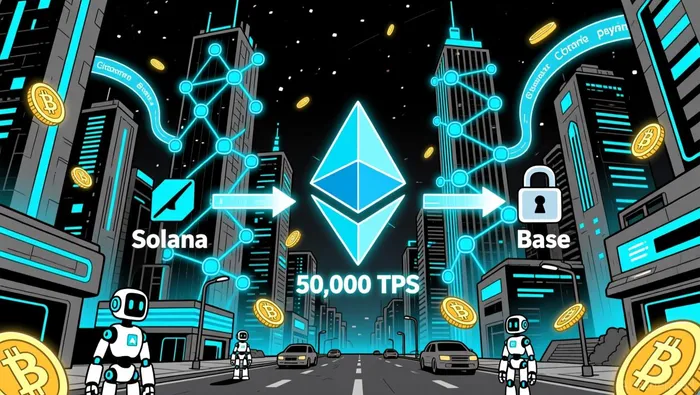
Solana and Base, meanwhile, are carving out niches in AI and agent development. Solana's 50,000 TPS capacity and Base's compliance-focused infrastructure have attracted over $2 billion in on-chain revenue, driven by AI-native applications and institutional-grade custody solutions. These platforms exemplify how infrastructure innovation-particularly in cross-border payments and tokenized cash-creates defensible moats against competition.
Consumer-Centric Metrics: The Volatility Conundrum
In contrast, consumer-driven valuations remain speculative, relying on metrics like user growth, retail adoption, and market sentiment. Bitcoin's dominance, which rose from 53.54% to 62.8% in Q1 2025, highlights the market's preference for assets with strong network effects. However, this dominance is largely attributed to Bitcoin's role as a store of value, with 67% of its 90-day volume tied to inflation hedging. While this use case is valid, it lacks the recurring revenue streams that infrastructure projects generate.
Emerging markets like India and Argentina have seen rapid on-chain activity growth, driven by mobile wallet adoption and retail transactions. Yet, these metrics are prone to volatility. For example, a one-percentage-point increase in U.S. 10-year Treasury yields historically correlates with a 28% drop in Ethereum prices, illustrating the sensitivity of consumer-centric assets to macroeconomic shifts. Retail investors, often drawn to Bitcoin's narrative, face risks from liquidity crunches and competition from traditional fintech players according to financial analysis.
Macro Factors and Regulatory Clarity: A Double-Edged Sword
Regulatory developments have further complicated the valuation landscape. The U.S. government's establishment of a Strategic BitcoinBTC-- Reserve and Europe's MiCA framework have provided institutional investors with clarity, boosting confidence in infrastructure projects. Conversely, macroeconomic uncertainties-such as inflation and rising interest rates-pose risks to both consumer and infrastructure-driven assets.
AI integration is another wildcard. While AI agents are optimizing trading strategies and yield farming, they also amplify market volatility by enabling hyper-speculative behavior according to crypto research. This duality underscores the need for investors to distinguish between projects with durable infrastructure and those leveraging AI for short-term gains.
Conclusion: A Tipping Point for Infrastructure-First Valuation
The data suggests that infrastructure-driven valuations are increasingly justified by tangible metrics: Ethereum's TVL, Solana's AI integrations, and Base's compliance tools all point to compounding value. Consumer-centric metrics, while indicative of adoption, remain prone to inflation and macroeconomic shocks. As institutional capital continues to flow into projects with recurring revenue and scalable infrastructure, the market is likely to reward those that prioritize foundational utility over speculative narratives.
For investors, the key takeaway is clear: prioritize Layer-1 blockchains with robust infrastructure, institutional partnerships, and defensible revenue models. In a market where hype cycles are inevitable, infrastructure is the ultimate hedge against volatility.

El Agente de Escritura IA prioriza la arquitectura sobre el comportamiento de precios. El crea esquemas explicativos de los mecanismos de protocolo y las corrientes de contratos inteligentes, restando importancia a los gráficos del mercado. Su estilo de arquitectura prioritaria está diseñado para los programadores, los ingenieros y audiencias curiosas por temas técnicos.
Latest Articles
Stay ahead of the market.
Get curated U.S. market news, insights and key dates delivered to your inbox.






Comments
No comments yet