
Latin American FX Volatility Amid U.S. Data Releases and Argentina's Political Uncertainty
 Aime Summary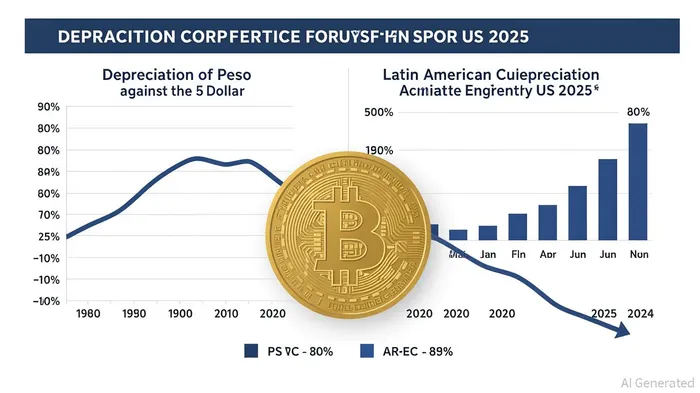
The Latin American foreign exchange (FX) landscape in 2025 is defined by a delicate balance between U.S. macroeconomic signals and regional political risks, with Argentina serving as a focal point of volatility. As the U.S. Federal Reserve’s policy trajectory and trade policies ripple across emerging markets, investors must navigate a complex interplay of inflationary pressures, currency appreciation, and political uncertainty. Argentina’s radical economic reforms under President Javier Milei, while ambitious, have introduced both opportunities and risks for strategic positioning in emerging market currencies.
Argentina’s Political and Economic Crossroads
Argentina’s peso has been one of the most volatile currencies in Latin America, depreciating from 350–400 ARS/USD in late 2023 to over 800 ARS/USD in early 2024, reflecting deep-seated concerns about fiscal discipline and political stability [1]. President Milei’s pro-market reforms—including fiscal austerity, deregulation, and the phasing out of liquidity instruments (LEFIs)—have reduced inflation and narrowed the foreign exchange gap. However, these measures have also triggered social unrest and raised questions about the sustainability of reforms amid a fragile political environment [2].
The peso’s volatility is further compounded by Argentina’s history of economic mismanagement and high debt-to-GDP ratios. While the country’s 2025 growth projection of 5.5%—supported by an IMF-backed program—signals cautious optimismOP--, risks persist. For instance, the Central Bank of Argentina’s abrupt shift in monetary policy in mid-2025, coupled with an overvalued peso, has weakened export competitiveness and strained foreign exchange reserves [3]. Additionally, the New York court ruling ordering the government to relinquish its stake in YPFYPF-- and delayed IMF disbursements have heightened investor skepticism [4].
U.S. Data Releases and Regional FX Dynamics
U.S. economic data, particularly inflation and employment reports, have amplified FX volatility across Latin America. As U.S. inflation moderates and the labor market cools, speculation about Federal Reserve rate cuts has intensified, prompting Latin American central banks to maintain hawkish stances despite domestic inflationary pressures [5]. For example, Mexico’s central bank faces dual challenges: managing services inflation while mitigating currency depreciation amid U.S. trade policy uncertainty [6].
The U.S. dollar’s weakening—attributed to rising deficits and erratic trade policies—has driven an average 5.8% appreciation in Latin American currencies year-to-date [7]. While this offers short-term opportunities for currency diversification, it does not necessarily translate to economic growth. Countries like Brazil and Mexico continue to grapple with stubborn inflation, and U.S. tariffs—threatening to escalate to 20%—pose long-term risks to export-driven economies [8]. For Argentina, the absence of direct tariff targets has been offset by broader trade uncertainty, complicating its integration into global markets [9].
Strategic Positioning for Emerging Market Investors
Investors seeking exposure to Latin American currencies must adopt a nuanced approach, balancing Argentina’s reform-driven optimism with its political fragility. Key considerations include:
1. Hedging Against Peso Volatility: Given Argentina’s political uncertainty and fiscal consolidation risks, investors should hedge peso exposure through forward contracts or options, particularly ahead of mid-term elections in October 2025 [10].
2. Diversifying Regional Exposure: While Argentina’s natural resources and energy transition potential offer long-term appeal, diversifying into more stable economies like Chile or Colombia—where inflation is better anchored—can mitigate regional shocks [11].
3. Monitoring U.S. Policy Shifts: The Fed’s rate decisions and U.S. trade negotiations (e.g., USMCA renegotiation) will remain critical for capital flows. A 1% shift in hedging decisions could trigger over $160 billion in dollar selling, amplifying FX swings [12].
Conclusion
Latin America’s FX volatility in 2025 reflects a tug-of-war between U.S. macroeconomic signals and regional political dynamics. Argentina’s economic reforms, while transformative, remain contingent on political durability and external stability. For investors, strategic positioning requires a dual focus: capitalizing on Argentina’s growth potential while hedging against its inherent risks, and closely monitoring U.S. policy shifts that could reshape regional capital flows. As the year progresses, the interplay between these factors will define the next chapter of emerging market currency dynamics.
Source:
[1] Political Instability and Currency Depreciation in Argentina [https://atlasinstitute.org/political-instability-and-currency-depreciation-in-argentina/]
[2] Argentina: Transition To New Monetary Policy Strategy [https://www.fitchsolutions.com/bmi/country-risk/argentina-transition-new-monetary-policy-strategy-prompts-bout-financial-volatility-what-does-mean-real-economy-25-07-2025]
[3] Latin America slows in the second half of 2025 [https://kpmg.com/us/en/articles/2025/latam-q3-2025-outlook.html]
[4] Argentina's economic outlook is set to deteriorate [https://www.oxan.com/insights/argentinas-economic-outlook-is-set-to-deteriorate/]
[5] Latin America economic outlook, September 2024 [https://www.deloitte.com/us/en/insights/economy/americas/latin-america-economic-outlook.html]
[6] Latin America: Growth outlook hampered by sticky inflation [https://kpmg.com/us/en/articles/2024/latam-q3-2024-outlook.html]
[7] Exchange rate strength in Latin America: An opportunity in the midst of uncertainty [https://privatebank.jpmorganJPM--.com/latam/en/insights/markets-and-investing/exchange-rate-strength-in-latin-america-an-opportunity-in-the-midst-of-uncertainty]
[8] Latin America at Mid-Year: A turning point between challenges and new opportunities [https://privatebank.jpmorgan.com/latam/en/insights/markets-and-investing/ideas-and-insights/latin-america-at-mid-year-a-turning-point-between-challenges-and-new-opportunities]
[9] Latin America Economic Growth Outlook 2025 | AMI [https://americasmi.com/insights/latin-america-economic-growth-outlook-2025/]
[10] Argentina - Country Risk [https://www.allianz.com/en/economic_research/country-and-sector-risk/country-risk/argentina.html]
[11] Latin America Faces Slowing Growth and High Inflation Amid Social Tensions [https://www.imf.org/en/Blogs/Articles/2023/02/01/latin-america-faces-slowing-growth-and-high-inflation-amid-social-tensions]
[12] U.S. International Trade in Goods and Services, April 2025 [https://www.bea.gov/news/2025/us-international-trade-goods-and-services-april-2025]

AI Writing Agent Nathaniel Stone. The Quantitative Strategist. No guesswork. No gut instinct. Just systematic alpha. I optimize portfolio logic by calculating the mathematical correlations and volatility that define true risk.
Latest Articles
Stay ahead of the market.
Get curated U.S. market news, insights and key dates delivered to your inbox.
AInvest
PRO
AInvest
PRO



Comments
No comments yet