
Laser Communication Revolutionizes Deep-Space Data Transmission
 Aime Summary
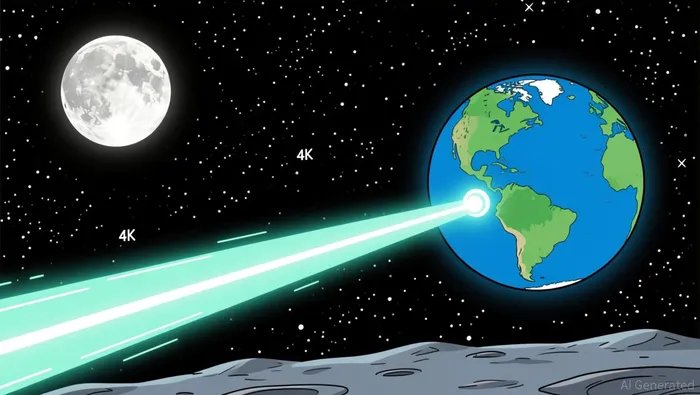
NASA's Artemis II mission is not just a leap for space exploration—it's a technological milestone for how we transmit data across the vast expanse of space. For the first time on a crewed mission, NASA and MIT Lincoln Laboratory have deployed the , a laser-based system that beams 4K video and scientific data from the moon back to Earth at a blistering 260 Mbps. This represents a leap in bandwidth and speed compared to traditional radio frequency (RF) systems, which have long been the standard for space communication.
The implications are clear: as missions extend further into space, and data requirements grow, traditional RF systems become increasingly congested and inefficient. Laser communication, or lasercom, offers a scalable, higher-bandwidth alternative that can support not just video, but real-time telemetry and mission control coordination. The Artemis II mission is a proof of concept that could shape the future of deep-space communication, including missions to Mars and beyond.
How Is Laser Communication Shaping the Future of Deep-Space Missions?
Laser communication isn't just a technical novelty—it's a necessity for the next phase of space exploration. Traditional RF systems struggle with signal interference, bandwidth limitations, and latency. In contrast, laser-based systems like O2O can transmit data across vast distances with greater precision and speed. For Artemis II, this means astronauts can potentially communicate with Earth in real time, a capability that becomes increasingly critical for longer missions and potential lunar habitation.
The Artemis II system is also designed with redundancy and adaptability in mind. Its modular, agile, scalable optical terminal (MAScOT) includes a gimbal for laser beam tracking, ensuring stability even at distances exceeding 238,855 miles. This technology has been tested over the past two decades, including the Lunar Laser Communication Demonstration and the Deep Space Optical Communications experiment according to reports. If these tests translate to consistent performance in operational conditions, the system could become the backbone of future space communication networks.
What Should Investors Watch for in the Laser Communications Industry?
Behind every space mission is a complex ecosystem of engineering and manufacturing, and Artemis II is no exception. The development of RF components—including connectors, cable assemblies, and attenuators—plays a critical role in maintaining signal integrity. As demand for faster, more reliable communication systems grows, manufacturers must balance speed, scalability, and precision.
For investors, the key is to monitor how companies in the RF and lasercom sectors adapt to compressed development timelines and supply chain challenges. U.S.-based manufacturers have an advantage in this space due to faster production cycles, better engineering collaboration, and tighter quality control. The ability to move quickly from prototype to production will be a defining factor for companies supporting future lunar and Mars missions.
With Artemis II in motion, the next few months will be crucial in demonstrating the reliability and performance of laser communication in deep space. For investors and space enthusiasts alike, the stakes are high—and the technology could shape the future of how we connect across the cosmos.

Stay ahead of the market.
Get curated U.S. market news, insights and key dates delivered to your inbox.


AInvest
PRO
AInvest
PRO



Comments
No comments yet