
Las Vegas Strip Casinos Fully Unionized for First Time in History
 Aime Summary
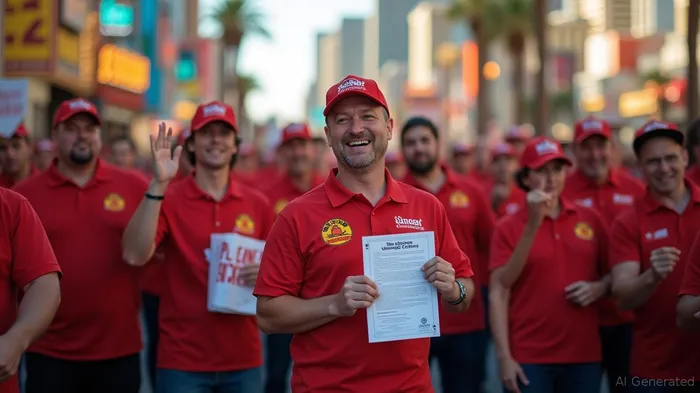
All major casinos on the Las Vegas Strip are now unionized for the first time in history, marking a transformative development in Nevada's labor landscape. This milestone, achieved through recent labor agreements, includes the previously unorganized Venetian and the newly opened Fontainebleau [1]. The Culinary Workers Union, which has advocated for hospitality workers in Las Vegas for 90 years, now represents all major Strip casinos. With 60,000 members, the union is the largest in Nevada and a key player in shaping labor conditions in the hospitality sector [1].
The change was made possible by a shift in ownership at the Venetian, which had resisted unionization for 25 years, and the strategic momentum from the Fontainebleau’s initial labor contract. These agreements, finalized late last year, have brought the long-standing standoff between the union and casino operators to a close. Patrick Nichols, president and CEO of the Venetian, expressed confidence in the new partnership, saying it would bring long-term benefits to workers and the industry [1].
For many workers, the impact is already tangible. Susana Pacheco, a housekeeper, now enjoys better pay, guaranteed days off, and a more manageable workload, allowing her to spend more time with her children. She emphasizes that the union has given her and her colleagues a voice in negotiations and a stake in their working conditions [1].
The union’s success comes amid a broader decline in U.S. union membership, which stood at 10% of workers in 2024, down from 20% in 1983 [1]. National policies, including “right-to-work” laws and regulatory changes, have weakened labor organizations across the country. Yet, the Culinary Union’s deep roots in Las Vegas and its ability to adapt to industry changes have allowed it to maintain influence. Ruben Garcia, a labor law expert from the University of Nevada, Las Vegas, notes that the union’s strength lies in its ability to navigate complex power dynamics with casino operators and to consolidate support among hospitality workers [1].
The union’s recent wins were also driven by a high-stakes moment in early 2023 when the threat of a strike by 35,000 hospitality workers with expired contracts loomed over the Strip. A last-minute deal with Caesars Entertainment averted a walkout and set off a chain reaction, with similar agreements quickly reached at MGM Resorts and Wynn properties. The contracts secured a 32% pay increase over five years, with workers expected to earn an average of $35 per hour, including benefits [1].
Beyond wages, the union’s influence extends to political and social realms. With the ability to mobilize thousands of members for voter outreach and canvassing, the union’s endorsements are highly sought after, especially by Democrats aiming to secure working-class votes [1].
Despite its successes, the union continues to face opposition. Earlier this year, two food service workers filed complaints with the National Labor Relations Board, accusing the union of unauthorized dues deductions. The union maintains that between 95% and 98% of workers choose to remain members [1]. Critics like Renee Guerrero, a T-Mobile Arena worker, argue that the union does not represent their interests and have taken steps to opt out of membership.
Supporters, however, praise the union’s role in fostering long-term careers in the hospitality industry. Paul Anthony, a Bellagio food server and union member for 40 years, credits the union with providing free family health insurance861218--, consistent raises, and job security. Ted Pappageorge, the union’s lead negotiator, calls this the “Las Vegas dream,” emphasizing the goal of making the city a union town [1].
The unionization of all major Strip casinos represents both a historic victory and a complex challenge. As the hospitality industry evolves and labor dynamics shift, the Culinary Workers Union will likely continue to play a central role in shaping the future of work in Las Vegas.
Source:
[1] https://fortune.com/2025/08/04/las-vegas-casinos-unionized-first-time-ever/

Stay ahead of the market.
Get curated U.S. market news, insights and key dates delivered to your inbox.


AInvest
PRO
AInvest
PRO



Comments
No comments yet