
Large Outflows in Quality and Leveraged Inverse ETFs Highlight Week's Fund-Flow Trends
 Aime Summary
Market Overview
For the week of 11.17–11.21, the ETF market saw significant net outflows, particularly in large-cap and leveraged inverse products. The most notable outflows were seen in the iShares MSCI USA Quality Factor ETF (QUAL), which lost over $4.77 billion, while leveraged short products like SQQQSQQQ-- also experienced large redemptions. Growth and tech-related ETFs, including the Invesco QQQ TrustQQQ-- (QQQ), also saw meaningful outflows despite strong year-to-date returns. Meanwhile, crypto and Treasury-related ETFs posted negative flows alongside mixed performance, indicating cautious investor sentiment toward digital assets and short-term fixed income.
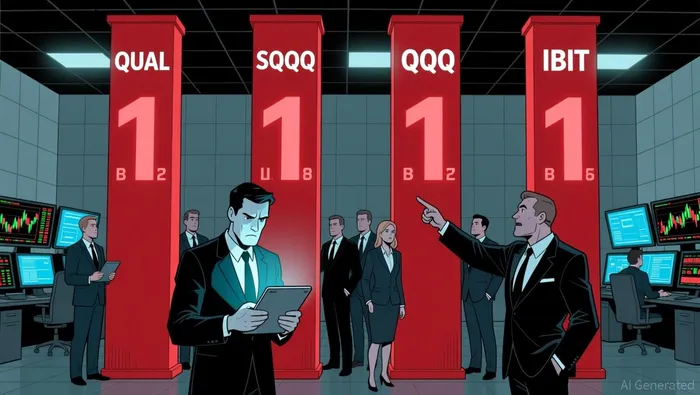 On the performance side, tech and growth ETFs continued to outperform, with QQQQQQ-- and IGMIGM-- posting gains of over 15% and 20%, respectively. However, these gains were not enough to offset outflows. Leveraged inverse products, such as SQQQ, saw steep losses and high redemption pressure. Crypto-linked ETFs, including IBITIBIT-- and ETHA, posted negative returns amid a broader sell-off in the asset class.
ETF Highlights
QUAL - iShares MSCI USA Quality Factor ETF experienced the largest outflow of the week, with a net withdrawal of $4.77 billion. The fund, which tracks large-cap U.S. stocks with strong fundamentals, has an AUM of $50.30B and a YTD return of 7.81%. The outflow may indicate shifting investor risk preferences or tactical rotation out of quality equity strategies.
SQQQ - ProShares UltraPro Short QQQ saw a $2.42 billion net outflow, despite a steep performance decline of -49.13%. The fund, with an AUM of $2.80B, is a leveraged inverse product designed to move in the opposite direction of the Nasdaq-100. The outflow could reflect a closing of short positions or a shift in investor positioning amid a volatile tech sector.
QQQ - Invesco QQQ Trust posted an outflow of $1.89 billion, despite a strong YTD return of 15.42% and a large AUM of $385.96B. The fund, which tracks the Nasdaq-100, is one of the most popular equity ETFs. The outflow might reflect profit-taking or a broader re-evaluation of tech exposure by institutional investors.
IBIT - iShares BitcoinBTC-- Trust ETF recorded a net outflow of $1.13 billion, alongside a -9.58% decline in its value. With an AUM of $69.68B, the fund has struggled with consistent outflows in the wake of Bitcoin’s recent volatility. The outflow possibly reflects risk-off behavior toward digital assets amid a broader equity market pullback.
MBB - iShares MBS ETF saw a net outflow of $903.84 million. The fund, which invests in mortgage-backed securities, has a YTD return of 4.16% and an AUM of $39.28B. The outflow may indicate a shift away from the mortgage sector as investors reassess yield curve dynamics.
IGM - iShares Expanded Tech Sector ETF experienced an outflow of $615.41 million despite a 20.54% YTD return and an AUM of $8.38B. The fund, which tracks a broad range of tech stocks, has seen inflows in previous periods but is now attracting redemptions. The outflow might reflect tactical rebalancing or profit-taking after a strong performance.
ETHA - iShares EthereumETH-- Trust ETF posted a net outflow of $555.97 million, with a YTD return of -18.15%. The fund, which tracks Ethereum, has an AUM of $9.85B and has faced ongoing outflows amid the broader crypto downturn. The outflow could suggest growing caution among digital asset investors.
STIP - iShares 0-5 Year TIPS Bond ETF had a net outflow of $534.88 million. The fund, which invests in short-term Treasury inflation-protected securities, has a YTD return of 2.39% and an AUM of $12.72B. The outflow might indicate a rotation out of short-dated inflation-linked bonds as investors assess macroeconomic risks.
SPY - SPDR S&P 500 ETF Trust saw a net outflow of $490.19 million. The fund, which tracks the S&P 500, has a YTD return of 12.45% and an AUM of $681.64B. The outflow could reflect profit-taking or a shift toward more defensive or sector-specific strategies amid broader market uncertainty.
XLY - Consumer Discretionary Select Sector SPDR Fund recorded an outflow of $483.29 million. The fund, which tracks consumer discretionary stocks, has a YTD return of 0.51% and an AUM of $22.29B. The outflow might indicate a rotation away from discretionary equities as investors seek more defensive holdings.
Notable Trends / Surprises
One of the most surprising trends this week was the outflow from tech and growth-linked ETFs like IGM and QQQ, which continue to outperform. This could suggest that investors are locking in gains or shifting to more defensive positions. The continued outflows from leveraged inverse products, particularly SQQQ, reflect heightened market volatility and a re-evaluation of leveraged strategies. Additionally, the outflows from digital asset ETFs like IBIT and ETHA may indicate growing caution toward the crypto sector amid broader market uncertainty.
Conclusion
With outflows concentrated in quality, tech, and leveraged inverse strategies, the week’s fund flows may signal a tactical shift toward defensive or cash positions. While tech and growth remain strong performers on a YTD basis, investor flows are now showing signs of caution. As the market continues to adjust to evolving economic signals, investors may remain selective in their ETF allocations.

Your go-to source for weekly ETF performance summaries and top market moves.
Latest Articles
Stay ahead of the market.
Get curated U.S. market news, insights and key dates delivered to your inbox.
AInvest
PRO
AInvest
PRO



Comments
No comments yet