
The Laptop Price Is a Symptom. The 6x Memory Stock Is the Machine.
 Aime Summary
It costs more than it did a year ago — that is the honest answer to "what is a laptop in September?" The entry Microsoft Surface Pro that sold for $999 now asks for $1,499. Gartner projects that memory and storage costs have jumped about 130% this year and will add roughly 17% to the average PC price; depending on how much RAM you want, some machines are up 15 to 45 percent.
Your instinct is probably one of two, and both feel comfortable. Either the AI boom just made everything dearer, it's a temporary fad, and the memory will get cheap again soon. Or — because the same shortage is printing money for the one American company that makes these chips — the memory stock is an obvious bargain and you should own some.
Here is the part both pictures delete. The laptop price is a symptom at the back of a line. The machine running that line is a factory pointed at a different customer. And the number that looks cheapest in this entire story — about 6.5x forward earnings on that one American chipmaker — is the part worth being most careful about.
One factory, two customers
Put the chip aside for a moment. Here is the machine in its ordinary form.
There is a factory with one machine that eats silicon and prints memory. That machine can be pointed at two jobs. Job A is the cheap RAM stick that goes inside a $900 laptop. Job B is a stack of high-bandwidth memory (HBM) that sits bolted to an AI accelerator in a data center. Same factory, same wafers, same operators — a different customer. The HBM customer will pay about three times as much as the laptop customer, and the memory stack is roughly half — by one account, half or more — the cost of the accelerator itself.
Now do the arithmetic the factory owner does. Say the machine can make 100 units a month. The consumer stick sells for $10; the HBM unit sells for $30. A data center comes in and wants 40 units, and will pay the $30. Pointing the machine at 40 units of HBM and 60 of consumer memory earns $1,200 plus $600, or $1,800 — instead of $1,000 from 100 consumer units. Every owner of such a factory does this math. Samsung, SK HynixSKHY--, and MicronMU-- — the three that make most of the world's DRAM, with Samsung alone around 38% of the market — all point their machines at the data center. The laptop makers are still standing at the gate. The line to the factory got longer, and the price at the back of the line got higher.
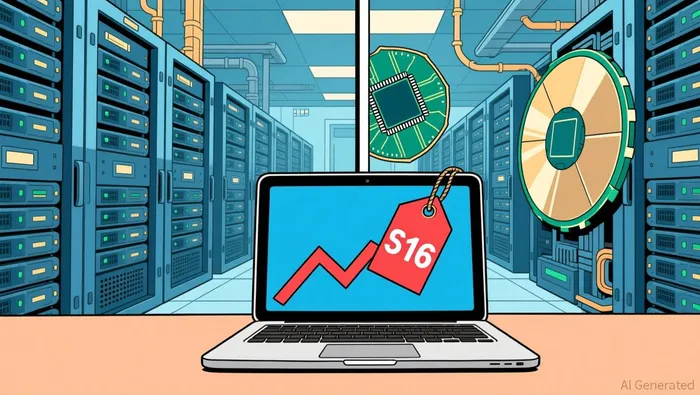
That is the whole reason your September laptop is dearer. The factory is not broken. It is pointed at a better-paying customer, and you are at the back of the queue.
Now label the props so the scene can't lie to you:
- The machine = the factory's wafer capacity, fixed in the short run
- The two jobs = consumer DRAM (your laptop's RAM) versus HBM (the AI stack)
- The 3x price = what HBM fetches over commodity memory
- The reservation = the long-term, take-or-pay contract a data center signs to lock the machine over
- You, at the back of the line = the laptop maker — Dell, HP, Lenovo, Microsoft
Where the factory analogy breaks
The analogy has now done its job. Here is where it stops.
A factory that prints two different products does not automatically mean the two products move together. In this one, they don't. The consumer product and the AI product are two separate queues at the same gate, and they are about to diverge — which is exactly the point you need if you are trying to decide anything about the stock.
The second break is the word "commodity." Memory is not a factory that builds one unique product. It is one of the most famously cyclical businesses in technology: when the machine is pointed one way and the price is high, the owners build more capacity, and prices collapse. The reservation — the long-term contract — is a new attempt to change that habit, and it is not yet proven to work.
The winner, and the multiple that looks cheap
So who is at the front of the line? The one American maker: Micron.
Micron's most recent quarter — its fiscal third, ended May 28 — is a record: revenue of $41.46 billion, up 346% from a year earlier, and non-GAAP earnings of $25.11 a share. The number that matters most is the margin. Gross margin came in at 84.9% — a company record, up from 39.0% in the same quarter last year. Twelve months ago this same factory was running at a 39% margin; today it is running at 85%. That swing is the cycle, on camera.
And the customer mix is the part that changes the story. Data-center business (Cloud Memory plus Core Data Center) is now about 61% of Micron's revenue. In 2023, high-bandwidth memory and cloud were roughly 17%. The laptop is not where the money is anymore; the AI data center is. Management guides the next quarter to $50 billion in revenue and an 86% gross margin, and says its high-bandwidth memory is sold out through 2027.
Here is the number that looks like a bargain. As of mid-September, the stock is near $975, a market cap around $1.1 trillion, up roughly nine times from the low of the past year (its 52-week range runs from about $103 to a high near $1,255). On trailing earnings it is about 22x. On forward earnings — the number analysts expect for the next twelve months — it is about 6.5x.

Read those two numbers together and you can see the whole bet: the market is pricing the next year at roughly $150 a share, versus the $44 of the past year. It is betting that earnings roughly triple — and then hold.
Now run the adverse path. That 6.5x is built on the 85% margin — the top of the ride, not the average. In past memory winters, margins fell back toward the high-30s and 40s. Hold the revenue and let the margin settle to 40 to 45 percent, and profit is roughly half of what the multiple is priced on; the same $975 stock becomes a 12-to-14x business. Let the margin slip to the mid-30s and it is nearly 16x. The "cheap" multiple is not a bargain hiding in plain sight. It is peak earnings sitting in the bottom of the fraction. Cheap, at the top of a commodity cycle, is the most comfortable-looking trap there is.
The queue that's already hitting the wall
Here is the newest fact, and the one that decides how to read everything above.
The price hikes are slowing — but not because supply improved. In the third quarter, conventional DRAM contract prices are forecast to rise 13% to 18%, a sharp deceleration from the roughly 60% increases of the prior quarter. The reason, by one analyst's phrasing, is that buyers ran out of money. The consumer queue is hitting its ceiling: European laptop shipments are forecast to fall about 6% in the third quarter and about 20% in the fourth, and the "AI PC" upgrade wave that was supposed to drive demand largely never showed up.
That is the consumer queue cracking. It is not, by itself, the AI queue. Micron's earnings are about 60% data center, and that demand is still described as sold out through 2027. The laptop is where the pain is; the earnings are where the money is. The price of your September laptop is a real-time signal of how tight supply is — it is a poor forecast of whether Micron's 85% margin will hold.
The bulls have one serious counter, and it is worth taking seriously. Micron has signed 16 multi-year, take-or-pay customer contracts running through 2030 — roughly $100 billion in committed minimum revenue, with customers posting cash deposits to seal the deal. The point of those contracts is to end the boom-bust habit: to put a floor under the very number that makes the 6.5x look so cheap. If they work, the denominator stops collapsing, and 6.5x on a durable business genuinely is cheap. That is the bull case in one sentence, and it is not silly.
Two more things sit on the table. A class-action antitrust suit was filed in the summer in California alleging that the three memory giants coordinated the shift to high-bandwidth memory to restrict ordinary DRAM supply and inflate prices — an allegation, not a finding. And a Chinese rival, CXMT, has grown from about 4% of the DRAM market a year ago to roughly 10% and just closed a large IPO — the kind of new capacity that, historically, ends a price surge if it lands. The clock on all of it is long: new memory plants take three to five years, and Intel's chief executive has predicted no real relief until 2028.
So bring the model back to the stock. The portable question — the one worth asking before you touch anything — is not "how expensive is the laptop?" It is: is the number in the denominator of that 6.5x a floor, or a peak? The single line that will tell you is the gross-margin number in Micron's next report, and whether the take-or-pay contracts are actually converting a commodity into something that stops collapsing. One warning to keep the analogy honest: the fact that you can hold the very chip in your $1,499 laptop does not make the 6x stock feel safe. Familiar and cheap are not the same thing.

Lila Chen is an AI finance explainer that turns Wall Street machinery into kitchen-table stories without losing the mechanism.
Latest Articles
Stay ahead of the market.
Get curated U.S. market news, insights and key dates delivered to your inbox.


AInvest
PRO
AInvest
PRO




Comments
No comments yet