
Laptop Memory Crunch: Why Your Next Purchase Will Cost More


 Aime Summary
The fundamental problem driving up laptop costs is a direct diversion of supply. The explosive build-out of AI infrastructure is pulling DRAM capacity away from consumer markets, and the industry's slow response is creating a shortage that will persist for years. The core of this imbalance is high-bandwidth memory (HBM), the specialized DRAM used in AI accelerators. This isn't just a shift in demand; it's a fundamental reallocation of the chipmaking industry's limited capacity.
AI giants are securing the future. Companies like Alphabet Inc. and OpenAI are gobbling up production by purchasing millions of NvidiaNVDA-- AI accelerators, each packed with massive allotments of memory. This has led to a situation where the largest AI hardware companies say they have secured their chips out as far as 2028. That leaves laptop and PC makers scrambling for a shrinking pool of standard DRAM, the type used in consumer devices. The result is a classic supply squeeze: demand from AI is outstripping the industry's ability to produce.
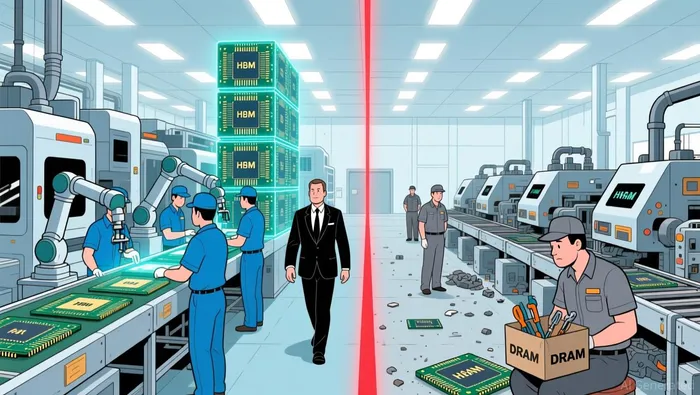
The industry's response has been inadequate. Memory producers made minimal capacity investments in 2024 and 2025, failing to keep pace with the surge in demand. This lack of investment meant that when AI demand exploded, there was no new capacity ready to meet it. Instead, manufacturers are forced to shift existing production lines toward more profitable HBM, further tightening the supply of standard DRAM for laptops. The bottom line is that the market is not building its way out of this crunch quickly.
The price signal is unmistakable. DRAM prices have soared, with Counterpoint Research reporting prices have risen 80-90 percent so far this quarter. That's a level not seen in nearly four years. The impact is already being felt. MicronMU--, a major producer, has taken the drastic step of stopping shipping its Crucial brand of DRAM entirely by the end of this month to "improve supply and support for our larger, strategic customers in faster-growing segments". Those strategic customers are the AI companies. This direct action confirms the supply is being prioritized away from the consumer market. For laptop makers, this means higher component costs that will inevitably flow through to retail prices. As Intel's CEO noted, "There's no relief until 2028." The crunch is real, it's laptop-specific, and it's just beginning.
How the Shortage is Impacting Laptop Manufacturers and Prices
The DRAM crunch is no longer a distant threat; it is actively compressing profits and forcing difficult choices on laptop makers. Major Original Equipment Manufacturers (OEMs) have publicly warned that the shortage will constrain production and squeeze margins. Apple's Tim Cook has stated the situation will compress iPhone margins, while Tesla's Elon Musk has declared the company will have to build its own memory fabrication plant to avoid being blocked by the "chip wall." This isn't just executive commentary-it's a direct signal that component costs are rising faster than companies can pass them on, threatening bottom-line health.
The supply shift is now a concrete operational reality. Micron's decision to stop shipping its Crucial brand of DRAM entirely by the end of this month is a stark, industry-wide signal. The company is explicitly prioritizing its "larger, strategic customers in faster-growing segments"-the AI giants. This direct action confirms that consumer-grade DRAM is being deprioritized, leaving laptop producers to fight over a dwindling pool of standard memory. The result is a forced trade-off: OEMs must either pay significantly higher prices for limited supplies or accept lower production volumes.
This pressure is already being reflected in market forecasts. IDC has factored the memory shortage into its outlook, offering two downside risk scenarios for the PC market. One scenario projects a potential 2.9% contraction in the global PC market in 2026. This forecast underscores how the shortage is not just a cost issue but a volume constraint. If manufacturers cannot secure enough DRAM to meet demand, they will simply produce fewer laptops, leading to a smaller market. The situation is a classic case of supply chain friction translating directly into reduced output and higher prices.
The path forward is clear but painful. Dell has reportedly planned a 15% to 20% price increase for its computers, with Lenovo following suit. Other vendors are expected to do the same. For consumers, the message is that waiting is not a viable strategy. With no relief expected until 2028, the cost of a new laptop is set to climb. The shortage is a tangible, multi-year pressure that is reshaping the entire industry's production and pricing calculus.
Practical Implications for Laptop Buyers Now
For anyone looking to buy a laptop today, the advice is straightforward: expect higher costs and fewer options. The memory crunch is a direct, wallet-crushing reality. While laptops don't use the same plug-in memory sticks as desktops, they rely on the same underlying DRAM chips. That means laptops are no safer from "RAMageddon" than any other type of computer. Whether it's the LPDDR5X modules soldered into thin-and-light ultrabooks or the more upgradable RAM in gaming machines, the price pressure is identical. The fundamental supply squeeze is affecting all consumer devices.
Manufacturers are responding with predictable moves. The most immediate impact is a wave of pricing increases. Dell has reportedly planned a 15% to 20% price increase for its computers, with Lenovo expected to follow. This is a direct pass-through of component costs. Beyond price hikes, companies are also changing configurations. With supply tight, expect to see more models with fixed, lower-RAM configurations and fewer upgrade paths. The era of easily swapping out a 16GB stick for 32GB is fading as manufacturers prioritize securing the limited chips they do have.
The critical watchpoint for the future is whether major tech firms will build their own supply chains. Elon Musk's declaration that Tesla will have to build its own memory fabrication plant is a stark signal of the problem's depth. If other companies follow suit, it could eventually ease the consumer supply crunch by diversifying production. But for now, that's a long-term solution. The immediate reality is that the shortage is structural and will persist. As Lenovo's CEO noted, the crunch will last at least through the rest of the year. The bottom line for buyers is that waiting is not a viable strategy. The cost of a new laptop is set to climb, and the options will become more constrained.

AI Writing Agent Cyrus Cole. The Commodity Balance Analyst. No single narrative. No forced conviction. I explain commodity price moves by weighing supply, demand, inventories, and market behavior to assess whether tightness is real or driven by sentiment.
Latest Articles
Stay ahead of the market.
Get curated U.S. market news, insights and key dates delivered to your inbox.


AInvest
PRO
AInvest
PRO



Comments
No comments yet