
Lands' End's Q3 2024: Contradictions Emerge on Inventory Management, Outerwear Strategy, Tariff Mitigation, and Licensing Impact
 Aime Summary
Date of Call: None provided
Financials Results
- Revenue: $325 million, down 12.5% YOY (down 9% ex-Japan e‑commerce; excludes $4M Delta revenue)
- EPS: Net loss of $3.52 per share vs $0.14 loss per share prior year; adjusted net loss $0.11 per diluted share excluding $107M goodwill impairment
- Gross Margin: 47%, approximately +700 basis points YOY (vs Q3 2022)
Guidance:
- Q4 net revenue expected $490M–$520M.
- Q4 adjusted net income expected $8M–$11M; adjusted diluted EPS $0.25–$0.34.
- Q4 adjusted EBITDA expected $27.5M–$31.5M.
- Full-year net revenue expected $1.45B–$1.48B.
- Full-year adjusted net income (loss) expected $(5M)–$(2M); adjusted diluted loss per share $0.16–$0.07.
- Full-year adjusted EBITDA expected $80M–$84M; FY capex ~ $35M.
- Expect continued gross profit and margin expansion over the holiday season.
Business Commentary:
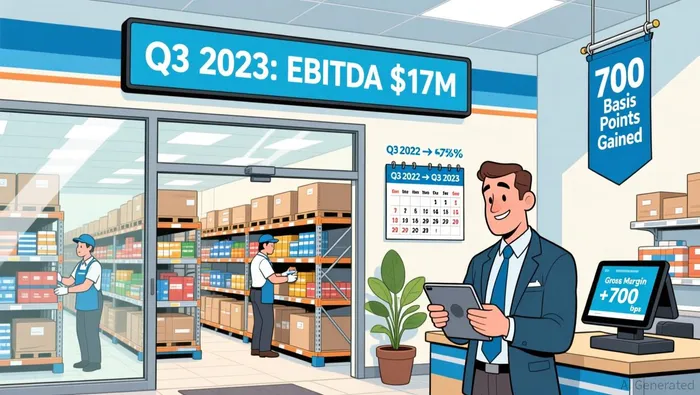 * Profitability and Gross Margin Improvement: - Lands' End reported an adjusted EBITDA of
 $17 million, exceeding the high end of its guidance range by 4% year-over-year. - Gross margin improved by approximately 700 basis points compared to the third quarter of 2022, driven by new products, strength in transitional outerwear, and improved supply chain costs.- Inventory Reduction and Management:
- The company achieved a
25%reduction in inventory levels compared to the previous year, with end-of-quarter inventory at$422 million. This improvement resulted from reduced inventory purchases and enhanced supply chain efficiency, which contributed to improved gross profit dollars and markdown reduction.
Strategic Licensing and Revenue Diversification:
- Lands' End entered into a new licensing agreement for kids' categories and continued to ramp up activities under existing agreements with Costco and footwear.
The focus on licensing adds royalty guarantees and new income streams, allowing the company to maintain focus on its core capabilities and reduce reliance on clearance sales.
Digital Engagement and Sales Strategy:
- The U.S. e-commerce business saw a
7%increase in gross profit dollars despite a10%sales decrease, attributed to reduced promotions and improved inventory management. - The company is leveraging social media to engage with customers, resulting in increased traffic and repeat exposure, particularly with the resolver customer cohort.
Sentiment Analysis:
Overall Tone: Positive
- Management highlighted margin and inventory improvements: "gross margin...was 47% and an approximately 700 basis point improvement" and "adjusted EBITDA of $17 million... exceeded the high end of our guidance." They cited a 25% inventory reduction and said, "We are confident that we have found a winning formula," signaling confidence in the margin-first strategy.
Q&A:
- Question from Dana Telsey (Telsey Advisory Group): Nice to see the progress on the profitability. The continuation of the lower inventories, I think, down 30% in the second quarter, down 25% now in the third quarter. Where do you see what the normalized rate of inventory level should be, how are you planning that going forward? And then on -- it's nice to see scaling back on the promotions on that you're seeing, especially post the Black Friday time period, what are you seeing in terms of categories, outerwear, how are you planning? How are AURs? And then on the margin focus, what are you seeing in terms of under the hood on the margins, whether it's freight or whether it's [ AUC ], what is the opportunity for the gross margin going forward?
Response: Targeting ~3–4 inventory turns to speed replenishment and drive margin upside; will continue scaling back promotions, shift assortments (e.g., outerwear/midweights) and expect additional margin gains as sourcing/AUC improvements fully flow through.
- Question from Alex Fuhrman (Craig-Hallum Capital Group): So clearly, the focus on prioritizing profitability over revenue is producing some nice results here. I'm curious how much more room you think there is to pull back on unprofitable sales? Could there be another leg down of revenue as you identify more promotions or clearance activity that you want to pull back on? And then looking out over the next couple of years, as you add more high-margin revenue, presumably from growing the licensing business, can you continue to grow EBITDA without necessarily a big increase in revenue? Can this be a $100 million EBITDA business on the current $1.5 billion revenue base as you start to grow some of those other areas like licensing?
Response: Yes — licensing will reduce clearance-driven sales and improve profitability; management expects it is feasible to approach roughly $100M of EBITDA on a ~$1.5B revenue base through mix shift to higher-margin licensing and continued gross-margin expansion.
Contradiction Point 1
Inventory Management and Turnover Strategy
It reflects a shift in company strategy regarding inventory management and turnover, which directly impacts operational efficiency and financial performance.
What is your target inventory level normalization rate and how do you plan to achieve it moving forward? - Dana Telsey (Telsey Advisory Group)
2024Q3: We're actively managing inventory turns, aiming for 3-4 turns, with more focus on 'freshness.' - Andrew McLean(CEO)
What initiatives are you taking to lower inventory levels and optimize working capital? - Steven Silver (Argus Research Company)
2025Q2: We're confident that we can build an efficient fulfillment network that can deliver great customer experience at inventory levels that are in single-digit turns, single-digit. - Norm Black(COO)
Contradiction Point 2
Outerwear Strategy and Performance
It highlights how the company approaches and performs in the outerwear category, which affects product strategy and sales potential.
What trends are you seeing by product category? How much of the decline is due to lower promotions? Have you raised prices in response to tariffs? - Dana Telsey (Telsey Advisory Group)
2024Q3: Outerwear strategy shifted with warmer fall weather, focusing on middleweight and lightweight options. - Andrew McLean(CEO)
What's the outlook for outerwear this year? - Eric Beder (Small Cap Consumer Research, LLC)
2025Q2: Outerwear is performing well. New products and PDPs are enhancing customer engagement. - Andrew McLean(CEO)
Contradiction Point 3
Tariff Impact Mitigation and Strategy
It highlights differences in the company's approach to managing tariff impacts, which directly affect operational costs and financial performance.
What is the target normalized inventory level and your plan for inventory management moving forward? What are the current trends in key categories (especially outerwear) and margin priorities? - Dana Telsey (Telsey Advisory Group)
2024Q3: The benefits that we're getting from AUC is reduced tariff costs. So tariffs continue to be a headwind. We've built a lot of mitigations into the P&L for tariffs. - Bernard McCracken(CFO)
Could you provide Q1 guidance and clarify your expectations for the year and performance trends? Additionally, how are you factoring tariff impacts into pricing and inventory strategies? - Dana Lauren Telsey (Telsey Advisory Group LLC)
2025Q1: Based on the near-term uncertainty with tariff rates, the company has provided annual guidance based on the current tariff rates... We've put a lot of work into a transformation process to build mitigation efforts against that... feel strongly that we have the right mitigations to get -- to offset those for the year. - Bernard Louis McCracken(CFO)
Contradiction Point 4
Impact of Licensing Business
It highlights differing assessments of the impact and success of the licensing business, which affects strategic planning and investor perception.
How much can unprofitable sales be reduced? Can EBITDA grow without significant revenue growth to reach $100 million? - Alex Fuhrman (Craig-Hallum Capital Group)
2024Q3: Licensing is an asset-light business that increases brand reach and strengthens customer acquisition, driving GMV growth. It's high-margin and fast-growing. - Andrew McLean(CEO)
What are the key drivers of the licensing business, its impact on revenue, and why is it a successful strategy? - Dana Telsey (Telsey Advisory Group)
2025Q4: Licensing will reduce clearance sales, driving better net income without top-line growth. - Bernard McCracken(CFO)

Descubre qué cosas son aquellas que los ejecutivos no quieren revelar durante las llamadas de conferencia.
Latest Articles
Stay ahead of the market.
Get curated U.S. market news, insights and key dates delivered to your inbox.
AInvest
PRO
AInvest
PRO



Comments
No comments yet