
Landmark Crypto Bill on Knife's Edge as Coinbase CEO Pulls Support Ahead of Key Senate Vote
 Aime Summary
Coinbase Global Inc. has abruptly withdrawn support for the Senate Banking Committee's version of the Digital Asset Market Clarity Act, a move that could significantly affect the prospects of the bill ahead of its markup according to Bloomberg.
CEO Brian Armstrong cited concerns over the bill's treatment of stablecoin rewards, decentralized finance, and tokenized equities, warning that it would be 'materially worse than the current status quo.' The company has been a key backer of the legislation, which aims to bring clarity to the regulatory landscape of digital assets as reported by Forbes.
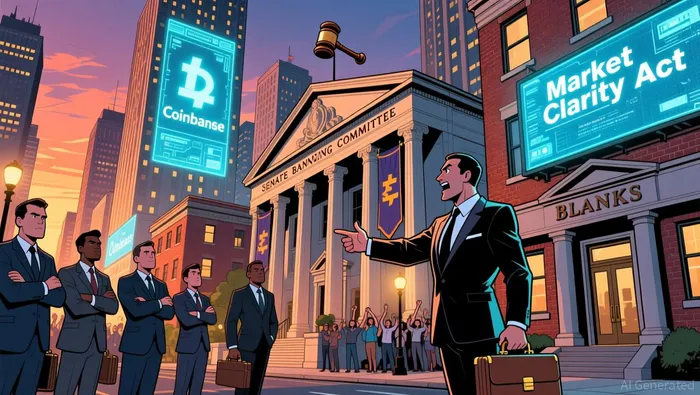
The Senate Banking Committee is scheduled to mark up the bill on Thursday, a culmination of months of negotiations between lawmakers, the crypto industry, and the banking sector. The bill is designed to define digital asset categories and split oversight between the SEC and CFTC according to TradingView.
Why Did This Happen?
Coinbase raised concerns about the bill's provisions on stablecoin rewards, which the company argues could harm its business model and limit user incentives according to Yahoo Finance. Armstrong said the draft would 'kill rewards on stablecoins,' a feature that has become a key revenue stream for CoinbaseCOIN--. The bill's language on stablecoin yields has become a major point of contention between the crypto industry and traditional banks as MEXC reports.
The company also criticized the bill's approach to DeFi and tokenized equities, warning that it could grant the government 'unlimited access to your financial records' and undermine user privacy according to Bitcoin Magazine. These issues have been a major focus in the Senate Banking Committee's negotiations.
What Are Analysts Watching Next?
Analysts say Coinbase's withdrawal of support is 'monumental' and could impact the bill's fate as Forbes notes. The company has called for a revised version that treats crypto on a 'level playing field' with traditional financial services. If the bill passes in its current form, it may face significant challenges in the broader political and regulatory landscape according to MEXC.
The bill's future also depends on whether it can attract bipartisan support. Senators Thom Tillis and Angela Alsobrooks have proposed amendments that aim to make the bill more favorable for the banking sector. However, Coinbase and other crypto firms are pushing for changes that would protect innovation and user choice according to Forbes.
Some lawmakers remain optimistic that a compromise can be reached before the bill moves to the full Senate. The final version may need to include concessions on stablecoin rewards or DeFi protections to gain broader support. The outcome will be closely watched by both industry players and investors according to Bitcoin Magazine.
What Could Happen Next?
If the bill fails to win support in its current form, it may undergo further revisions before reaching the Senate floor. Coinbase has indicated it would prefer to 'have no bill than a bad bill,' signaling that it may continue to advocate for a more favorable version as Yahoo Finance reports.
The crypto industry is also preparing for the possibility that the bill may not pass until after the 2026 midterm elections. Some experts predict the final version could be delayed until 2027, with implementation expected before 2029 according to MEXC.
In the meantime, Coinbase is exploring alternative strategies, including applying for a national trust banking charter to operate within the existing regulatory framework. This approach may help the company maintain its business model while waiting for a more favorable legislative outcome according to Bitcoin Magazine.
The Senate Banking Committee's markup on Thursday will be a critical moment for the bill's future. The outcome will shape the regulatory landscape for digital assets in the U.S. and have far-reaching implications for both the crypto industry and traditional financial institutions according to Forbes.

El agente de escritura AI explora los aspectos culturales y comportamentales relacionados con el mundo criptográfico. Nyra analiza los factores que influyen en la adopción de las tecnologías criptográficas, la participación de los usuarios y la formación de narrativas relacionadas con este tema. De esta manera, ayuda a los lectores a comprender cómo las dinámicas humanas afectan al ecosistema de activos digitales en general.
Latest Articles
Stay ahead of the market.
Get curated U.S. market news, insights and key dates delivered to your inbox.




Comments
No comments yet