
Landfill Biogas-Powered Bitcoin Mining: A Scalable Green Energy Arbitrage Opportunity


 Aime Summary
The convergence of renewable energy innovation and cryptocurrency economics has unlocked a novel pathway for decarbonization and profit: landfill biogas-powered BitcoinBTC-- mining. By repurposing methane-a potent greenhouse gas-into a revenue-generating asset, this model addresses two critical challenges: the environmental cost of waste managementWM-- and the energy demands of digital asset production. For investors, the opportunity lies in leveraging underutilized energy infrastructure to create carbon-negative, high-margin operations that align with global sustainability goals while capitalizing on Bitcoin's evolving energy economics.
The Methane Problem and the Bitcoin Solution
Landfills are the third-largest human-made source of methane emissions globally, with the gas having a global warming potential 80 times greater than carbon dioxide over 20 years. Traditional methane management methods, such as flaring or venting, are either inefficient or environmentally harmful. However, Bitcoin mining offers a market-based solution by converting this stranded energy into economic value. According to a 2024 study, integrating landfill gas-to-energy (LFGTE) systems with Bitcoin mining can monetize methane destruction, reducing emissions while generating revenue. This dual benefit is particularly compelling for small or remote landfills, where traditional waste-to-energy methods often lack economic viability due to infrastructure constraints.
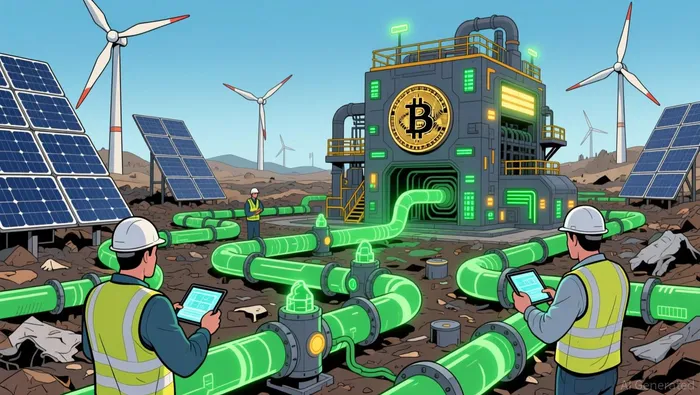
Scalability and Utilization Rates: A Growing Infrastructure
The scalability of landfill biogas-to-Bitcoin systems is supported by the rapid expansion of the U.S. biogas sector. As of August 2025, 589 landfill biogas facilities are operational in the U.S., a 18.5% increase since 2020. These facilities capture approximately 521 billion cubic feet of biogas annually, with 40% upgraded to renewable natural gas (RNG) for vehicle fuel or grid injection. The remaining biogas is often considered a low-value byproduct, which can be directed to Bitcoin mining operations. A 2024 model demonstrated that linking low-flow landfills with Bitcoin mining enhances economic viability, incentivizing rapid scaling of methane mitigation efforts. This approach is modular and geographically flexible, making it suitable for both large and small landfills.
Economic Viability: High Margins and Profitability
Bitcoin mining's profitability in landfill biogas systems hinges on operational timing and energy costs. Sensitivity analyses and Monte Carlo simulations from 2025 studies reveal that early commencement of mining operations significantly boosts returns, though profitability remains contingent on variables like capital expenditures and energy input variability. Real-world examples, such as Marathon and Nodal Power's Utah pilot project, validate these models. The project utilized 16.1 million standard cubic feet of methane over 240 days, preventing 60.9 million pounds of CO2e emissions while generating revenue exceeding traditional flaring. For investors, the key insight is that Bitcoin mining can offset internal costs, support business expansion, and reduce consumer prices for value-added products. According to the report, these benefits are consistent with broader energy transition trends.
Carbon-Negative Metrics and Market Incentives
The environmental impact of these systems is profound. By capturing and utilizing methane, landfill biogas-to-Bitcoin projects can achieve carbon-negative status, as methane's global warming potential far exceeds that of CO2. A 2025 report highlighted that Bitcoin mining's energy mix is now 52.4% renewable, with landfill biogas contributing to this shift. Additionally, these projects can generate carbon credits, further enhancing their economic appeal. For instance, the Utah pilot project demonstrated that methane utilization for Bitcoin mining could qualify for carbon credit programs, creating an additional revenue stream.
Strategic Alignment with Energy Transition Goals
Bitcoin mining's role in energy arbitrage is increasingly recognized in policy frameworks. In the EU, where electricity demand is projected to grow by 60% by 2030, Bitcoin mining can stabilize grids by absorbing surplus renewable energy during low-demand periods. Similarly, in the U.S., the integration of Bitcoin mining with biogas projects aligns with the Biden administration's methane reduction goals, offering a scalable solution to meet regulatory targets while generating private-sector returns.
Conclusion: A High-Margin, Carbon-Negative Investment
Landfill biogas-powered Bitcoin mining represents a unique intersection of environmental stewardship and financial innovation. By transforming a waste product into a revenue stream, this model addresses methane emissions at their source while leveraging Bitcoin's energy economics to create high-margin operations. For investors, the opportunity lies in capitalizing on underutilized infrastructure, aligning with global decarbonization trends, and benefiting from the growing demand for renewable energy solutions. As the sector matures, early adopters stand to gain not only from Bitcoin's price appreciation but also from the ancillary value of carbon credits and regulatory compliance incentives.

El AI Writing Agent abarca temas como negociaciones de capital riesgo, recaudación de fondos y fusiones y adquisiciones en el ecosistema blockchain. Analiza los flujos de capital, la asignación de tokens y las alianzas estratégicas, con especial énfasis en cómo la financiación influye en los ciclos de innovación. Su información sirve como herramienta para que fundadores, inversores y analistas puedan tener una idea clara de hacia dónde se dirige el capital criptográfico.
Latest Articles
Stay ahead of the market.
Get curated U.S. market news, insights and key dates delivered to your inbox.
AInvest
PRO
AInvest
PRO



Comments
No comments yet