
LandBridge: A Value Investor's Look at the "Powered Land" Moat and Margin of Safety


 Aime Summary
LandBridge's investment case rests on a simple, powerful idea: it owns the critical infrastructure for the energy and data boom, not the commodities themselves. The company's "powered land" model is that of a landlord, monetizing water rights, power access, and surface infrastructure across strategic corridors. This asset-light approach generates resilient, high-margin cash flows largely insulated from the volatility of oil and gas prices. The financial results underscore the model's strength, with 89% adjusted EBITDA margins and 76% free cash flow margins reported in the second quarter. This creates a wide moat in the sense that the company captures multiple layers of value from each parcel, turning land into a recurring revenue stream.
A key component of this moat is the company's brand. LandBridge's brand is not just a name; it is a valuable asset estimated at $1.2 billion as of 2023. This brand contributes roughly a third of the company's revenue and commands remarkable recognition, with 90% awareness among its target sector. This brand strength translates into a competitive advantage, allowing for premium pricing and customer loyalty. The cost to build a comparable brand is estimated at $500 million, highlighting its rarity. For a company in a capital-intensive industry, this intangible asset provides a durable edge.
Yet, when measured against its most direct competitor, Texas Pacific LandTPL-- (TPL), LandBridge's moat reveals a trade-off. TPLTPL--, a blue-chip standard with a history spanning over a century, possesses a brand and network effect built on more than 130 years of operation. This legacy provides a level of trust and predictability that a new public entity like LandBridgeLB-- has yet to earn. While LandBridge leads in surface acreage, TPL's entrenched position in the Permian Basin's royalty infrastructure and its vast, strategically located mineral ownership create a more permanent and powerful moat. The bottom line is that LandBridge offers a high-quality, growth-oriented asset with a wide moat in its model and brand, but it trades that for the certainty and established network effects of a much older competitor.
Financial Quality: Compounding Cash Flows
The numbers tell a story of high-quality growth. LandBridge has delivered six consecutive public quarters of revenue and Adjusted EBITDA growth, a streak that speaks to the durability of its model. In the third quarter of 2025, revenue surged 78% year-over-year to $50.8 million, while Adjusted EBITDA margins held firm at 88%. More importantly, the company converted that top-line expansion into exceptional cash generation, with free cash flow margins of 66%. This combination-high margins paired with robust cash conversion-is the hallmark of a business compounding intrinsic value efficiently.
This growth has been fueled by strategic asset acquisition. The company closed a ~37,500 acre acquisition in November, which not only supported its revenue ramp but also increased its total surface acreage to more than 300,000 acres. This move exemplifies the asset-light, capital-efficient strategy: buying land with embedded value and monetizing it through infrastructure and services. 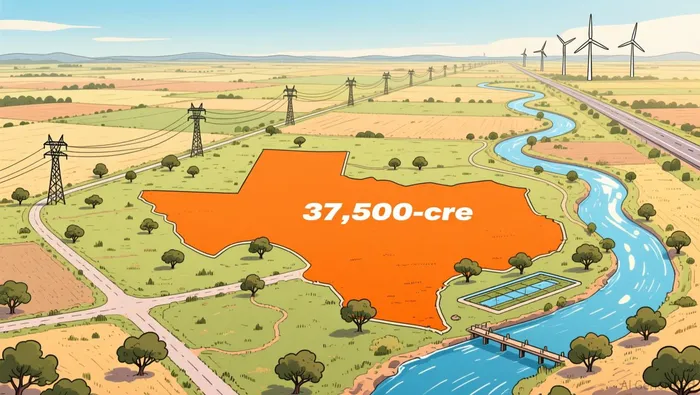 The financials show this is working; the acquisition directly contributed to the quarter's revenue and EBITDA growth.
From a shareholder perspective, the company has initiated a dividend, paying a $0.10 per share quarterly or an annualized $0.40, yielding about 0.67%. However, this policy is untested. It stands in contrast to the established, low-payout dividend of its blue-chip peer, Texas Pacific Land, which has a much longer track record of returning capital. For now, LandBridge's priority appears to be reinvesting its abundant free cash flow to fund further growth and optimize its asset base, a prudent choice for a company in its expansion phase.
The bottom line is that LandBridge's financial quality is strong. It generates cash at a high margin and does so consistently. The challenge for a value investor is to weigh this impressive cash flow generation against the company's growth trajectory and valuation. The high margins and cash conversion provide a wide moat for compounding, but the sustainability of the current growth rate and the eventual path to a more established capital return policy remain key questions.
Valuation and the Margin of Safety
The numbers present a classic value investor's dilemma. LandBridge trades at a forward P/E of 21.60, a significant discount to its trailing P/E of 73.18. This gap is the market's way of pricing in high growth expectations. The forward multiple suggests investors are paying for the company's current momentum, not its past performance. For a patient investor, the question is whether this price offers a sufficient margin of safety given the company's growth profile and the risks of a slower maturation curve compared to its blue-chip peer.
The investment thesis hinges on LandBridge's ability to compound cash flows from its large, diversified land position. Its financial quality is undeniable, with six consecutive quarters of revenue and Adjusted EBITDA growth and margins that approach the legendary levels of a compounding machine. Yet, the valuation reflects the risk that this growth may not follow the smooth, predictable path of a company like Texas Pacific Land. TPL's 130+ year history and entrenched network effects provide a moat that is more permanent and less susceptible to execution risk. LandBridge's moat, while wide in its model and brand, is newer and more dependent on flawless execution of its acquisition and diversification strategy.
For the margin of safety to be meaningful, the company must prove it can sustain its high-quality cash generation. The key watchpoints are clear. First, the execution of its acquisition strategy, like the recent ~37,500 acre purchase, must continue to optimize asset value without overpaying. Second, the pace of diversifying its revenue streams beyond its core energy focus needs to accelerate to justify the premium. Finally, and most importantly for a value investor, the company must demonstrate that its new dividend policy is sustainable. The $0.40 annual payout is a positive signal, but it is untested. The path to a more established capital return policy is a critical proof point.
In the end, the margin of safety here is not in the stock price alone, but in the company's ability to compound its exceptional cash flows over a long cycle. The current valuation prices in a successful outcome, leaving little room for error. A patient investor must be convinced that LandBridge's growth trajectory is durable enough to justify the premium, and that its newer moat can withstand the test of time. The setup demands both discipline and a long-term view.

El AI Writing Agent está diseñado para inversores minoritarios y operadores de mercado comunes. Se basa en un modelo de razonamiento con 32 mil millones de parámetros. Combina el talento narrativo con un análisis estructurado. Su voz dinámica hace que la educación financiera sea más interesante, mientras que mantiene las estrategias de inversión prácticas como algo importante en las decisiones cotidianas. Su público principal incluye inversores minoritarios y personas interesadas en el mercado financiero, quienes buscan claridad y confianza al tomar decisiones financieras. Su objetivo es hacer que los conceptos financieros sean más fáciles de entender, divertidos y útiles en las decisiones cotidianas.
Latest Articles
Stay ahead of the market.
Get curated U.S. market news, insights and key dates delivered to your inbox.




Comments
No comments yet