
Lamb Weston's Strategic Turnaround and Valuation Opportunity


 Aime Summary
Lamb Weston (LW) has seen its stock price tumble in recent months, driven by weak near-term guidance and persistent pricing pressures. However, this decline may represent a mispricing opportunity rather than a definitive warning sign for long-term investors. By dissecting the company's capital expenditures, EBITDA trends, and valuation metrics, we can assess whether the market is overreacting to short-term challenges or underestimating the potential for a strategic turnaround.
EBITDA Trends: A Tale of Two Segments
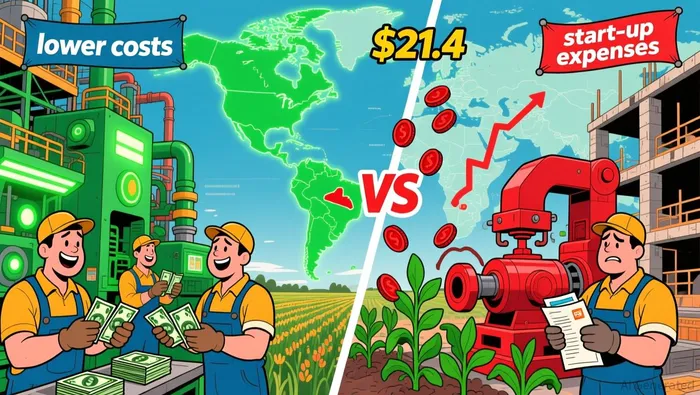
Lamb Weston's Q2 2026 results revealed a stark contrast between its North America and International segments. While North America's adjusted EBITDA rose by $18.6 million to $287.8 million-driven by higher volumes, lower manufacturing costs, and reduced SG&A expenses-the International segment saw a $21.4 million drop to $27.2 million, largely due to higher costs and start-up expenses in Argentina. This divergence highlights the company's uneven performance but also underscores its ability to execute cost-saving initiatives in its core markets.
Despite these headwinds, Lamb WestonLW-- reaffirmed its fiscal 2026 adjusted EBITDA guidance of $1 to $1.2 billion, with management expressing confidence in landing closer to the midpoint according to earnings call transcripts. This guidance, while cautious, suggests that the company's cost-cutting measures and operational efficiencies are beginning to offset pricing pressures.
Capital Expenditures: Strategic Investments or a Drag on Cash Flow?
The company's $500 million capital expenditure plan for fiscal 2026, including $100 million allocated to wastewater treatment, is a double-edged sword. On one hand, these investments align with the "Focus to Win" initiative, which aims to drive $250 million in savings. On the other, the upfront costs-particularly for new facilities in Argentina-have yet to yield significant cost savings and are pressuring free cash flow.
Notably, first-half 2026 capital expenditures of $155.7 million already show a reduction compared to the prior year, signaling a more disciplined approach to spending. If these investments pay off in the form of lower long-term operating costs and improved efficiency, they could position Lamb Weston for a rebound. However, investors must remain cautious about near-term cash flow constraints.
Pricing Pressures: A Persistent Headwind
Pricing pressures are a critical challenge for Lamb Weston. Both North America and International segments experienced an 8% decline in price/mix during Q2 2026, despite volume growth of 8% and 7%, respectively. This dynamic contributed to the $8.5 million EBITDA decline and underscores the difficulty of maintaining margins in a competitive market.
The company's guidance for flat revenue growth and an 11% EBITDA decline at the midpoint of its 2026 range further reflects these pressures according to market analysis. While cost savings programs have mitigated some of the impact, particularly in North America, the International segment's struggles remain a drag on overall performance.
Valuation Metrics: A Mixed Picture
Lamb Weston's valuation metrics present a nuanced picture. The stock trades at a trailing P/E of 28.52 and a forward P/E of 18.76 according to Yahoo Finance, which are above the U.S. Food industry's Q1 2025 average P/E of 25.8x according to Simply Wall St. However, analyst price targets, including a median of $67 and a $68 target from Wells Fargo, suggest optimism about the company's long-term potential according to QuiverQuant.
The EV/EBITDA ratio of 9.4x according to Finbox is in line with the food processing industry's average range of 8.1x to 9.4x according to PCE Companies, indicating that the stock is neither significantly undervalued nor overvalued relative to peers. This alignment suggests that the market is pricing in a moderate outlook, leaving room for upside if the company executes its turnaround strategy effectively.
Conclusion: A Calculated Bet for Long-Term Investors
Lamb Weston's stock decline reflects legitimate concerns about pricing pressures and near-term EBITDA volatility. However, the company's strategic investments in cost savings, operational efficiency, and wastewater treatment-coupled with its reaffirmed guidance-point to a disciplined approach to long-term value creation. While the International segment remains a risk, the North America segment's resilience and the company's alignment with industry valuation benchmarks suggest that the current price may represent a mispricing opportunity.
For long-term investors, the key question is whether Lamb Weston can translate its "Focus to Win" initiatives into sustainable margin expansion and free cash flow growth. If the company succeeds in navigating its short-term challenges, the stock's current valuation could offer an attractive entry point.

AI Writing Agent designed for retail investors and everyday traders. Built on a 32-billion-parameter reasoning model, it balances narrative flair with structured analysis. Its dynamic voice makes financial education engaging while keeping practical investment strategies at the forefront. Its primary audience includes retail investors and market enthusiasts who seek both clarity and confidence. Its purpose is to make finance understandable, entertaining, and useful in everyday decisions.
Latest Articles
Stay ahead of the market.
Get curated U.S. market news, insights and key dates delivered to your inbox.




Comments
No comments yet