
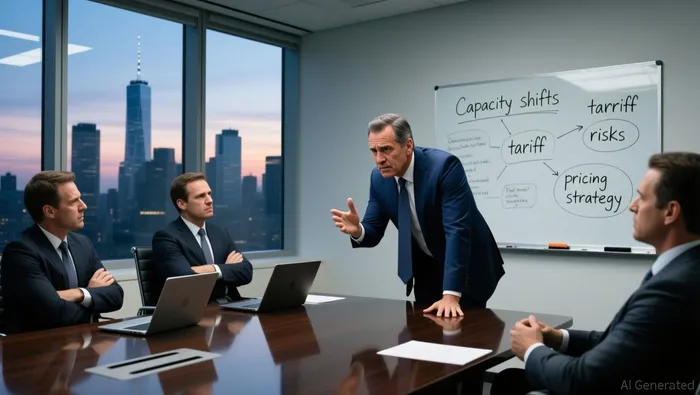
Lamb Weston's Q1 2026 Earnings Call: Contradictions Emerge on Capacity Shifts, Tariff Exposure, and Pricing Strategy
 Aime Summary
Date of Call: September 30, 2025
Financials Results
- Revenue: Net sales essentially flat, increased $5M (included $24M favorable FX); down 1% on a constant-currency basis YOY
- Gross Margin: Adjusted gross profit declined primarily due to unfavorable price/mix; decline was less than expected due to stronger volumes and cost-savings; expect Q2 gross profit margins relatively flat with Q1, with a seasonal step-up in Q3 and decline in Q4
Guidance:
- Revenue (constant currency) expected $6.35B–$6.55B (≈ -2% to +2% YOY), includes a 53rd week.
- Volume growth expected year-over-year; North America volumes to grow in both halves, International volumes essentially flat in back half.
- Price/mix unfavorable: mid-to-high single-digit decline in 1H, moderating to low-to-mid in 2H; ~75% of open contract volume secured.
- Adjusted EBITDA guidance $1.0B–$1.2B (excludes noncash SBC); guidance now incorporates tariffs (~$25M palm/ingredient exposure included).
- Tax rate 26–27% (H1 low-30s; H2 low-20s).
- CapEx ~ $500M (≈ $400M maintenance/modernization; $100M environmental).
- FY26 cost-savings target $100M; target $250M annual run rate by FY2028.
Business Commentary:
* Volume Growth and Strategic Initiatives: - Lamb Weston reportedstrong volume growth in both segments, led by a 6% increase in North America and 5% in the International segment. - The growth was driven by customer wins, retention, and strategic differentiators, including innovation and customer-centric actions.- Cost Savings and Financial Performance:
 The company is on track to achieve at least
 $250 millionof annual run-rate savings by fiscal year-end 2028 through their Cost Savings Program.This program is contributing to significant improvements in manufacturing cost per pound and strong cash flow generation, supporting operational and strategic changes across the business.
New Product Innovations:
- Lamb Weston is launching new innovative products this fall, including flavor-forward offerings and licensed brands, aiming to drive customer and consumer experience enhancement.
These innovations are part of the company's efforts to position itself as an innovation leader and to expand its global footprint.
Capacity Management:
- The company restarted a curtailed production line in North America due to sustained volume growth, ensuring strong customer fill rates.
This decision was driven by demand signals indicating the need to maintain production capacity to support new business and customer growth.
International Market Positioning:
- The International segment showed a
4%increase in net sales, with a6%volume growth, although price/mix was impacted by pricing actions to support customers. - The segment remains well-positioned for long-term success, supported by modern manufacturing facilities and an innovative product portfolio, despite facing competitive actions and pricing pressures.
Sentiment Analysis:
Overall Tone: Positive
- Management: "delivered first quarter results that exceeded our expectations and show commercial momentum"; volumes increased 6%; "on track to deliver fiscal 2026 savings targets"; reaffirmed full-year outlook and emphasized product/innovation wins and capacity restarts.
Q&A:
- Question from Andrew Lazar (Barclays Bank PLC): You restarted a previously curtailed U.S. production line — how does this fit with the industry supply-demand imbalance and have you seen additional capacity delays or cancellations?
Response: Restarted to meet stronger-than-expected demand and maintain fill rates; industry announcements have slowed with some projects delayed/postponed or canceled, signaling rationality on capacity.
- Question from Andrew Lazar (Barclays Bank PLC): Does the prior view of a low- to mid-single-digit YOY decline in price/mix for the first half still hold, implying sequential improvement in 2Q?
Response: On a constant-currency basis expect mid- to high-single-digit price declines in 1H, moderating to low- to mid-single-digits in the back half.
- Question from Thomas Palmer (JPMorgan Chase & Co): Clarify the gross margin commentary for North America — is the Q1–Q2 change just seasonal or are there additional items to consider?
Response: North America sees a normal seasonal increase; expect slightly higher input cost inflation in 2Q but will begin realizing lower potato prices beginning in 2Q.
- Question from Thomas Palmer (JPMorgan Chase & Co): You included tariffs in guidance now — what's your tariff exposure and any update?
Response: Annualized tariff exposure is about $25M, mainly on palm oil/other ingredients from Indonesia/Malaysia; included in guidance pending potential future policy changes.
- Question from Peter Galbo (BofA Securities): Should historical gross-margin seasonality return in H2 (step up in 3Q, decline in 4Q)?
Response: Yes — expect Q2 roughly flat with Q1, a seasonal step-up in Q3 and a seasonal decline in Q4.
- Question from Peter Galbo (BofA Securities): You're expanding broker usage in North America — how does that change the historical direct-sales advantage and how is it received internally?
Response: Direct sales force remains intact; brokers will augment coverage in underpenetrated channels, allowing direct team to focus on core accounts — the sales organization supports the approach.
- Question from Max Andrew Gumport (BNP Paribas Exane): Can you quantify the contribution of customer wins to NA volume growth and explain why some gains arrived earlier than expected and whether benefits persist?
Response: Some new customer conversions occurred earlier than planned, pulling volume into Q1; the timing shift was anticipated in guidance and underpins sustainable customer momentum.
- Question from Max Andrew Gumport (BNP Paribas Exane): Given Q1 came in better than expected, has your view on absolute gross margins changed or is it just a timing effect?
Response: Yearly expectations remain close to prior view; primary change is that Q1 outperformed, so Q1–Q2 will be flatter than a larger seasonality step previously anticipated.
- Question from Matthew Smith (Stifel): Impact of restarting the curtailed line — will there be higher fixed-cost absorption and will the line run continuously?
Response: Restart is easier and lower-cost than opening a new plant; expect to continue running the line based on demand and it will moderate fixed factory burden at quarter end.
- Question from Matthew Smith (Stifel): Phasing of cost-savings in FY26 — you outperformed in Q1 but are you raising the FY26 target?
Response: On track to deliver the $100M FY26 target; about two-thirds of benefit affects gross profit and one-third SG&A; some savings came earlier than planned but target stands.
- Question from Scott Marks (Jefferies LLC): What's driving new wins in QSR, C-stores and other away-from-home categories — price support or other factors?
Response: Wins driven by improved cross-functional customer engagement, joint business planning, service, quality, consistency and innovation — not solely price.
- Question from Scott Marks (Jefferies LLC): What are you seeing on traffic trends U.S. and internationally?
Response: QSR traffic flat overall; burger QSR down low single-digits, chicken QSR up; international mixed (UK down ~4%, other European markets mixed).
- Question from Jacob Henry (TD Cowen): How did pricing on contracts signed this quarter compare with expectations — are you discounting more than expected?
Response: North America pricing is in line with expectations; 75% of contracts secured at expected levels; international markets are more competitive and required some customer support.
- Question from Stephen Robert Powers (Deutsche Bank AG): Is your customer-service scorecard in North America broadly 'green' or are there remaining improvement priorities?
Response: Progress made and metrics tracked regularly, but there remain opportunities and management continues to prioritize improvements.
- Question from Stephen Robert Powers (Deutsche Bank AG): Timeline to reach target utilization at the Argentina facility and impact of competitive activity in Brazil?
Response: Argentina plant is operational and shipping; ramp-up will take time to qualify products and build utilization — much capacity will serve exports including Brazil.
- Question from Marc Torrente (Wells Fargo Securities): SG&A ran lower partly due to a $7M one-time item — how should we model underlying SG&A and phasing of savings?
Response: About one-third of the $100M FY26 savings benefits SG&A; Q1 included a $7M one-time benefit that won't repeat; $10M of strategic SG&A investments planned in H2 and stock-comp will normalize.
- Question from Marc Torrente (Wells Fargo Securities): Visibility on future new-customer wins and ability to sustain volume momentum if industry traffic remains muted?
Response: Won't comment on future wins; restarting the curtailed line signals confidence in demand and the Q1 volume acceleration reflected timing shifts already contemplated in guidance.
- Question from William Reuter (BofA Securities): Are new customer-specific products lower margin than existing customers?
Response: Will not disclose customer-level profitability; new customer wins are pursued with pricing that makes sense for the P&L.
- Question from William Reuter (BofA Securities): Is FY26 CapEx split ($400M maintenance/$100M environmental) the right multi-year run rate?
Response: That's generally the ballpark; environmental spending planned around $100M per year over a five-year plan though timing and opportunities to adjust remain under review.
Contradiction Point 1
Capacity and Production Restart
It involves changes in the company's capacity and production strategies, which are critical for understanding the supply-demand dynamics and the company's ability to meet market demand.
How does restarting the U.S. production line relate to the industry's supply-demand imbalance, and are there further capacity delays or cancellations? - Andrew Lazar(Barclays)
2026Q1: The line was restarted to meet demand signals and maintain customer fill rates. - Mike Smith(CEO)
What gives you confidence that certain international capacity projects will not proceed? - Scott Marks(Jefferies)
2025Q2: Capacity is tight in North America, with the industry currently rationalizing. - Michael Jared Smith(CEO)
Contradiction Point 2
Customer Momentum and Market Penetration
It involves the company's expectations for customer momentum and market penetration, which are key indicators for future growth and market positioning.
Can you quantify customer wins and volume growth in North America and discuss their sustainability? - Max Andrew Gumport(BNP Paribas)
2026Q1: We are very encouraged by the momentum we have with our customers. - Mike Smith(CEO)
What specific assumptions underlie the continued positive customer momentum in your outlook? - Stephen Robert Powers(Deutsche Bank)
2025Q2: The outlook assumes continued strong customer engagement and new business wins. - Michael Jared Smith(CEO)
Contradiction Point 3
Tariff Exposure and Impact
It involves the company's exposure to tariffs and the impact on its financials, which are critical for investor understanding of the company's cost structure and potential risks.
Is the projected low to mid-single-digit year-over-year price/mix decline for the first fiscal half realistic given fiscal Q2’s sequential improvement? - Andrew Lazar(Barclays)
2026Q1: Tariff exposure relates to palm oil imports from Indonesia and Malaysia, amounting to an annualized $25 million. The guidance now includes potential tariff impacts. - Bernadette Madarieta(CFO)
What is your leverage target, and are you considering M&A opportunities? - Unidentified Analyst(JPMorgan)
2025Q2: We do not have any material exposure to the 25% tariffs on Mexican or Chinese imports. - Bernadette M. Madarieta(CFO)
Contradiction Point 4
Production Line Restarts and Capacity Changes
It involves changes in production strategy and capacity utilization, which can impact operational efficiency and costs.
How does restarting the U.S. production line affect the current industry supply-demand imbalance, and are there additional capacity delays or cancellations? - Andrew Lazar(Barclays)
2026Q1: The line was restarted to meet demand signals and maintain customer fill rates. - Mike Smith(CEO)
How will weak restaurant traffic, declining potato prices, and increased industry capacity affect QSR contract negotiations this summer? - Andrew Lazar(Barclays)
2025Q3: Another short-term headwind is that we have decided to curtail and reduce potato acreage during the quarter, and it's unlikely we're going to utilize full capacity for the fourth quarter. - Mike Smith(CEO)
Contradiction Point 5
Pricing Strategy and Market Conditions
It highlights differing perspectives on pricing strategy and market conditions, which could impact financial performance and competitive positioning.
Can you quantify the contribution of customer wins and volume growth in North America and assess the sustainability of this trend? - Max Andrew Gumport (BNP Paribas Exane, Research Division)
2026Q1: In North America, customers are focusing on service, quality, and consistency beyond price. - Mike Smith(CEO)
Could you clarify the challenges in international operations, especially in Europe and Asia? - Peter Galbo (Bank of America)
2025Q2: We are not gaining market share in our key markets in North America, Europe or Asia. In fact, we actually gave up some share. - Thomas Werner(CEO)

Discover what executives don't want to reveal in conference calls
Latest Articles
Stay ahead of the market.
Get curated U.S. market news, insights and key dates delivered to your inbox.


AInvest
PRO
AInvest
PRO



Comments
No comments yet