
Lam Research's (LRCX) Record Q2 Results and AI-Driven Semiconductor Growth: A Moat of Atomic Precision
 Aime Summary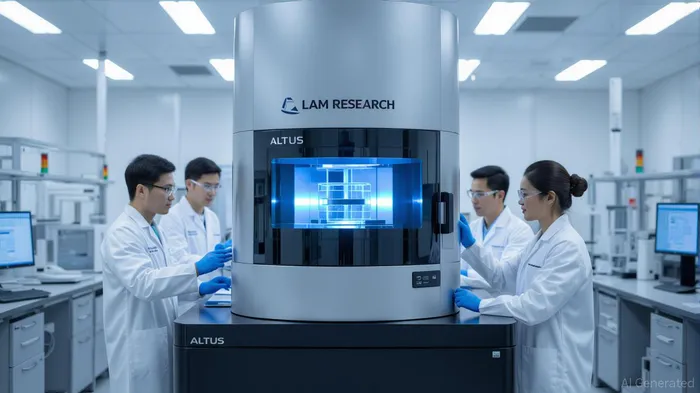
Lam Research Corporation (LRCX) has cemented its position as a linchpin in the AI chip revolution, delivering record Q2 2025 financial results that underscore its dominance in atomic-level manufacturing. Revenue surged to $5.17 billion, a 9.6% sequential increase, with non-GAAP operating margins hitting 34.4%—a testament to its pricing power and operational discipline. But beyond the numbers lies a deeper narrative: Lam's technological moat, built on decades of innovation in atomic layer deposition (ALD) and etching, is uniquely positioned to capture long-term value as the AI semiconductor market accelerates.
Atomic Precision: The Core of Lam's Competitive Edge
Lam's ALTUS® Halo molybdenum (Mo) deposition system is a cornerstone of its AI-driven growth. This tool addresses the critical challenge of interconnect reliability in sub-3nm architectures, where traditional materials like tungsten hit physical limits. Molybdenum's shorter electron mean-free path reduces resistance in ultra-narrow interconnects, enabling faster signal integrity in 3D-stacked AI chips. The ALTUS Halo has already been adopted by leading foundries such as TSMCTSM-- and Samsung, who are racing to commercialize 2nm and 1.4nm nodes.
Equally transformative is Lam's Akara® conductor etch platform, designed for gate-all-around (GAA) transistors—a key enabler of AI accelerators. GAA structures require angstrom-level precision to maintain electrostatic control and power efficiency, which the Akara achieves through proprietary technologies like DirectDrive® and SNAP™ ion energy control. These capabilities are indispensable for manufacturers like IntelINTC--, who are pivoting to GAA designs to meet the demands of generative AI and large language models.
AI's Infrastructure: Lam's Role in the Ecosystem
The AI semiconductor market is projected to grow at a 7.5% CAGR through 2030, with generative AI chips alone expected to surpass $500 billion in value by 2028. Lam's served market in wafer fabrication equipment (WFE) now spans 35% of the industry, driven by its exposure to three critical AI workloads:
1. Logic Chips: GAA and backside power technologies for AI accelerators.
2. Memory: 3D NAND and high-bandwidth memory (HBM) for data centers.
3. Packaging: 2.5D/3D heterogeneous integration to stack HBM with logic chips.
Lam's SABRESABR-- 3D copper plating system, with 6,000 installed cells—the largest in the industry—ensures the high-throughput data transfer required for AI training. This system is pivotal for heterogeneous integration, a process adopted by NVIDIANVDA-- and AMDAMD-- to combine HBM with advanced logic chips. While Lam's tools are not directly named as NVIDIA's or AMD's suppliers, their indirect role via foundries like TSMC and Samsung is undeniable. For example, NVIDIA's GB200 NVL2 platform relies on TSMC's 3nm node, which in turn depends on Lam's etch and deposition tools.
Financial Fortitude and Strategic Depth
Lam's Q2 results highlight its financial resilience: a 50.3% gross margin, $1.33 non-GAAP diluted EPS, and $6.4 billion in cash reserves. Its free cash flow margin of 46.1% provides flexibility to reinvest in R&D or return capital to shareholders. The company's Semiverse® Solutions platform, which uses AI-driven simulation tools to accelerate R&D cycles for customers, is another growth driver, creating recurring revenue streams in software and data analytics.
Historical data further bolsters the investment case. Lam has exceeded earnings expectations 11 times since 2022, and its stock has historically outperformed post-earnings beats, with a 90.91% win rate over 10 days and a 54.55% win rate over 3 days. This pattern suggests strong institutional confidence in the company's ability to sustain its growth trajectory.
Long-Term Investment Thesis
Lam's atomic-level manufacturing moat is not just a technical advantage—it's a strategic one. As AI workloads become more compute-intensive, the demand for tools like the ALTUS Halo and Akara will only intensify. The company's deep integration into the supply chains of leading-edge foundries and its partnerships with ASML and imec on EUV lithography further solidify its position.
For investors, the case for LRCX is compelling. With a P/E ratio of 18.5x (as of Q2 2025) and a projected 7.5% CAGR in the AI semiconductor market, Lam offers a rare combination of near-term growth and long-term durability. Its recurring revenue model, driven by maintenance contracts and software solutions, adds stability to its cash flows.
Conclusion
Lam Research's record Q2 results are more than a quarterly win—they signal the company's role as a foundational enabler of the AI era. By mastering atomic-scale manufacturing, Lam has created a moat that is both technological and financial. As the industry transitions to 1.4nm and beyond, investors who recognize the value of atomic precision will find LRCX to be a durable, high-conviction holding in their portfolios.
"""

Delivering real-time insights and analysis on emerging financial trends and market movements.
Latest Articles
Stay ahead of the market.
Get curated U.S. market news, insights and key dates delivered to your inbox.
AInvest
PRO
AInvest
PRO



Comments
No comments yet