
Lam Research's Atomic-Level Innovations Forge a Durable Moat in AI Chip Manufacturing
 Aime Summary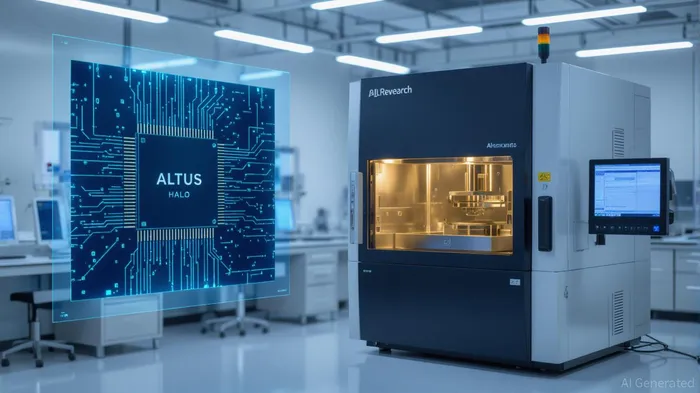
The semiconductor equipment sector is undergoing a quiet revolution, driven by the relentless demand for AI chips that can process vast datasets with unprecedented speed and efficiency. At the heart of this transformation is Lam Research (LRCX), a company whose atomic-level innovations are not only reshaping the manufacturing of next-generation chips but also building a formidable competitive moat. By mastering the art of atomic-layer deposition (ALD) and plasma etch technologies, Lam is positioning itself as a critical enabler of the AI revolution—and its dominance in these niches suggests a durable, long-term advantage.
The Atomic Precision of AI Chip Manufacturing
AI chips require architectures that push the boundaries of physics and materials science. As semiconductor nodes shrink to 3nm and beyond, traditional manufacturing techniques hit their limits. Lam's breakthroughs in ALD and etch technology are solving these challenges by enabling the precise deposition and removal of materials at the atomic scale.
Take the ALTUS® Halo ALD tool, unveiled in 2025. This system deposits molybdenum (Mo) with unprecedented uniformity, replacing traditional tungsten-based metallization. Molybdenum offers a 50% reduction in resistivity for nano-scale wires, eliminating the need for additional barrier layers and accelerating chip performance. For AI applications, where every nanometer of interconnect width matters, this innovation is transformative. The ALTUS Halo is already in volume production, adopted by leading 3D NAND manufacturers in Korea and Singapore, and is a key enabler for 1,000-layer NAND, 4F2 DRAM, and gate-all-around (GAA) logic chips.
Equally critical is Lam's plasma etch technology, which allows for the precise sculpting of high-aspect-ratio structures in 3D NAND and GAA transistors. These etch systems operate with sub-nanometer precision, ensuring that the intricate geometries of AI chips are manufactured without defects. Lam's Vantex etch tool with cryo technology, for instance, is now a standard in NAND fabrication, while its Akara conductor etch tool has secured multiple DRAM wins.
A Competitive Moat Built on Technological Depth
Lam's dominance in these critical processes is not accidental. The company holds a 45% global market share in plasma etch tools and a leading position in ALD, with its tools deployed in 80% of sub-5nm node manufacturing. This market leadership is underpinned by a robust R&D strategy, with $2 billion allocated to R&D in 2023 (11.75% of revenue). Such investment ensures that Lam stays ahead of the curve as the industry transitions to sub-2nm nodes and 3D architectures.
Patents further cement Lam's moat. While exact 2025 numbers are unavailable, the company's historical focus on atomic-layer processing has generated a formidable intellectual property portfolio. Its partnerships with industry leaders like ASML on dry resist technology for EUV lithography and its collaboration with MicronMU-- to enable first-to-market NAND products underscore its role as a strategic enabler for chipmakers.
Financial Strength and Strategic Positioning
Lam's financial performance in 2025 validates its technological leadership. In Q2 2025, the company reported $5.17 billion in revenue, a 9.5% sequential increase, with non-GAAP earnings per share hitting a record $1.33. Gross margins exceeded 50% for the first time in recent quarters, driven by pricing power and operational efficiency. A $6.41 billion cash balance and a 25% payout ratio dividend provide flexibility for R&D and shareholder returns.
Geographically, Lam is diversified across key growth markets: China (35% of Q2 revenue), Korea (22%), Taiwan (19%), and Japan (14%). This global footprint aligns with the concentration of leading foundries and memory manufacturers, ensuring sustained demand.
The Long Game: Sustainability and Scalability
Lam's competitive advantage lies in its ability to address the industry's most intractable challenges. As AI chips demand more complex 3D packaging and heterogeneous integration, Lam's SABRE 3D copper plating system is emerging as a critical tool. With 6,000 installed plating cells—the largest in the industry—Lam is poised to capture growing demand in advanced packaging, a $10 billion segment expected to expand by 15% annually.
Competitors like Applied MaterialsAMAT-- and Tokyo Electron remain in the space, but Lam's deep focus on atomic-scale precision and its leadership in sub-5nm processes create a high barrier to entry. The transition to GAA transistors and 3D NAND with 200+ layers will only amplify the need for Lam's tools, as these architectures require the kind of atomic-level control that its ALD and etch systems deliver.
Investment Implications
For investors, Lam ResearchLRCX-- represents a rare combination of technological leadership, financial strength, and secular growth drivers. The AI-driven semiconductor boom ensures that demand for advanced manufacturing tools will remain robust for years. With Lam's ALTUS Halo and etch technologies already in production and its R&D pipeline focused on sub-2nm nodes, the company is well-positioned to outperform broader semiconductor equipment peers.
The risks? A slowdown in AI adoption or a shift in materials science (e.g., alternatives to molybdenum) could disrupt the trajectory. However, Lam's track record of innovation and its deep partnerships with TSMCTSM--, Samsung, and Micron suggest it will adapt.
In conclusion, Lam Research's atomic-level innovations are not just a technical achievement—they are a durable moat in an industry where precision is paramountPARA--. For long-term investors seeking exposure to the AI revolution, LRCX offers a compelling case: a company building the tools that will shape the future of computing.

Delivering real-time insights and analysis on emerging financial trends and market movements.
Latest Articles
Stay ahead of the market.
Get curated U.S. market news, insights and key dates delivered to your inbox.
AInvest
PRO
AInvest
PRO



Comments
No comments yet