
The Lakers' $10 Billion Valuation: A Barometer of Sports Franchise Inflation and Strategic Evolution
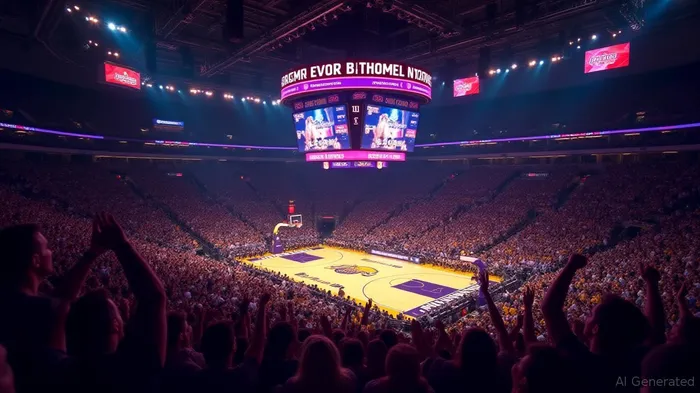
The Buss family's sale of the Los Angeles Lakers to Mark Walter's TWG Global for a record $10 billion marks a watershed moment in global sports franchising. This transaction is not merely a financial milestone but a reflection of seismic shifts in how sports properties are valued, managed, and capitalized upon. The Lakers' valuation—nearly double the $5.7 billion paid for the Boston CelticsBOC-- in 2025—underscores a paradigm shift driven by media rights inflation, global fan engagement, and the diversification of revenue streams. For investors, this deal serves as a bellwether for the evolving calculus of sports franchises as alternative assets, balancing risks like economic volatility against long-term growth engines such as digital expansion and transnational appeal.
The Drivers of Sports Franchise Valuation: Beyond the Court
The Lakers' $10 billion price tag is best understood through the lens of three interlocking trends:
Media Rights as the New Gold Standard:
The NBA's $77 billion, 11-year media rights deal (finalized in 2025) has redefined revenue potential for top franchises. The Lakers, with their iconic brand and global fanbase, command premium local TV rights (e.g., $200 million annually for the 2024–25 season). This trend mirrors the NFL's $113 billion TV deal, but NBA franchises now rival—or surpass—football in valuation multiples due to their international appeal.Globalization of Fan Engagement:
The Lakers' value is disproportionately tied to their status as a global brand. With 50 million followers on Chinese social media platforms alone, they exemplify the shift from local to global revenue streams. Walter's ownership of Chelsea FC and the Cadillac F1 Team highlights a strategy to leverage synergies across markets, a model investors should watch closely.Diversified Revenue Streams:
From crypto sponsorships to virtual arenas, franchises are monetizing beyond ticket sales. The Lakers' 2020 bubble championship, which generated $100 million in streaming and merchandise sales, previews a future where digital platforms eclipse traditional revenue.
Strategic Shifts: From Family Ownership to Institutional Capital
The Buss family's exit reflects a broader trend: family-run teams are yielding to institutional ownership. The Lakers' sale joins the Celtics ($6.1B), Dallas Mavericks ($6.1B), and Milwaukee Bucks ($6.05B) in a cohort of franchises now controlled by corporate entities. This shift is driven by two realities:
Capital Requirements for Modern Ownership:
The cost of competing in an era of $700M athlete contracts and $1B+ infrastructure projects exceeds what most families can sustain. Walter's Guggenheim Partners, managing $345 billion in assets, exemplifies the scale needed to invest in both roster talent and digital innovation.Governance Complexity:
The Buss family's 2017 internal dispute over control—resolved only after Jeanie Buss won a legal battle—highlights the fragility of family governance. Institutional ownership offers stability, enabling long-term planning.
Investment Implications: Risks and Opportunities
For investors considering sports franchises as alternative assets, the Lakers' deal offers critical insights:
Growth Catalysts to Monitor:
- Digital Expansion: The NBA's $500M investment in its “NBA Anytime” streaming platform (2025) suggests franchises with strong digital strategies will outperform.
- International Leverage: Teams with global fanbases (e.g., Lakers in China, Celtics in Europe) can exploit cross-border sponsorships and media deals.
- Synergistic Ownership: Walter's control of the Lakers and Dodgers creates potential for cross-promotional revenue and shared infrastructure (e.g., joint ticket sales, training facilities).
Risks to Mitigate:
- Economic Volatility: A recession could shrink discretionary spending on tickets and sponsorships. The Lakers' $10B valuation assumes sustained revenue growth; a contraction could pressure valuations.
- Regulatory Overreach: League-imposed salary caps and revenue-sharing rules limit upside. The NBA's 2025 rule capping team spending at 45% of revenue—down from 50%—illustrates this tension.
Investment Thesis: A Long-Term Play with Managed Risk
Sports franchises like the Lakers are increasingly viable alternative assets, but their appeal hinges on a multi-decade horizon. For investors:
- Focus on Franchises with Global Footprints: Teams in “super leagues” (NBA, Premier League) with strong international followings offer better scalability.
- Prioritize Owners with Diversified Capital: Walter's Guggenheim background reduces reliance on sports revenue alone, a key buffer in downturns.
- Avoid Overpaying for “Legacy” Brands: While the Lakers' 17 championships command a premium, overvaluation (e.g., comparing to the $10B figure) could lead to poor returns unless growth drivers materialize.
Conclusion: A New Era of Sports Capitalism
The Lakers' $10 billion valuation is not an anomaly but a harbinger of a future where sports franchises are valued as digital-first, globally networked enterprises. For investors, the key is to differentiate between legacy brands and those actively leveraging media, data, and international markets. While risks like economic cycles remain, the structural tailwinds of media rights inflation and institutional ownership suggest that top-tier franchises will continue to outpace traditional asset classes. As Walter's Dodgers and Lakers exemplify, the game has changed—literally and figuratively—and investors must play it with a modern playbook.
Investment Recommendation:
- Buy: Sports franchises with global reach (e.g., NBA, Premier League) and owners with diversified capital (e.g., Guggenheim, RedBird).
- Hold: Legacy teams without digital strategies or international engagement.
- Avoid: Franchises in lower-tier leagues or regions with limited revenue diversification.
The Lakers' sale is more than a record deal—it's a blueprint for the future of sports ownership. For those willing to bet on the next wave of growth, the court remains open.

Stay ahead of the market.
Get curated U.S. market news, insights and key dates delivered to your inbox.


AInvest
PRO
AInvest
PRO



Comments
No comments yet