
Labubu's Global Conquest: Can Pop Mart Sustain Its Profit Surge?
Pop Mart International Group Limited (HK:9992) has ignited the global toy market with a 350% year-over-year (YoY) net profit surge in Q1 2025, driven by its viral Labubu plush dolls. This meteoric rise raises a critical question: Is this a fleeting fad, or a sustainable shift in the collectibles industry? With Labubu's global appeal fueling a 200%+ revenue jump, the company now sits atop a $44 billion market cap, surpassing legacy giants like HasbroHAS-- and MattelMAT--. Let's dissect the drivers, risks, and investment potential behind this phenomenon.
The Labubu Phenomenon: From China's Shelves to Global Icons
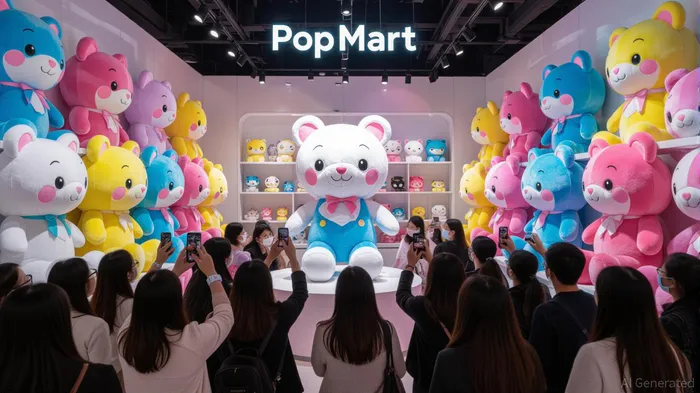
Labubu's jagged-toothed, mischievous design has transcended its origins as a blind box toy to become a global cultural symbol. Celebrities like Rihanna and Blackpink's Lisa have amplified its mystique, while its scarcity model—limited editions sold in vending machines and pop-up stores—has created a secondary market frenzy. A human-sized Labubu recently sold for $150,000 at auction, underscoring its status as a luxury collectible.
The 350% profit jump stems not just from Labubu's popularity but from Pop Mart's strategic scaling:
- Plush toys revenue skyrocketed 1,289% to RMB 2.83 billion in 2024, now 21.7% of total revenue.
- Overseas markets exploded with a 475–480% YoY revenue surge, led by a 900% leap in the Americas and 600% in Europe.
Operational Efficiency: Margins and Supply Chain Mastery
Pop Mart's 66.8% gross margin—nearly double that of competitors like Xiaomi or BYD—reflects its cost discipline. The company has optimized production (scaling Labubu output from 300,000/month to 10 million/month) and reduced reliance on distributors via a direct-to-consumer (DTC) model. For instance, its U.S. stores and 1.7 million members now contribute nearly as much revenue as all 2024 U.S. sales in just three months.
Global Expansion: Opportunities vs. Risks
Growth Drivers:
1. Untapped Markets: Southeast Asia's collectibles sector is still nascent, with Vietnam and Thailand showing sixfold revenue gains. Pop Mart's plans to open 100+ new stores in 2025—targeting super-flagships in Sydney, Paris, and the U.S.—could unlock further upside.
2. IP Diversification: Beyond Labubu, IPs like Hirono (now in tech accessories) and collaborations with artists like Kasing Lung provide a pipeline for new hits.
3. Cultural Localization: Partnerships in regions like the Philippines (co-developing culturally relevant collectibles) reduce the risk of “one-size-fits-all” failures.
Risks to Watch:
- Market Saturation: The Chinese collectibles market, while growing at a 20% CAGR to RMB 110 billion by 2026, faces competition from rivals like TopToy (Miniso's brand), which captured RMB 9.8 billion in 2024.
- IP Dependency: Labubu and the Monster series account for 23.3% of revenue. A decline in its popularity could hit profitability hard.
- Supply Chain Strains: Rapid scaling risks logistical bottlenecks, especially in new markets.
Investment Outlook: A Buy with Caveats
Pop Mart's stock has surged nearly 600% over the past year, reaching a market cap of HK$338.1 billion. Analysts rate it a “Buy” with a HK$105 target, but investors should consider:
Bull Case:
- Labubu's longevity as a premium brand could mirror the success of Pokémon or Barbie, with secondary markets sustaining demand.
- Global expansion into untapped regions (e.g., Middle East, Africa) offers scalability.
Bear Case:
- Overvaluation: At current levels, the stock trades at 45x trailing P/E, higher than Hasbro's 20x. A correction could occur if growth slows.
- Regulatory Risks: China's crackdown on “excessive speculation” in collectibles could impact pricing dynamics.
Recommendation: Position for Growth, but Stay Prudent
Pop Mart's Q1 2025 results confirm its transformation from a regional retailer to a global IP powerhouse. Investors seeking exposure to trend-driven retail should consider:
- Buying on dips: Use pullbacks below HK$70 as entry points, with a stop-loss at HK$55.
- Long-term hold: If Labubu's cultural relevance endures, Pop Mart's 67% gross margin and DTC model could sustain outsized returns.
- Risk Management: Allocate no more than 5% of a portfolio to this volatile stock, given its valuation and IP concentration.
Final Take
Pop Mart's 350% profit leap is more than a viral moment—it's a testament to the power of scarcity-driven models and global IP scalability. While risks like saturation and competition loom, the company's execution in overseas markets and IP diversification gives it legs to outpace competitors. For investors willing to accept volatility, Pop Mart offers a compelling play on the next phase of the collectibles boom—but tread carefully, and don't bet the farm on Labubu's smile forever.

Stay ahead of the market.
Get curated U.S. market news, insights and key dates delivered to your inbox.
AInvest
PRO
AInvest
PRO



Comments
No comments yet