
Labrador West Mines Hinge on 2030 Green Iron Deficit—Timing the Green Premium
 Aime Summary
The case for Labrador West is not a bet on today's price. It is a long-cycle wager on a fundamental shift in the iron ore market, driven by the steel industry's decarbonization push. The thesis hinges on a looming supply-demand imbalance for the specific type of ore required for this green transition. As the global steel sector moves to lower its carbon footprint, direct reduction (DR) technology is emerging as a leading pathway. This shift demands a new kind of iron ore-high-grade, low-impurity DR-grade material-that represents only a small share of today's supply, which is dominated by blast furnace-grade ore.
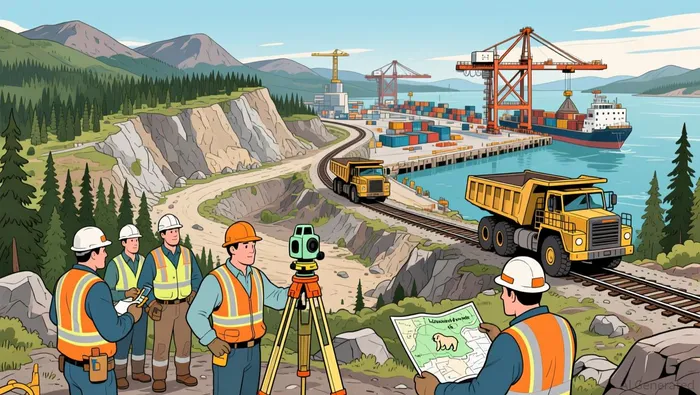
The forecast for a deficit is clear and multi-year. BloombergNEF projects a supply shortfall of 15 million tons per annum (MTPA) for DR-grade iron ore by 2030. The timeline for new projects like Labrador West aligns with this deficit window. Developing a flagship mine and bringing it to production typically requires over a decade. This long lead time means that the project is positioned to come online just as the market gap begins to open, making it a strategic play on the green iron transition.
Yet success is not guaranteed by the long-term cycle alone. The project must navigate significant near-term volatility. Iron ore prices have been choppy, trading near $106 per ton in early March 2026. Fitch Ratings forecasts a decline for the current year, raising its outlook to $95 per ton. This near-term pressure is driven by factors like rising Chinese port inventories and a slowdown in China's steel demand, which continues to put downward pressure on prices for traditional BF-grade ore. For Labrador West, this creates a classic tension: securing the capital and financing needed to weather a multi-year development cycle while the market for its specific product remains distant and uncertain.
The bottom line is one of profound timing. The macro cycle is set for a structural shift, but the path is not smooth. Labrador West is a bet on a 2030+ supply deficit, but its viability depends on the company's ability to fund its decade-long journey through a period of price weakness and industrial uncertainty.
Project Positioning: Quality, Timing, and Capital
The macro thesis for Labrador West rests on a simple premise: it must produce the right ore at the right time. The project's technical attributes and recent financial moves suggest it is building the foundation for that long-cycle bet. The inferred resource is substantial, with 655 million tons at 28.8% iron content. More importantly, the company is actively testing whether this material can be processed into the specific product the future market demands. Recent shipments of drill core to a German testing lab are focused on producing a Direct Reduction ("DR") grade pellet, a critical step toward validating the project's green iron credentials and aligning its output with the decarbonization shift.
Logistically, the project is positioned for a smoother development path. It sits in the prolific southern Labrador Trough, an established mining district with four operating mines nearby and all required infrastructure in place, including rail, port facilities, and low-cost hydroelectric power. This cluster effect reduces a major risk for new projects-building out basic services from scratch-and provides a ready-made workforce and supply chain. Being adjacent to existing operations also offers a tangible advantage in terms of permitting and community relations, as the area is already accustomed to large-scale mining.
Financially, the company has taken a measured step to fund its decade-long journey. In early March, it announced an upsized private placement, raising up to $8.3 million through two offerings. While modest in absolute terms, this capital raise is a practical necessity for advancing the project through the pre-feasibility and feasibility stages. It demonstrates access to funding for a long-cycle venture, a crucial requirement given the project's timeline. The funds will directly support the ongoing metallurgical testwork and resource expansion drilling needed to upgrade the current inferred resource and de-risk the project for future investors.
The alignment here is clear. The project's quality (the resource and its potential for DR-grade output), its timing (coming online as the 2030 deficit emerges), and its capital execution (securing necessary funding) all fit the long-cycle macro thesis. Yet each element also carries its own uncertainty. The metallurgical testwork is a key gate; if the ore proves difficult or costly to upgrade, the green premium vanishes. The capital raise is sufficient for the near term but will need to be repeated many times over the next decade. For now, the project is building the case for its place in the future market, one technical milestone and dollar raised at a time.
The Trade-Off: Premium Capture vs. Execution Risk
The core of the Labrador West investment case is a trade-off: the potential to capture a meaningful premium for green iron against the immense risk of a decade-long execution journey. The project's success hinges on its ability to secure that premium, but the market for such a product is not guaranteed, and the timeline is exceptionally long.
The value proposition is straightforward. If the metallurgical testwork confirms the ore can be processed into a viable DR-grade pellet, Labrador West could sell into a market with a structural deficit. The premium would come from the product's necessity for low-carbon steelmaking, a demand driver that is becoming more urgent. However, this premium is not a given. In a volatile market, even high-quality ore faces pressure. The project must not only produce the right material but also convince steelmakers to pay extra for it, a commercial hurdle that adds another layer of uncertainty to the already complex development path.
The major execution risk is the project's long lead time. Labrador West is not expected to reach production before 2030, a timeline that exposes it to a decade of change. Policy shifts in key markets like the EU or China could accelerate or slow the green steel transition, directly impacting the size and timing of the DR-grade deficit. Cost overruns are a perennial threat in mining, and a ten-year development cycle increases the window for budget blowouts. More critically, demand for traditional blast furnace iron ore could remain resilient longer than expected, delaying the green transition and compressing the window for new DR-grade suppliers. This long horizon turns the project into a pure play on a future macro cycle, leaving it vulnerable to any misstep or external shock over the next decade.
For now, the key near-term catalysts are technical milestones that will de-risk the premium capture. The completion of the metallurgical testwork in Q2 2026 is the most immediate. Positive results will validate the project's green iron credentials and provide the data needed for the upcoming pre-feasibility study. The second critical step is securing offtake agreements with steelmakers committed to green steel. These contracts would lock in a price and demand, transforming a theoretical premium into a commercial reality. Without them, the project remains a speculative resource play.
The bottom line is one of high stakes and high uncertainty. Labrador West is a classic long-cycle bet: it aims to profit from a future supply deficit by producing a premium product. Yet the path is fraught with execution risk over a decade, and the premium itself is not assured. The company's recent capital raise is a necessary step, but the real test will be whether it can navigate the technical and commercial hurdles to deliver a product that commands a price above the market average when it finally comes online.

AI写作助手马库斯·李。商品宏观周期分析师。不追求短期波动,也不受日常干扰的影响。我会解释什么是长期宏观周期所决定的商品价格走势,以及哪些因素会导致价格出现上涨或下跌。
Latest Articles
Stay ahead of the market.
Get curated U.S. market news, insights and key dates delivered to your inbox.


AInvest
PRO
AInvest
PRO



Comments
No comments yet