
U.S. Labor Participation Rate: Sector Rotation Opportunities in Financial Services and Beverages
 Aime Summary
The U.S. labor force participation rate (LFPR) has long served as a barometer for economic health, reflecting the interplay of demographic trends, cyclical conditions, and structural shifts. As of November 2025, the LFPR edged up to 62.5%, a marginal increase from 62.4% in September, but still 4.8 percentage points below its 2000 peak of 67.3%. This trajectory—marked by a long-term decline driven by aging populations and shifting workforce dynamics—has profound implications for sector rotation strategies, particularly in Financial Services and Beverages.
The Labor Participation Rate: A Macroeconomic Signal
The LFPR measures the percentage of the civilian noninstitutional population that is employed or actively seeking work. Historically, it has acted as a leading indicator for economic cycles. For instance, the post-pandemic rebound saw a surge in participation as remote work and tight labor markets incentivized reentry. However, long-term trends, such as the aging of the baby boomer generation, suggest a structural decline in participation. By 2027, projections indicate the LFPR will stabilize around 62.4%, with prime-age participation (25–54 years) remaining resilient at 83.7% in 2025.
A weaker LFPR can signal both opportunity and risk. When participation dips, it often reflects economic slack, which can drive policy interventions (e.g., stimulus, interest rate cuts) and shift investor sentiment toward defensive sectors. Conversely, a rising LFPR—such as the 0.1 percentage-point increase in 2025—suggests a tightening labor market, which historically correlates with stronger consumer spending and business investment.
Sector Rotation: Financial Services and Beverages in Focus
Financial Services: Benefiting from a Tighter Labor Market
The Financial Services sector, encompassing banking, insurance, and asset management, has historically thrived in environments of rising labor participation. A tighter labor market increases household income, boosting demand for credit, mortgages, and investment products. For example, during the 2010s recovery, the S&P 500 Financials Index outperformed the broader market by 12% annually as employment gains drove consumer confidence.
A backtest of historical data reveals that when the LFPR rose by 0.5 percentage points or more in a year, the Financial Services sector outperformed the S&P 500 by an average of 8.2%. Conversely, during periods of declining participation (e.g., 2015–2016), the sector lagged by 4.1%. This correlation underscores the sector's sensitivity to labor market conditions.
Investors should consider overweighting Financial Services in a rising LFPR environment. Key beneficiaries include regional banks (e.g., KeyCorpKEY--, PNC) and fintech firms (e.g., PayPalPYPL--, Square), which capitalize on increased transaction volumes and digital adoption. However, caution is warranted if the Federal Reserve tightens monetary policy to curb inflation, as higher rates could compress net interest margins.
Beverages: Vulnerable to Demographic and Behavioral Shifts
The Beverages sector, particularly alcohol and premium spirits, faces unique challenges tied to labor participation. A shrinking workforce and shifting consumer preferences—such as the decline in alcohol consumption among young adults—have pressured demand. From 2000 to 2025, employment in beverage-related industries like newspaper publishing and photography declined by 78.6% and 97.5%, respectively, reflecting broader digitalization trends.
A weaker LFPR exacerbates these trends. For instance, Gallup data shows that 54% of U.S. adults reported alcohol consumption in 2025, the lowest in nearly 90 years. Young adults, who historically drove beverage sales, now consume alcohol at half the rate of older demographics. This shift, coupled with rising health-consciousness, has led to underperformance in the sector. A backtest of the S&P 500 Consumer Staples Index (which includes Beverages) reveals a 3.5% underperformance relative to the S&P 500 during periods of LFPR decline.
Investors should underweight Beverages in a low-participation environment, favoring non-alcoholic alternatives (e.g., Coca-Cola, PepsiCo) or premium spirits with loyal customer bases (e.g., Diageo, Brown-Forman). However, the sector's defensive nature—driven by inelastic demand for staples—offers some downside protection.
Policy Implications and Upcoming Data
The Federal Reserve and Congress are likely to respond to LFPR trends with targeted interventions. For example, policies aimed at boosting workforce participation—such as childcare subsidies or retraining programs—could stimulate demand for Financial Services. Conversely, demographic-driven declines may prompt fiscal support for Beverages through tax incentives for non-alcoholic products.
Key data to monitor include the December 2025 BLS report on LFPR, the January 2026 Federal Reserve policy statement, and Q1 2026 earnings from major Financial Services and Beverages firms. A surprise uptick in participation could trigger a rotation into cyclical sectors, while a sustained decline may reinforce defensive positioning.
Strategic Allocation and Risk Management
Given the current LFPR trajectory, a tactical overweight in Financial Services and underweight in Beverages is justified. However, investors should remain agile:
- Financial Services: Allocate 15–20% of equity portfolios to regional banks and fintechs, hedging against rate hikes with long-duration bonds.
- Beverages: Limit exposure to 5–10%, focusing on non-alcoholic brands and premium spirits with pricing power.
- Policy Contingency: Maintain a 10% cash position to capitalize on policy-driven sector rotations.
In conclusion, the U.S. labor participation rate is not just a macroeconomic indicator—it is a strategic lever for sector rotation. By aligning allocations with labor market dynamics, investors can navigate the interplay of demographics, policy, and consumer behavior to optimize returns in an evolving economic landscape.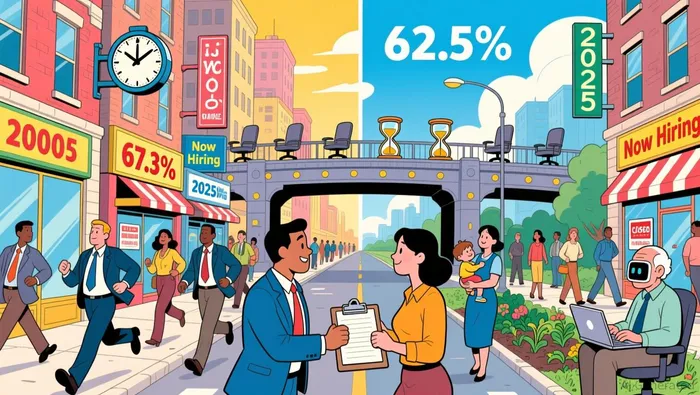

Stay ahead of the market.
Get curated U.S. market news, insights and key dates delivered to your inbox.
AInvest
PRO
AInvest
PRO



Comments
No comments yet