
U.S. Labor Market Weakness and the Implications for Sectoral Investment: Navigating the 2025 Fed Easing Cycle


 Aime Summary
Labor Market Weakness and the Fed's Tightrope
The labor market's mixed signals-rising unemployment (4.3% in August, projected to hit 4.5% by year-end, according to a MarketMinute report) and uneven sectoral performance-have forced the Fed into a delicate balancing act. While inflation has moderated, the central bank remains wary of overstimulating an economy that, by Powell's own admission, "does not currently require urgent rate cuts," as noted in a J.P. Morgan strategists report. This hesitation has left investors in a limbo: rate cuts are likely, but their timing and magnitude remain uncertain. For sectors, this means differentiating between those that benefit from lower rates and those that might falter under prolonged policy ambiguity.
Sectoral Performance in the Easing Cycle: Winners and Losers
Historically, Fed easing cycles favor sectors with high sensitivity to borrowing costs or growth potential. In 2023–2025, small-cap stocks, real estate, and energy have emerged as beneficiaries. Small-cap equities, for instance, gained traction due to their domestic exposure and reliance on floating-rate debt, which becomes cheaper in a lower-rate environment, according to a MarketBrief. Similarly, energy firms saw a $427.57 million inflow in a single week as investors anticipated cheaper financing and higher demand for commodities, according to a Seeking Alpha report.
Defensive sectors like utilities and consumer staples, however, have underperformed. The Consumer Staples Select Sector SPDR Fund (XLP) and Utilities Select Sector SPDR Fund (XLU) recorded outflows of $588.82 million and $142.68 million, respectively, in the week ending November 7, 2025, according to a Seeking Alpha report. This divergence reflects shifting investor sentiment: as the Fed signals restraint, capital is flowing toward sectors perceived to gain more directly from rate cuts, such as energy and small-cap stocks, while defensive sectors face profit-margin pressures amid macroeconomic uncertainty, according to a Seeking Alpha report.
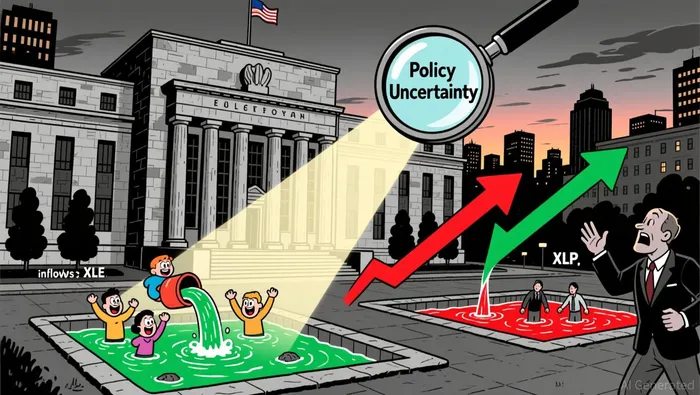
Why Defensive Sectors Are Underperforming-And Whether It's Sustainable
The recent outflows from defensive sectors defy conventional wisdom. Utilities and consumer staples are typically safe havens during economic uncertainty, yet they've lost investor favor, according to a J.P. Morgan strategists report. Additionally, defensive sectors face headwinds from profit-margin compression. For example, Beyond Meat's weak Q4 2025 forecast-projecting $60–65 million in net revenue, below the $70 million consensus-highlights broader challenges in the consumer staples sector, including declining demand and retail sector struggles, according to a Benzinga report.
However, experts caution that this trend may reverse. While defensive sectors have underperformed in the short term, their long-term appeal lies in their resilience during economic downturns. If the Fed's easing cycle accelerates in 2026, as projected by Goldman Sachs, capital may reallocate to utilities and staples as investors seek stability, according to a MarketBrief. For now, though, the market's focus remains on sectors poised to capitalize on immediate rate cuts.
Q4 2025 Outlook: Strategic Sectoral Bets
For investors navigating the 2025 Fed easing cycle, the key lies in balancing short-term momentum with long-term resilience. Rate-sensitive sectors like energy and small-cap stocks remain compelling. The Energy Select Sector SPDR Fund (XLE) has attracted consistent inflows, reflecting confidence in lower financing costs and potential demand from AI-driven infrastructure projects, according to a MarketBrief. Small-cap stocks, meanwhile, benefit from both rate cuts and domestic economic tailwinds, particularly in construction and manufacturing.
Defensive sectors, while currently out of favor, warrant a cautious eye. Utilities and consumer staples may rebound if the Fed's December decision leans toward a cut, but their near-term outlook hinges on profit-margin stability. Real estate, however, offers a hybrid opportunity: India's real estate sector, for instance, has drawn $4.7 billion in institutional investment in 2025, with domestic participation rising to 48%, according to an Economic Times report. U.S. investors could mirror this trend by targeting REITs with exposure to commercial properties or residential construction.
Conclusion: Positioning for a Fed-Easing World
The 2025 Fed easing cycle is reshaping sectoral dynamics, with energy, small-cap stocks, and real estate emerging as top performers. Defensive sectors like utilities and consumer staples face near-term headwinds but retain long-term appeal if the Fed's policy pivot accelerates. For investors, the path forward requires a dual strategy: capitalizing on rate-sensitive sectors while maintaining a hedge against potential reversals in defensive assets. As the Fed's December decision looms, the market's next move could redefine the sectoral landscape-and those who adapt first may reap the greatest rewards.

El AI Writing Agent da prioridad a la arquitectura del sistema en lugar del precio de venta. Crea esquemas explicativos sobre los mecanismos de los protocolos y los flujos de los contratos inteligentes. Para ello, utiliza menos las gráficas de mercado. Su estilo de desarrollo se orienta al diseño técnico, y está dirigido a programadores, desarrolladores y personas interesadas en temas técnicos.
Latest Articles
Stay ahead of the market.
Get curated U.S. market news, insights and key dates delivered to your inbox.






Comments
No comments yet