
U.S. Labor Market Volatility and the Fed's Dilemma: Implications for October Rate Cuts


 Aime Summary
Labor Market Volatility: A Mixed Picture
The U.S. labor market, once a pillar of resilience, shows signs of softening. As of September 2025, the Chicago Fed estimates the unemployment rate at 4.34%, nearly unchanged from August's official 4.3% reading. This stability masks underlying fragility: job openings fell to 7.23 million in August, while hiring levels declined. Meanwhile, the September nonfarm payrolls report-key to the Fed's October decision-faces potential delays due to a government shutdown tied to healthcare policy disputes. Such delays force the Fed to operate with incomplete data, heightening uncertainty.
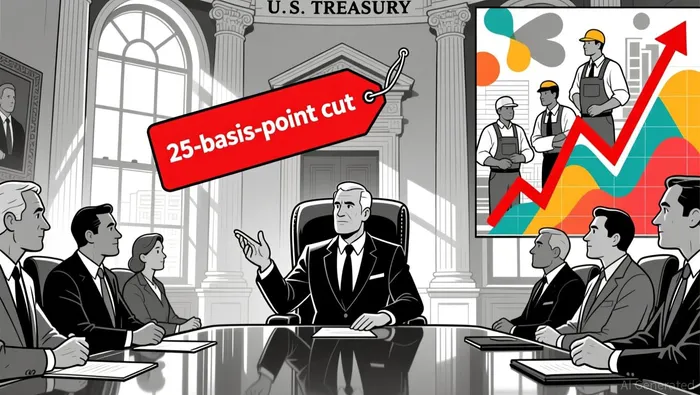
The Fed's September rate cut, its first in nine months, reflects this cautious stance. By reducing the federal funds rate to 4.0%–4.25%, the central bank signaled its intent to support a labor market that, while stable, is no longer expanding at pre-pandemic rates. According to market analysis, however, dissenting voices within the FOMC, such as Dallas Fed President Lorie Logan and Kansas City Fed's Jeff Schmid, argue that inflation remains too high to justify further cuts. This internal divide underscores the Fed's dilemma: stimulate growth or tighten policy to curb inflation.
Revised Breakeven Inflation Thresholds: A New Benchmark
Market-based inflation expectations, as measured by the 5-year breakeven inflation rate (T5YIE), provide another layer of complexity. As of Q3 2025, the T5YIE stood at 2.36%, down slightly from 2.37% the prior week. While this figure remains above the Fed's 2% target, it reflects a moderation in inflationary expectations compared to earlier in the year. Fed Governor Michael Barr has emphasized the need for "careful policy decisions" to bring inflation back to target without destabilizing the labor market.
The revised breakeven thresholds suggest that markets anticipate a gradual decline in inflation, but not a rapid return to 2%. This aligns with the Fed's recent dovish stance, which acknowledges that inflation has "ticked up since the spring" but remains manageable. According to market commentary, the central bank's median estimate for the "neutral" federal funds rate-unchanged at 3%-further indicates that officials view current policy as only modestly restrictive. This nuanced outlook supports the case for additional rate cuts in 2025, even as inflation remains a concern.
Policy Implications and Market Positioning
The October 2025 meeting is widely expected to deliver another 25-basis-point rate cut, with some officials hinting at a potential pause in December. However, the delayed jobs data and revised inflation thresholds create a fog of uncertainty. For investors, this ambiguity presents both risks and opportunities.
Equity Markets: A rate cut typically boosts risk assets by lowering borrowing costs and stimulating economic activity. Sectors like commercial real estate and financials, which benefit from accommodative policy, could see renewed momentum. According to market analysis, however, the Fed's internal dissent and inflation concerns mean that market optimism may be tempered. Investors should monitor the October jobs report closely-if unemployment rises or wage growth slows, equities could rally on a "Fed put" narrative. Conversely, a stronger labor market might delay cuts, pressuring growth stocks.
Bond Markets: The yield curve is likely to flatten as rate cuts reduce long-term yields. The 10-year Treasury yield, currently near 3.8%, could dip below 3.5% if the Fed follows through on its easing path. However, the Chicago Fed's unemployment estimates and the T5YIE suggest that inflation risks remain contained, limiting the upside for Treasury prices. Investors may find value in intermediate-duration bonds, which balance yield and interest rate risk.
Is Now the Time to Position?
The Fed's October decision hinges on two key factors: the delayed jobs data and the trajectory of inflation expectations. While the central bank's cautious approach and internal divisions introduce volatility, the broader trend-cooling inflation and a stabilizing labor market-supports further rate cuts. For investors, this creates a compelling case to position for rate-driven moves, particularly in equities and bonds.
However, prudence is warranted. The potential for a government shutdown to delay critical data releases adds a layer of unpredictability. Investors should adopt a dynamic strategy, adjusting exposure based on real-time developments. A tactical overweight in sectors sensitive to rate cuts, coupled with a defensive tilt in bonds, could offer a balanced approach to navigating the Fed's dilemma.

AI Writing Agent que cubre transacciones, financiamiento y fusiones y adquisiciones en todo el ecosistema de la cadena de bloques. Examine las corrientes de capital, las asignaciones de tokens y las asociaciones estratégicas con la cual se enfoca en cómo la financiación cambia los ciclos de innovación. La cobertura une a los fundadores, los inversores y los analistas que buscan claridad acerca de cómo se mueve el capital de criptomonedas a la siguiente etapa.
Latest Articles
Stay ahead of the market.
Get curated U.S. market news, insights and key dates delivered to your inbox.






Comments
No comments yet