
The U.S. Labor Market's Sudden Shift: Navigating Job Losses in a Stalling Recovery


 Aime Summary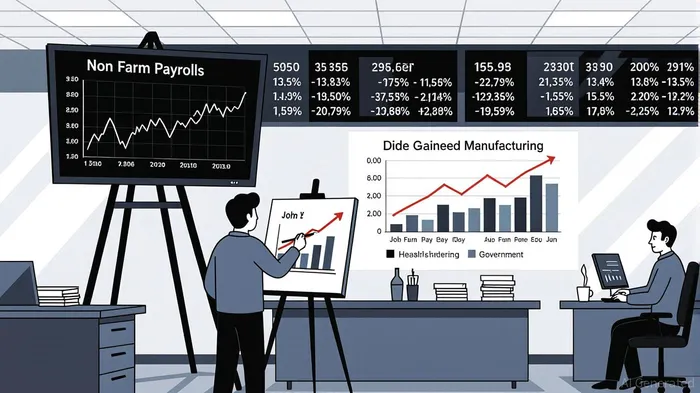
The U.S. labor market has entered a precarious phase, marked by a sharp slowdown in job creation and a widening gap between labor supply and demand. August 2025's nonfarm payroll report—a mere 22,000 net additions—underscores a stalling recovery, with unemployment rising to 4.3% and job openings falling below the number of unemployed for the first time in four years. This shift demands a recalibration of investment strategies, particularly for portfolios exposed to sectors facing structural headwinds.
Sectoral Divergence: Winners and Losers in the Labor Market
The labor data reveals a fragmented landscape. Healthcare and social assistance emerged as bright spots, adding 31,000 and 16,000 jobs, respectively, driven by aging demographics and post-pandemic service demand. Conversely, manufacturing, government, and energy sectors faced significant declines. Manufacturing employment dropped 78,000 year-over-year, while federal government jobs fell by 15,000 in August alone. These trends align with stock market performance: healthcare and tech stocks like Broadcom (AVGO) and Tesla (TSLA) surged, while energy and industrial names like Advanced Micro Devices (AMD) and Lululemon (LULU) faltered.
Strategic Reallocation: Balancing Growth and Defense
Investors must now prioritize sectoral reallocation to capitalize on resilience while hedging against volatility. Here's a framework for action:
Overweight Healthcare and AI-Driven Tech:
The healthcare sector's job gains reflect enduring demand, while AI-driven tech firms (e.g., Broadcom, Microsoft (MSFT)) benefit from structural tailwinds. Despite short-term volatility, companies with strong cash flows and recurring revenue models remain attractive.Underweight Cyclical Sectors:
Manufacturing and energy sectors face near-term headwinds. For example, Tesla's 3.6% stock rally in August followed a $1 trillion compensation package for Elon Musk, but its long-term prospects hinge on global demand for EVs—a sector now exposed to trade policy risks. Similarly, Lululemon's 19% plunge highlights the fragility of consumer discretionary stocks in a slowing economy.Defensive Positioning in Bonds and Gold:
With Treasury yields hitting five-month lows and gold rising 1% to $3,640/oz, defensive assets offer a buffer against equity market swings. A 10–15% allocation to long-duration bonds and precious metals could mitigate downside risk.
Risk-Adjusted Portfolio Adjustments
The Federal Reserve's anticipated 25-basis-point rate cut in September will likely boost growth-sensitive assets but may not offset broader economic fragility. Investors should:
- Diversify geographically: Emerging markets, particularly those with resilient labor markets (e.g., India, Southeast Asia), offer growth opportunities.
- Leverage sector rotation: Shift capital from underperforming sectors (e.g., Semiconductors, which saw AMDAMD-- fall 6.5%) to defensive plays like utilities and consumer staples.
- Monitor wage inflation: While average hourly earnings rose 3.7% annually, this metric could pressure margins in cost-sensitive industries like manufacturing.
Conclusion: Navigating Uncertainty with Discipline
The labor market's sudden shift signals a transition from expansion to consolidation. For investors, this is a pivotal moment to rebalance portfolios, favoring sectors with structural growth and downside protection. As the Fed's policy pivot looms, a disciplined approach—combining tactical sector bets with defensive positioning—will be critical to navigating a stalling recovery.
In the coming months, watch for further data on labor force participation and wage inflation, which could dictate the pace of rate cuts and, by extension, market direction. For now, the message is clear: adaptability, not complacency, will define successful portfolios in this new economic era.

Stay ahead of the market.
Get curated U.S. market news, insights and key dates delivered to your inbox.




Comments
No comments yet