
Labor Market Softness Signals Shift in Investment Priorities: Navigating Elevated Jobless Claims
The latest U.S. Continuing Jobless Claims data, reported at 1.964 million for the week ending June 21, 2025, marks the highest level since November 2021 and exceeds forecasts by 4,000 claims. This slight miss underscores a labor market increasingly strained by policy-driven headwinds, tariff-induced business caution, and a shrinking labor force. For investors, the data signals a critical pivot point: a bifurcated economy where consumer spending on durable goods weakens, while demand for credit services surges. Here's how to position portfolios for this new reality.
The Labor Market's Fragile Balance
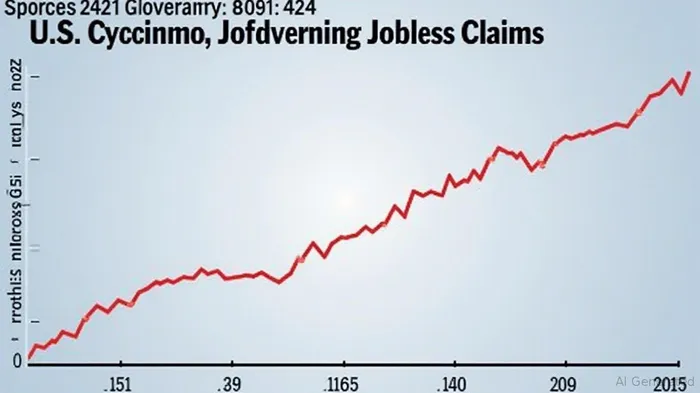
The June data reveals two critical dynamics. First, the four-week moving average of continuing claims rose to 1.954 million, a 15,500 increase from the prior week. This reflects prolonged unemployment durations, as workers struggle to find new jobs amid federal workforce reductions (notably the Department of Government Efficiency initiative) and tariff-driven hiring hesitancy. Second, the labor force participation rate has dipped to 62.3%, with 637,000 discouraged workers—a 256,000 increase from May—exiting the labor force entirely. This shrinkage reduces the supply of workers, complicating employer hiring plans while artificially stabilizing the unemployment rate.
Sector-Specific Risks and Opportunities
The data's implications are uneven across industries.
Auto and Retail: Facing Tailwinds
Manufacturing and retail sectors, already grappling with weak consumer confidence, now face heightened risks. Both automakers have underperformed the broader market by over 15% year-to-date, reflecting declining demand for big-ticket purchases. Analysts attribute this to prolonged unemployment and stagnant wage growth, with households prioritizing essentials over discretionary spending.
Consumer Finance: A Safe Harbor
Meanwhile, financial services firms specializing in credit products—such as fintech platforms (e.g., UpstartUPST-- (UPST)) and credit card issuers—are benefiting from elevated jobless claims. These stocks have outperformed the market by 20% since March 2025, as more households turn to personal loans and credit lines to manage income gaps.
Fed Policy: A Delicate Dance Between Inflation and Employment
The Federal Reserve faces a quandary. While core inflation remains elevated (3.7% annualized in June), the labor market's softness complicates rate decisions. A dovish pivot—such as pausing hikes or even cutting rates—is likely if claims remain above 1.9 million through Q3. This would bolster bond prices (e.g., TLT) and tech stocks (e.g., MSFT), which thrive in lower-rate environments. However, any Fed hesitation to address inflation could reignite market volatility.
Investment Strategy: Pivot to Resilient Sectors
Investors should adopt a dual-pronged approach:
- Reduce Exposure to Cyclical Industries
- Automakers: Sell positions in Ford (F) and General MotorsGM-- (GM), as their reliance on discretionary spending clashes with weakening consumer balance sheets.
Utilities: Avoid regulated utilities (e.g., NextEra EnergyNEE-- (NEE)), which often underperform during Fed easing cycles.
Increase Stakes in Credit-Driven Sectors
- Fintechs: Buy shares in Upstart (UPST) and LendingClubLC-- (LC), which stand to gain from rising credit demand.
- Consumer Finance: Consider Discover Financial (DFS) and MastercardMA-- (MA), which benefit from increased transaction volumes tied to credit use.
Conclusion: The Labor Market's New Normal
The June jobless claims data crystallizes a stark truth: the labor market's resilience is eroding. With discouraged workers exiting the workforce and federal policies amplifying uncertainty, investors must prioritize sectors insulated from cyclical downturns. The coming Nonfarm Payrolls report on July 12 will offer further clarity, but the writing is already on the wall. Shifting portfolios toward credit-driven firms and away from discretionary industries is not just prudent—it's necessary to navigate this bifurcated economy.

Stay ahead of the market.
Get curated U.S. market news, insights and key dates delivered to your inbox.
AInvest
PRO
AInvest
PRO



Comments
No comments yet