
The U.S. Labor Market's Slowdown: A Reassessment of Cyclical Stock Exposure


 Aime Summary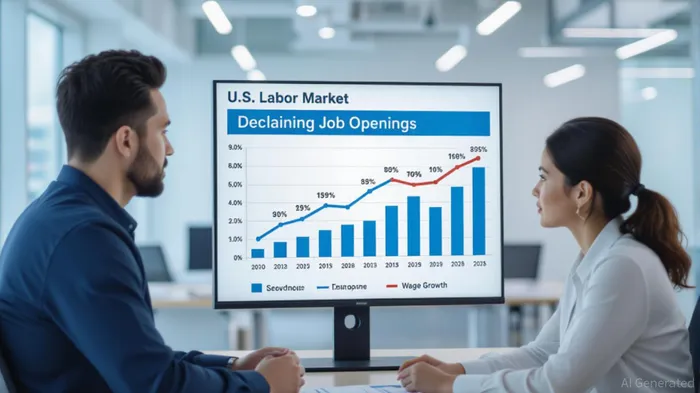
The U.S. labor market, once a bastion of resilience, is showing signs of strain. By July 2025, job openings had plummeted to 7.18 million—the lowest since September 2024—and the job openings-to-unemployed ratio had fallen to 0.99, a level last seen during the pandemic's peak. This shift signals a critical inflection point: for the first time since 2021, there are more unemployed workers than available jobs. For investors, this recalibration demands a reevaluation of exposure to cyclical sectors, which have historically thrived in a tight labor market but now face headwinds from slowing demand and rising costs.
The Labor Market's Structural Shift
The Bureau of Labor Statistics (BLS) data reveals a labor market in transition. Productivity in the nonfarm business sector rose 2.4% in Q2 2025, driven by a 3.7% output increase and a 1.3% rise in hours worked. However, unit labor costs climbed 1.6% due to a 4.0% surge in hourly compensation. Over the past four quarters, unit labor costs have grown 2.6%, outpacing productivity gains. This trend, while modest, reflects a broader pattern: employers are paying more for fewer hours, squeezing profit margins.
The manufacturing sector, a bellwether for cyclical stocks, offers a mixed picture. Productivity there rose 2.1% in Q2 2025, with durable goods industries seeing a 3.3% gain. Yet, unit labor costs in manufacturing climbed 1.7%, with nondurable goods sectors experiencing a 3.8% spike. These figures underscore a sector grappling with inflationary pressures and automation-driven efficiency gains, which may not offset rising input costs.
Equity Valuations Under Pressure
Cyclical sectors—industrials, materials, and consumer discretionary—have seen valuations contract as investors price in slower growth. The industrials sector, for instance, trades at a 15% discount to its 10-year average P/E ratio, reflecting concerns over tariffs, automation, and interest rates. Construction and manufacturing firms, which rely on robust labor demand, are particularly vulnerable. The materials sector faces dual headwinds: a slowdown in China's demand for commodities and U.S. economic moderation. Copper mining, however, remains a bright spot, with long-term demand from renewable energy projects offering a potential tailwind.
The consumer discretionary sector is equally complex. While a projected 25-basis-point Federal Reserve rate cut in September 2025 could boost borrowing affordability and discretionary spending, elevated grocery and gas prices persist. The MorningstarMORN-- US Consumer Cyclical Index has declined 1.10% year-to-date, as investors weigh the benefits of monetary easing against inflationary pressures. Retailers and travel operators like DisneySCHL-- and CarnivalCCL-- may benefit from cheaper financing, but broader economic uncertainty introduces volatility.
Strategic Reassessment for Investors
The labor market slowdown necessitates a nuanced approach to cyclical stock exposure. Here are three key considerations:
Prioritize Subsectors Aligned with Long-Term Trends
While the broader industrials and materials sectors face near-term challenges, subsectors tied to structural growth—such as renewable energy infrastructure and AI-driven logistics—offer resilience. For example, copper mining firms positioned to supply green energy projects may outperform peers in a decarbonizing economy. Similarly, industrials companies leveraging automation to offset labor shortages could see improved margins.Monitor Federal Reserve Policy and Tariff Impacts
The Fed's September rate cut decision will be pivotal. A 25-basis-point cut could provide a near-term boost to rate-sensitive sectors like housing and small-cap equities. However, investors must also assess the risk of margin compression for financial institutionsFISI--. Meanwhile, tariffs on imported goods are eroding profit margins in manufacturing and transportation, making domestic sourcing and AI-driven supply chains critical differentiators.Adopt a Selective, Value-Driven Strategy
Cyclical sectors are trading at historical discounts, but not all firms are created equal. Firms with strong cash flows and clear monetization strategies—such as AI-driven companies leveraging lower borrowing costs for R&D—could outperform those reliant on discretionary spending. Conversely, companies in sectors like travel and retail may require hedging against volatility, given their sensitivity to wage stagnation and inflation.
Conclusion: Navigating the New Normal
The U.S. labor market's slowdown is not a sudden collapse but a gradual shift toward a more subdued equilibrium. For cyclical stocks, this means a recalibration of expectations. Investors should focus on innovation-driven firms, monitor policy shifts, and adopt strategies that emphasize geographic mobility and AI fluency. By overweighting value stocks in resilient subsectors and underweighting those exposed to discretionary spending, investors can position themselves to navigate the evolving macroeconomic landscape.
As the labor market continues to evolve, the key will be balancing near-term risks with long-term opportunities. The next few months—marked by the August jobs report and the Fed's policy decisions—will provide critical insights into whether this slowdown is a temporary bump or a harbinger of deeper structural changes. For now, prudence and adaptability remain the watchwords for cyclical stock exposure.

Stay ahead of the market.
Get curated U.S. market news, insights and key dates delivered to your inbox.


AInvest
PRO
AInvest
PRO



Comments
No comments yet