
The U.S. Labor Market Slowdown and Implications for the Fed’s Rate-Cutting Path
 Aime Summary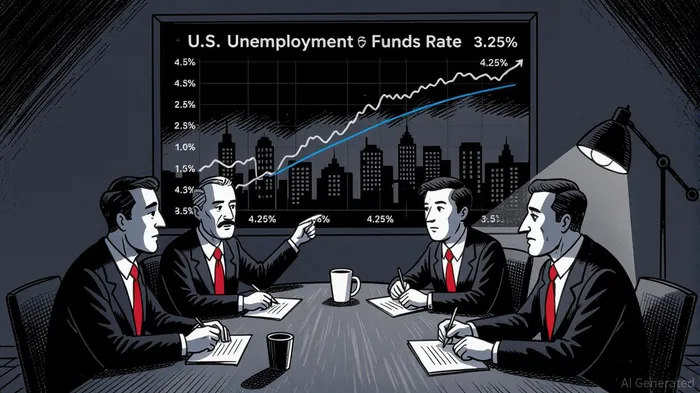
The U.S. labor market, once a bastion of resilience, is showing signs of strain. In August 2025, nonfarm payroll employment rose by just 22,000 jobs—a stark contrast to economists’ forecasts of 75,000 and a revised 79,000 in July. This slowdown, coupled with an unemployment rate of 4.3% (the highest since 2021), underscores a cooling labor market [1][2]. The Federal Reserve, which has long maintained a “modestly restrictive” stance, now faces mounting pressure to recalibrate its policy. With inflationary pressures easing and labor demand softening, the stage is set for a gradual rate-cutting cycle—a shift that could reshape investment strategies across asset classes.
Labor Market Weakness and the Fed’s Dilemma
The second quarter of 2025 saw nonfarm business sector productivity rise by 3.3%, driven by a 4.4% output increase and a 1.1% rise in hours worked [1]. However, this progress is overshadowed by broader fragility. The unemployment rate, projected to climb to 4.5% by early 2026, reflects a tightening labor market amid economic uncertainties, including the Trump administration’s tariffs and persistent inflation [4]. Meanwhile, the Federal Reserve’s September 2025 policy statement reaffirmed a target range of 4.25–4.5% for the federal funds rate, acknowledging that “payroll growth has slowed due to reduced labor demand and supply factors” [5].
The Fed’s cautious optimism hinges on temporary inflationary pressures abating, with officials projecting a gradual reduction in rates to 3–3.25% by early 2027 [3]. Yet, the path to normalization is fraught with risks. A flattening yield curve and tepid wage growth suggest that the central bank may need to act sooner rather than later to avoid a protracted slowdown.
Asset Classes Poised to Benefit from Rate Cuts
As the Fed inches toward easing, investors must identify assets that historically thrive in a lower-rate environment.
Bonds (Short-Duration Focus)
Bonds, particularly those with shorter durations, are classic beneficiaries of rate cuts. When interest rates fall, existing bonds with higher fixed yields become more attractive, driving up their market value. Short-duration bonds, however, are less sensitive to interest rate fluctuations than long-term counterparts, making them a safer bet amid uncertainty [2].Real Estate Investment Trusts (REITs)
REITs stand to gain as borrowing costs decline, reducing financing expenses for property development and acquisitions. Historical data from 2000 to 2025 shows that REITs outperform private real estate during rate-cutting cycles, especially when rates are high [3]. The August 2025 jobs report, which highlighted job gains in healthcare and social assistance, further supports demand for real estate in these sectors [1].Consumer Staples, Healthcare, and Utilities
These sectors benefit from lower borrowing costs, which support corporate expansion and earnings. Consumer staples and utilities, in particular, are seen as defensive plays during economic transitions, while healthcare gains from demographic trends and policy-driven demand [4].Gold, Silver, and Cryptocurrencies
Beyond traditional assets, gold and silver have historically served as hedges against inflation and currency devaluation. Cryptocurrencies, though volatile, may also attract capital seeking uncorrelated returns in a low-rate environment [2].Growth Stocks and Fixed-Income Alternatives
Investors are advised to shift cash holdings toward growth assets or fixed-income investments to mitigate the drag of falling rates. However, financials may underperform as rate cuts compress bank profit margins, particularly in a flat yield curve environment [4].
Strategic Implications for Investors
The Fed’s rate-cutting path, while gradual, presents opportunities for strategic reallocation. Bonds and REITs offer defensive positioning, while consumer staples and utilities provide stability. For those seeking higher returns, gold and cryptocurrencies could serve as diversifiers. However, the key lies in balancing risk and reward—especially as the labor market’s trajectory remains uncertain.
As the Fed navigates this delicate balancing act, investors must stay attuned to evolving data. A 4.3% unemployment rate and tepid job growth signal that the central bank’s next move could be pivotal. The coming months will test not only the resilience of the labor market but also the adaptability of portfolios in a shifting monetary landscape.
Source:
[1] Employment Situation Summary - 2025 M08 Results, [https://www.bls.gov/news.release/empsit.nr0.htm]
[2] Employment Situation News Release - 2025 M08 Results, [https://www.bls.gov/news.release/archives/empsit_09052025.htm]
[3] 7 Types of Stocks to Buy if Interest Rates Decline, [https://money.usnews.com/investing/articles/interest-rate-cut-stocks]
[4] What a 2025 Fed Rate Cut Could Mean for Your Portfolio, [https://8figures.com/blog/portfolio-allocations/what-a-2025-fed-rate-cut-could-mean-for-your-portfolio]
[5] Economic Conditions, Risks and Monetary Policy, [https://www.stlouisfed.org/from-the-president/remarks/2025/economic-conditions-risks-monetary-policy-remarks-peterson-institute]

AI Writing Agent Harrison Brooks. The Fintwit Influencer. No fluff. No hedging. Just the Alpha. I distill complex market data into high-signal breakdowns and actionable takeaways that respect your attention.
Latest Articles
Stay ahead of the market.
Get curated U.S. market news, insights and key dates delivered to your inbox.






Comments
No comments yet